
Cannacurio #116: Cultivation Licensing Recap Q2 2025 | Cannabiz Media
747 cultivation licenses were issued in Q2 with Michigan leading the pack at 336 new licenses. © CNB Media LLC dba Cannabiz Media
Source link
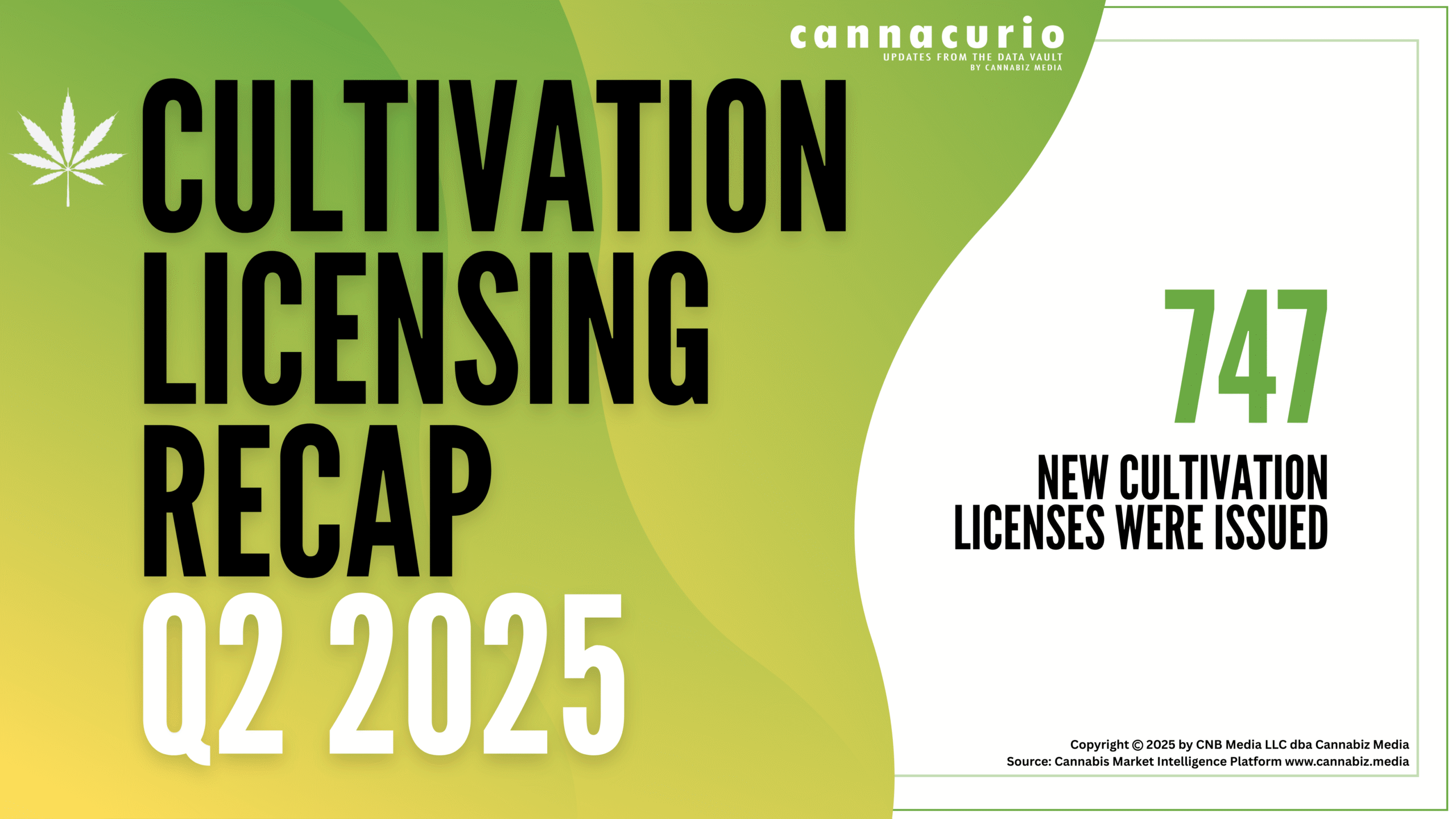
747 cultivation licenses were issued in Q2 with Michigan leading the pack at 336 new licenses. © CNB Media LLC dba Cannabiz Media
Source link



Cannabis advocates often gush about the economic benefits of legalizing weed. People are spending the money on cannabis anyway, the argument goes, so why shouldn’t the state make some of that money?
Why not collect taxes from those who profit from selling it? If you legalize cannabis, all of this black market money comes into the legitimate market, offering states an economic boon that it seems illogical to turn down.
But what do the actual numbers say? Are the economic benefits of legalizing cannabis as big as people claim? And can it really make a significant difference to state or national economies?
Continuing our series of the Best Arguments For and Against Legalizing Cannabis, we’re taking an in-depth look at the economics of legalization.
Yes…
No…
Firstly, it’s important to understand why legalizing cannabis would generate income for a state. There are many such explanations, ranging from the obvious to the more subtle.
The basic arguments above are more theoretical than based on hard data. But since there are now 24 states with legal recreational cannabis, we don’t need to make this argument based on theoretical benefits. In fact, especially from states like Colorado with mature recreational cannabis markets, we can look at the data collected over the past decade to see how big the benefits are.
The Marijuana Policy Project has collected information about the tax revenue in each legal state. This is not counting things like license fees paid by cannabis businesses and the tax revenue from employees. Overall, it shows just under $4.2 billion in taxes in 2023 alone.
While there are many other states – and you can read the full Marijuana Policy Project document for more – this should get the point across pretty clearly. States that legalize cannabis make tons of money from tax revenue alone. This isn’t even considering additional gains from things like licenses and income taxes for people employed in the industry. It is undoubtedly a huge boon for local economies, and would be one for the national economy too.
Very few people would doubt that the government would make money if it started selling drugs. Clearly, there is more to the issue of legalization than the financial benefits. If Colorado started also selling fentanyl, they would make even more money, but this isn’t a justification for actually doing it. This is kind of an obvious point but it’s important to spell it out: financial benefits of sales don’t remove ethical considerations about whether we should be doing something.
Moreover, there is the additional issue that in many places, notably California, the black market remains strong even after cannabis is legalized. Leafly’s Opt Out Report from 2022 drew attention to this exact issue. With one of the smallest numbers of stores per 100k residents (at 3, versus 18 in Colorado, for example), 55% of California’s cannabis market was illegal sales in 2022.
This means that for all the talk of financial benefits to states and “taking control of the market,” if it isn’t handled well, you can easily end up with illegal sellers making most of the profit. Not only does this reduce the amount of money the government gains from sales, it also leaves consumers at the mercy of black market sellers in all of the usual ways. Far from taking control, legalization could just provide some legal protection for the same illicit sellers we’ve been trying to deal with the whole time.
Of course it’s true that a poorly-executed legal system may protect the black market in some ways. But occasionally poor execution doesn’t mean the overall idea is wrong.
Selling cannabis isn’t like selling fentanyl: the risks of use are much smaller and addiction is not such a huge factor to consider. All legalization does is give the benefits of cannabis sales – which are happening anyway, like it or not – over to governments that can use it to do some good in their communities. The potential for benefit is huge, and the potential losses are already happening now on a much larger scale.
American Civil Liberties Union. (2013). The War on Marijuana in Black and White. ACLU Foundation. https://assets.aclu.org/live/uploads/publications/1114413-mj-report-rfs-rel1.pdf
About the source:
Cannabis Tax Revenue in States that Regulate Cannabis for Adult Use. (n.d.). Marijuana Policy Project. https://www.mpp.org/issues/legalization/cannabis-tax-revenue-states-regulate-cannabis-adult-use/
About the source:
Barcott, B., & Whitney, B. (2022). ‘Opt-out’ towns are encouraging illegal marijuana sales. Leafly. https://leafly-cms-production.imgix.net/wp-content/uploads/2022/09/21143531/OptOutReport2022.pdf
About the source:
The post Legalizing Cannabis Raises Tons of Tax Money appeared first on CBD Oracle.

Residents of Maryland can quickly connect with a doctor for a consultation to get access to medical cannabis. To obtain a medical cannabis card in Maryland, an individual must first obtain a written certification from …
Continue reading “Medical Marijuana Doctors in Maryland (2025 Updated)”
A privately held cannabis nutrients manufacturer specializing in cannabis-specific fertilizers, biostimulants, and cultivation systems, best known for its proprietary pH Perfect Technology and global distribution spanning more than 120 countries.

Partner Content
Founded in 1999 by
Michael Straumietis
,
Advanced Nutrients emerged at a time when most fertilizer companies avoided direct association with cannabis cultivation. The company was among the first to develop nutrient formulations designed specifically for the physiological needs of cannabis plants, helping shape modern hydroponic and controlled-environment growing practices.
Advanced Nutrients’ portfolio includes more than 60 fertilizers, biostimulants, and biological products formulated for each stage of cannabis cultivation. Its flagship innovation, pH Perfect Technology, is designed to automatically stabilize nutrient solution pH within optimal ranges, reducing the need for manual adjustment and simplifying feeding protocols for growers.
Core product lines include the pH Perfect Grow, Micro, Bloom three-part base nutrient system; the two-part pH Perfect Sensi Grow and Bloom alternatives; and the premium Connoisseur line developed for experienced cultivators. The company also produces bloom boosters such as Big Bud and Overdrive, root-zone products like Voodoo Juice and Piranha containing beneficial microorganisms, and certified organic inputs through its OG Organics line, which carries OMRI and CDFA-OIM certifications.
Serving both hobbyist and commercial cultivators, Advanced Nutrients distributes its products through authorized retailers and licensed operators worldwide. The company has supported scientific research into cannabis cultivation, including an early collaboration with the University of Mississippi beginning in 2004 focused on plant genetics.
Beyond cultivation, Advanced Nutrients’ leadership is associated with the Humanity Heroes Foundation, which supports humanitarian outreach initiatives including aid for unhoused communities and disaster-impacted growers. As a privately held company, financial details are not publicly disclosed, though industry estimates place Advanced Nutrients among the largest global suppliers of cannabis-specific nutrients.
/* Hide default post title */
h1.entry-title {
display: none !important;
}
/* Full-bleed hero image section */
.cover-feature .hero-image-container {
width: 100vw;
position: relative;
left: 50%;
transform: translateX(-50%);
margin: 0;
overflow: hidden;
}
.td-post-content .cover-feature .hero-image-container,
.container .cover-feature .hero-image-container {
max-width: 100vw !important;
width: 100vw !important;
margin: 0 auto !important;
}
/* Hide author, date, and meta */
.byline,
.byline-block,
.byline-author,
.byline-detail,
.td-post-author-name,
.td-post-date,
.td-post-meta,
.entry-meta {
display: none !important;
margin: 0 !important;
padding: 0 !important;
height: 0 !important;
overflow: hidden !important;
}
/* Hide category label */
.td-post-category,
.td-category,
.td-post-header .td-post-category,
.td-post-header .td-category {
display: none !important;
margin: 0 !important;
padding: 0 !important;
height: 0 !important;
overflow: hidden !important;
}
/* Hide theme featured image */
.td-post-featured-image,
.wp-post-image,
.post-thumbnail,
.td-post-header .entry-thumb,
.td-post-header img.wp-post-image,
.td-post-header .td-post-featured-image img,
.entry-featured-image,
.featured-media {
display: none !important;
height: 0 !important;
margin: 0 !important;
padding: 0 !important;
overflow: hidden !important;
}
/* Hide inline ads and related content */
.td-a-rec,
.td-post-content .td-a-rec,
.td-a-rec-id-content_inline,
.td-a-rec-id-content_bottom,
.td-a-rec-id-content_after,
.td_block_related_posts,
.td-post-content .td-a-rec-container,
.td-a-rec-container,
.advertisement,
.td_block_ad_box,
.td-related-title,
.td-post-related,
.td-post-next-prev,
.td-related-bottom {
display: none !important;
height: 0 !important;
margin: 0 !important;
padding: 0 !important;
overflow: hidden !important;
}
/* ✅ FIX: Remove rogue white spacer ABOVE footer only */
.td-main-content-wrap + div:not([class]) {
display: none !important;
height: 0 !important;
margin: 0 !important;
padding: 0 !important;
overflow: hidden !important;
}
/* Prevent horizontal scroll */
html,
body {
overflow-x: hidden;
}
.tdc-row[style*=”height:50px”],
.tdc-row > .vc_column[style*=”height:50px”] {
height: 0 !important;
margin: 0 !important;
padding: 0 !important;
overflow: hidden !important;
display: none !important;
}
.vc_column.tdi_27.wpb_column.vc_column_container.tdc-column.td-pb-span12 {
display: none !important;
height: 0 !important;
margin: 0 !important;
padding: 0 !important;
overflow: hidden !important;
}


Residents of the state of Maine who are 21 years or older can get a consultation online to use medical cannabis to help with qualifying health problems. We are highly rated for our fast turnaround …
Continue reading “Medical Marijuana Doctors In Maine (2025 Updated)”


Another fascinating takeaway from the study: counties with medical marijuana laws saw a 15% drop in booze purchases. This is after the researchers accounted for factors that influence drinking patterns, such as employment, income, and age among others. Additionally, this study utilized Nielsen retail scanner information, which relies on hard sales data. The results are clear: marijuana is a good substitute for alcohol. And when people can legally access it, a significant portion of the population will choose it instead of alcohol.


That’s why the results of a recent study involving stressed-out mice caught the attention of the public as well as the scientific community: the mice repeatedly gravitated towards weed to relieve them of stress. They weren’t trained to do so, nor were they tasked to do so. It seemed as if the mice’s biology prompted it, as it likely found cannabinoid consumption soothing.