
From Queens to the Cannabis Cup: Inside Torches, the Social Equity Dream Taking Over NYC’s Most Iconic Cigar Townhouse

From Queens to the Cannabis Cup: Inside Torches, the Social Equity Dream Taking Over NYC’s Most Iconic Cigar Townhouse


From Queens to the Cannabis Cup: Inside Torches, the Social Equity Dream Taking Over NYC’s Most Iconic Cigar Townhouse

Interviewing the Torches team was like talking to one person while chatting with four.

First came José, license holder and big-picture hustler from Jamaica, Queens. Then, Jonathan Santana, a former financial advisor who walked away from banking to bet on weed. Pedro Antonio pops in, the Colombian “spice” of the crew, half-strategist, half-hype man. Finally, there’s William Evans, the “honorary Dominican” and in-house buyer, juggling the call while checking on his sick daughter.

They start the conversation the way a lot of good weed stories begin in New York: in two languages, with jokes and a little bit of biography.

“We’re all Dominican,” Jonathan says.

“And I’m Colombian,” Pedro adds. “Got a little Colombian spice.”

Pedro explains how he was born in the U.S., sent back to Colombia as a kid, came back to New York at four, speaking only Spanish, then got swallowed whole by hip hop and the city.

“My mom says I told her I’d never speak English,” he laughs. “Then New York happened. I learned English, loved hip hop, and never turned back.”

When I tell them the true language is the one you use to curse, everybody cracks up. It’s a throwaway line, but it fits. Torches, which is in Manhattan, is bilingual, bicultural, and very much New York: immigrant roots, street logic, and a really elegant address. A social equity dispensary built by these amazing people.

Torches lives inside the former Nat Sherman Townhouse on 42nd Street, one of the most legendary cigar spaces in the city. And this month, it will become a flagship pickup location for the High Times Cannabis Cup Judges Kits.

If you’ve ever dreamed of what it would look like when legacy New York cannabis finally took over the old money cigar lounges, this is it.

“We always had weed in our story.”

Ask who the Polanco Brothers are and José starts in the most honest place possible.

“As New Yorkers, cannabis has been part of our lives for a very long time,” he says. “I’ve been consuming since I was young, and I’m pretty sure everybody on this call has some kind of experience with cannabis growing up.” 

They grew up in Queens in the 90s.

“Some neighborhoods, they got different choices,” José says. “In ours, it was cannabis, mostly. That was the environment. We enjoyed smoking together, and as we saw the game growing, legalization in other states, we knew one day it could be a possibility for us too.”

José came to the U.S. in 1993, at nine years old, not knowing the language. School wasn’t his strong suit. So instead of chasing degrees, he did what a lot of immigrants do when they want to earn their place: he started businesses. He built a family construction company from nothing. He ran car-sharing operations years before the big names took over. At one point, he and his circle had around 35 employees. All of that would turn out to matter in ways none of them could predict.

Because when New York’s social equity program for cannabis finally opened, the criteria were pretty specific: you needed

1.⁠ ⁠a cannabis-related charge, and

2.⁠ ⁠a proven track record of running a business for at least a couple of years.

José had both.

“It wasn’t easy,” Jonathan says. “That’s why some big players were kind of upset we got in before they did. They spent all this money lobbying for legalization, and then we show up with more power than they have, because they’re limited in how many stores they can open and how they can enter the rec program.”

They applied in the first round, sweating it out, thinking they might rank high and get in, but they didn’t. Then in 2023, in the second round of licenses, the Polanco Brothers’ name came up.

“Some of my friends thought I was crazy,” José says. “But they helped anyway. Some believed it could happen. The rest is history.”

“Giuliani had a locker down here.”

The hard part wasn’t getting the license. It was everything that came after.

First, they had to find a location in a city where cannabis-friendly landlords were rare, and zoning rules around churches, schools, and other dispensaries made compliant real estate feel like “a needle in a haystack.”

Then they found the former Nat Sherman Townhouse on 42nd Street, a three-story cigar temple just steps from Grand Central. “It has so much history,” Pedro says. “It’s its own story. The who’s who of New York used to be down there in that lounge where José is sitting right now.”

We’re talking hedge funds, banks, clergy, mobsters, politicians, celebrities. There’s a hidden entrance from Fifth Avenue where dignitaries would sneak in without being seen. The lockers in the basement once held private cigar stashes for the city’s elite.

“Giuliani had a locker down here,” they tell me. “The same guy pushing stop-and-frisk laws that ended up impacting so many in our communities was probably smoking cigars in that lounge, thinking through those policies.”

Now, those same rooms are being reclaimed by the very people those policies targeted—through a social equity license, in a legal cannabis shop.

Destiny is a word they use more than once.

When they chose the townhouse, there was a problem with MedMen. The collapsing cannabis giant had a store 860 feet away, and under the rules at the time, that proximity gave MedMen exclusivity. 

If MedMen converted from medical to recreational, Torches could never open at Nat Sherman.

“We were stuck for seven months,” Jonathan says. “We couldn’t open. We had to decide: do we walk away and pick another location, or do we wait them out?”

The Office of Cannabis Management even tried to nudge them away from the building, warning them they were passing on easier opportunities.

“They told us, ‘Real estate is so hard to come by. Pick another location. You won’t regret it,’” Pedro recalls. “They said if we stayed, it could be detrimental to the business. But we kept the dream and the vision.”

It really did come down to the shot clock.

If MedMen had filed to convert before the deadline, Torches wouldn’t exist in this format and the landlord might have demolished the building for a skyscraper. 

Instead, the floodgates opened in early 2024. Torches secured its proximity and started building.

Built by the same hands that grew up on the legacy side.

Torches wasn’t dropped in by a corporate general contractor, but built by the same family and friends who used to hustle to get by.

“We came in as builders,” José says. “We have a construction company. My brothers are the builders. Everything you see here was built by us.”

The townhouse already had something no other building on 42nd Street had: industrial-grade ventilation, designed for heavy cigar smoke. One of only three buildings in the entire state with that level of air circulation, they tell me. A structure literally built for people to consume something in comfort.

“It was meant to be a consumption lounge,” Pedro says. “The bones of the building were destined for cannabis.”

For now, the lounge is used for private events and meetings while New York slowly figures out its consumption regulations. But the infrastructure is there, locked and loaded.

“Like Bob Marley said, ‘what’s profitable’?”

William, the buyer, is the one with the deepest hands-on cannabis history. He started in the legacy market as a teenager, moved with the plant, watched the evolution from cheap corner bags to modern branded eighths and solventless everything.

“We really got our ears to the streets,” William says. “We’re nice people, but we’re not pushovers. People come to show us products. We can tell what’s good and what’s trash. We’ve learned a lot about marketing, too. Some folks come in trying to get over on us, and we close the door. Then two weeks later, they crawl back like, ‘We can do 50% off.’”

For Torches, “Torches-worthy” is a combination of Quality, Price and Relationship: brands that show up, do activities, educate, and give something back to the community.

“There are products for everybody,” William says. “Some people want the best of the best. Some just want a good deal, like a cigarette. We want to make sure the $25 eighth is actually decent, and the $50 eighth really earns that price.”

“Profitable” for José, though, goes beyond the ledger.

“Like Bob Marley said, what’s profitable?” He remembers Marley’s philosophy. “The relationships we’re building here, the currency we’re building for the culture—that’s more than just financial. We’re paying our bills, we’re growing, we’ll open more locations, sure. But profit for me is being in this space, having this conversation, building something for our people.”

“You shouldn’t be buying weed from the same guy you’re buying a sandwich from.”

New York has been cracking down hard on the unlicensed market for the past year, raiding smoke shops, padlocking corner stores selling gummies and mystery “zaza” out of glass cases.

The Polanco crew has complicated feelings about it.

“If you’re asking about enforcement on illegal stores on 42nd, we weren’t too impacted,” Jonathan says. “Here, rent is very high. Most of the raids hit community stores and corner spots in rougher neighborhoods. But if you’re asking about the legacy market, that’s where we all come from. We did the right thing to get here, and we pay a lot of tax. But I still respect legacy growers that take pride in their product, people who built real communities before legalization.”

The line for them is clear: they don’t support people flooding the market with contaminated, unsafe, or purely opportunistic products.

“It’s like what’s happening with some of the hemp stuff,” José says. “People putting anything out there, no pride in the product. If you’re doing that, unregulated, without caring, I don’t stand with you. But the legacy people who’ve been growing, who care, I wish them nothing but the best. I hope they all find a way into licensing and bring that fire to the legal market.”

Then Jonathan drops the line that should probably be printed on a poster somewhere:

“You shouldn’t be buying weed from the same guy you’re buying a sandwich from.”

Fair enough.

“We are the torch.”

Their relationship with High Times started at a cannabis expo and through Josh Kesselman.

“William spotted him,” Pedro says. “‘Yo, Josh is here.’ We went straight over. He was super cool, very real. We showed him a video of the store before renovations, with Nat Sherman still intact. He was blown away.”

Later, Josh came to visit Torches in person, unannounced. He filmed a tour of the entire space and posted it on Instagram, giving them a massive boost with zero ask in return.

“For us, that was huge.”

So why Torches as the flagship pickup location for the High Times Cannabis Cup Judges Kits?

“We really come from this,” says William. “We’re connected to the streets, but we also have this beautiful location in the heart of the city. There are smaller stores with culture, but they don’t have what we have. I feel like we really shine a light on the culture. And we’re still the little guys compared to the big companies. It’s a David and Goliath story.”

Then José brings it home.

“The reason you chose us is because we are Torches,” he says. “We are the light for the ones before us and the ones after us. When you accomplish something, we want to hand you your torch. We picked a name that means something to share, something to celebrate. We want to be like the Olympics. The Cup is the Olympics, and we’re the torch right behind it.”

He’s not exaggerating about location, either. This isn’t just Times Square tourism. It’s 42nd and Grand Central, a literal gateway where the whole world passes through.

“Every tourist, every businessperson, every kind of New Yorker comes through here,” José says. “We’re not just saying cannabis is coming. We’re saying it’s coming elegant, strong, smart, with swag and substance.”

“The people get to decide.”

“We always heard about the High Times Cannabis Cup,” William says. “We’d be like, ‘Oh my God, that brand won it.’ But we were never a part of it. It was all West Coast. Now we get to host the kits in New York.”

They’re showcasing the kits in custom glass cases upstairs, surrounded by the kind of old-world architecture that wasn’t built with weed in mind but somehow fits it perfectly.

“We’re curators,” Pedro says. “We’d love nothing more than to test every kit. But what we love about the Cup is that the people get to decide. No politics. No backroom deals. Just the community judging.”

What they want people to feel when they pick up their Judges Kits:

When I ask what vibe they want people to feel walking into Torches to grab their Cannabis Cup kits, José keeps it simple.

“The same thing they already feel when they come in,” he says. “We want them to know the level of quality in our menu is the same level of quality in the kits. We’ll have budtenders ready to educate, so people know what they’re picking up and can judge better.”

William adds the emotional side.

“I want people to be excited,” he says. “It’s fun. It’s different. You’re part of history. This townhouse is already historic, and now we’re launching something historic again.”

“The people get to decide,” adds Pedro.

“We want to inspire people like us to not give up”

At the end of the interview, I asked if there was anything they wanted to add.

“We just want to inspire people,” says José. “People like us to not give up, to get up and do things. To see that there are professional careers in this industry. We happen to be first right now, but we want to be good at it so other people feel like, ‘We can all do it.’ The more people do it, the better the space is going to be, the better the cannabis, the better the products.”

Pedro sees it as a responsibility.

“You’re talking to people at ground zero,” he says. “New York is still in its infancy as a legal market. We’re just crossing a billion in sales, pushing toward two, aiming at six. It’s still stigmatized. But we’re not going anywhere. We’re going to leave a legacy in New York cannabis.”

If you’re in New York, this is the moment. 

The High Times Cannabis Cup is officially in the 212, and Torches is the place to grab your Judges Kit

Step inside the old Nat Sherman townhouse, pick up your box, and make history this year.

Photos by Kyle Rosner.

<p>The post From Queens to the Cannabis Cup: Inside Torches, the Social Equity Dream Taking Over NYC’s Most Iconic Cigar Townhouse first appeared on High Times.</p>
Source link

Cereal Killa Feminized Grow Report

Cereal Killa Feminized Grow Report

Cereal Killa Feminized Grow Report

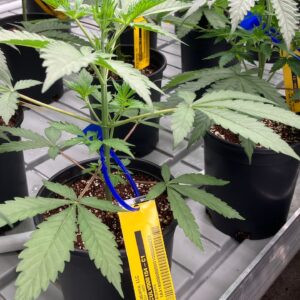
Cereal Killa Feminized wasn’t quite what we’d expected. With a predominantly indica lineage, this strain’s lanky, stretched-out frame, delayed flowering time, and smallish flower clusters are distinctly sativa-like. On the other hand, the rapid development of the buds once started, their density, and their sedative effects are classically indica.

The post Cereal Killa Feminized Grow Report appeared first on Sensi Seeds.

Source link

Centennials List the Best Animes to Watch While High — and Your Faves Aren’t in It

Centennials List the Best Animes to Watch While High — and Your Faves Aren’t in It

Centennials List the Best Animes to Watch While High — and Your Faves Aren’t in It

While Millennials grew up fawning over the fantastic trio of Dragon Ball Z, Pokémon, and Sailor Moon, Gen Zers couldn’t care less: they have their own icons. We may all share a love for weed, but these two generations are split by decades, and by very different vibes. It’s a well-known fact that each generation vibes with its own zeitgeist, and Centennials are drawing from new wells and going crazy for “other” works, not those we might consider “classics,” but rather, a reinvention of what we collectively call “anime to watch while high.”

It’s been this way since the dawn of time: one generation pulling away from the last. A few years ago, trap artists called indie rockers “old,” even though they were still at the peak of their careers. Later, because life is deeply cyclical, those trap artists ended up retiring, labeled as outdated by Swifties and K-pop fans. Like Grandpa Simpson said: “It’ll happen to you!” So, to start off with some dissenting opinions about what anime to watch while high, here are some recommendations from Juan Ruocco, one of the metaphysical references for internet Millennials.

Ruocco is a writer, podcaster, and prominent Argentine streamer. Seasoned by cable TV, the frenetic energy of early internet forums, and the age of online piracy (long before streaming platforms) he mentions Those Who Hunt Elves, an alternative anime that aired on Locomotion for Latin America and was available on DVD in the US thanks to the ADV Films label. “It’s a full-on psychedelic experience. In this story, a magician’s spirit is trapped inside a tank, and they have to find the spell to undo the whole thing,” he explains. The series has two seasons of 12 episodes each and, according to Ruocco, is “spectacular, highly recommended.”

For something a bit more chill, he mentions Oh! My Goddess, which he describes as “a good, somewhat romantic soap opera about a human food delivery guy and some goddesses.” And finally, he sticks to a classic (also a soap opera, but with a huge dose of science fiction) like The Super Dimension Fortress Macross: Do You Remember Love? “It’s an animated gem. You have giant robots, love, and life lessons. It’s for watching while you’re completely out of it.”

However, Gen Z has its own tastes. Many respect “the greats of Japanese animation,” but prefer other styles, crafting what might become future classics. Like young Millán, one of the hosts of Juju Podcast, a popular show specializing in manga and anime. When he’s high, Millán goes for Space Dandy, by the master Shinichiro Watanabe in collaboration with Shingo Natsume. In short: Watanabe is the author of the canonical Samurai Champloo and Cowboy Bebop, but Space Dandy is one of his lesser-known works. “The standout is the animation. It’s also hilarious, and the writing leans on clichés but pulls them off brilliantly. As for the story, we won’t worry too much about missing any important details because we’re out of our minds, since it’s much more enjoyable stoned.”

He also mentions Ping Pong the Animation, directed by Masaaki Yuasa. “Almost any of Yuasa’s work is perfect to watch while high, but some require a bit of attention to avoid missing important plot points. In Ping Pong, we’ll find dynamism, movement, speed, and completely out-of-place camera angles that will immerse us completely in a unique universe,” Millán points out.

And in that vein of works with a certain degree of organic incomprehensibility (those that, with or without weed, are inherently 420) he adds FLCL, from the legendary production company Gainax and directed by Kazuya Tsurumaki, who was in charge of the Evangelion rebuilds. “You won’t really get FLCL‘s story on the first watch; I’d say it’s the kind of show you need to see at least twice. It has everything we need to enjoy a Japanese cartoon while smoking pot: mechs, bizarre enemies, excellent music, a well-developed message, and a very nice ending,” the podcaster concludes.

Miguel, the Chilean podcaster behind 3 Ramen de Luca, is also blown away by FLCL (“a weird, short, and experimental trip”) and adds Paprika (“If you want something chaotic and visually explosive”), a sci-fi film directed by Satoshi Kon, to his list. However, when it comes to pairing anime with weed, he specifically leans towards “the last few episodes of Tengen Toppa Gurren Lagann,” an anime full of “fights, screams, and flashes everywhere.” And he assures us: “You end up high!”

Likewise, the alternative model Acronica is betting on Hypnosis Mic: Division Rap Battle, an anime that offers a solution to potential dilemmas: any existing tension is resolved with rap battles. “In a futuristic world, the Word Party takes power, a government of women whose first measure is to ban weapons and dictate conflict resolution through rap. Someone threatens to rob you on the street? Rap battle. Are they trying to charge you more for milk than the price marked on the shelf? Rap battle!” Acronica laughs. Her recommendation allows for healthy weed doses and is, in itself, an explosively drug-fueled work.

In keeping with the comedy, surprise, and laughter, Matías Glenadel, a journalist and one of the spokespeople for the Anime Argentina community, a digital forum where Centennials and Millennials coexist, believes that “the best anime to watch while high are those that make you laugh.” Under that premise, he points to Welcome to Demon School! Iruma-kun, an anime with three seasons and a fourth yet to premiere. “It’s an isekai (a subgenre of Japanese fantasy where the protagonist is transported to another world) in which a human child with a truly awful life is sent to Hell. But instead of being the horrible place we all imagine, it turns out to be much better than where he lived. There, he’s adopted by a demon who treats him like his grandson, and he starts attending high school, meeting some really funny characters,” Glenadel explains.

To top it all off, he adds Saiki Kusuo no Psi-nan, a 2016 anime with two seasons and a simple plot, without many twists and turns, but “hyper funny, especially if you’re high.” And he warns: “Neither show will give you a bad trip, since they don’t have many tense moments. I recommend Saiki more. It’s a little-known, even underrated, work. But… my God! I’ve never laughed so much with an anime!”

The classics aren’t the dominant force in the Centennials’ tier lists; right now, they’re defining their own. And this will continue until the next generation reaches for other works, even rarer, even newer. In any case, all that’s left is to light up, tune in to some of the recommendations, and let yourself be carried away by the swirling smoke, without overthinking it. Because, after all, age is just a number, and feeling young is a must to know you’re alive.

Cover photo created with Gemini.

<p>The post Centennials List the Best Animes to Watch While High — and Your Faves Aren’t in It first appeared on High Times.</p>



Source link

Big Alcohol Says Weed Will Make You Puke? Hmm…

Big Alcohol Says Weed Will Make You Puke? Hmm…

Big Alcohol Says Weed Will Make You Puke? Hmm…

In recent weeks, media outlets from Fox 8 to CNN have turned up the volume on stories about Cannabinoid Hyperemesis Syndrome (CHS), a rare but very real condition tied to chronic cannabis use. The coverage is loud, graphic, and alarmist. What it isn’t? Balanced.

Let’s be clear: CHS exists. It’s a documented medical syndrome involving cyclical vomiting and abdominal pain, most often found in heavy, long-term cannabis users. Many patients report compulsive use of hot showers or baths to relieve symptoms, a distinctive behavioral pattern that helps doctors identify the condition.

It was first identified in Australia in 2004 and recognized by the World Health Organization in 2025 with its own diagnostic code: R11.16. This will help improve clinical recognition and reduce misdiagnosis. That’s a win.

But in the same breath, let’s say something else, just as clearly: the media hype around CHS is spiraling into Reefer Madness 2.0. And this time, it comes with a new buzzword: scromiting.

A Rare Condition, Packaged as Crisis

The facts? CHS is uncommon. According to JAMA Network Open, emergency department visits for CHS rose during the pandemic, but even at their peak, they accounted for only 33.1 cases per 100,000 visits. It disproportionately affects people who use high-potency THC products multiple times daily, not the average cannabis consumer.

But you wouldn’t know that from headlines like “Mysterious marijuana-linked vomiting disorder gets official WHO code as ER cases jump” (Fox News), or “‘Scromiting,’ a bizarre condition linked to chronic marijuana use, is on the rise” (CNN), which pair dramatic anecdotes with foreboding language, often with little statistical context. Fox claimed ER cases had “surged 650%” without mentioning that most were easily treatable, non-lethal, and occurred in a narrow user population.

Scromiting Sells, Science Doesn’t

The term scromiting (screaming + vomiting) wasn’t coined by doctors: it originated on Reddit and TikTok. But news outlets have latched onto it because it’s lurid, clickable, and easy to sensationalize. And it’s working. Stories about CHS are trending, boosted by local affiliates and national newsrooms alike. Meanwhile, context takes a backseat.

Take this CNN piece, which paints a terrifying picture but fails to clearly state that CHS rarely results in hospitalization and has never been linked to a confirmed death in the medical literature.

The effect? Readers (and regulators) walk away believing cannabis is triggering a mysterious, life-threatening illness sweeping ERs. It’s not.

Follow the Money, Even If You Can’t Prove the Receipt

Is Big Pharma or Big Alcohol directly funding this CHS media blitz? We can’t say for sure. What we can say is that pharmaceutical companies spent over $5 billion on TV advertising in 2024, and networks like CNN and Fox receive a significant share of that revenue. In fact, CNN itself noted that cutting pharma ad time could “cripple” its operations.

When nearly every CHS news segment is sandwiched between ads for Zoloft, Ozempic, or Biktarvy, we’re allowed to ask: who benefits from amplifying cannabis harm narratives?

We also know that pharmaceutical and alcohol companies have historically lobbied against cannabis legalization. In 2016, opioid manufacturer Insys Therapeutics donated $500,000 to defeat adult-use cannabis in Arizona. More recently, the Distilled Spirits Council and pharmaceutical firms like Jazz Pharma have lobbied on cannabis regulatory issues in 2025.

So even without a smoking gun, the pattern is familiar: legal weed expands, cannabis replaces pills and booze, and suddenly the media discovers a new syndrome with a terrifying name.

The Right Way to Talk About CHS

CHS deserves real clinical attention. It is not a hoax, and those suffering from it shouldn’t be dismissed. But we need to talk about it the same way we talk about rare alcohol-related conditions or drug side effects: with proportionality, not panic.

That means:

  • Not pretending it’s common.
  • Not suggesting that all cannabis use is risky.
  • Not reviving prohibition-era scare tactics under a new name.

For now, there is no large-scale evidence that casual or occasional cannabis use leads to CHS. What does increase risk? High-frequency, high-potency consumption over time. That’s the kind of nuance missing from most headlines.

High Times Stands for Truth, Not Hysteria

We’ve covered CHS thoughtfully. We acknowledge it’s real. But we also know it’s rare. And we refuse to let it become a tool of reefer-madness-style misinformation.

So next time you see a local news anchor warning you about “scromiting,” ask yourself: are they reporting science, or selling fear?

And if you’re looking for facts, not fear? You’re already in the right place.

Photo: Ellie Burgin via Pexels

Disclaimer: This article is for informational and editorial purposes only and does not constitute medical advice. If you are experiencing persistent symptoms, consult a qualified healthcare provider.

<p>The post Big Alcohol Says Weed Will Make You Puke? Hmm… first appeared on High Times.</p>

Source link

Trump Weighs Executive Order to Advance Cannabis Rescheduling

Trump Weighs Executive Order to Advance Cannabis Rescheduling

Trump Weighs Executive Order to Advance Cannabis Rescheduling

President Donald Trump is weighing an executive order that would push the federal government to reclassify cannabis, a step that could mark the most significant shift in U.S. cannabis policy in decades—even as the White House cautions that no final decision has been made.
The deliberations, first reported late Thursday by The Washington Post, center on moving marijuana from Schedule I—the government’s most restrictive category, reserved for drugs deemed to have no accepted medical use—to Schedule III, a classification that would acknowledge medical value and loosen some federal controls. 

“This is an encouraging development and a strong indicator that comprehensive legalization is no longer a distant goal,” says Sorse Tech CEO Howard Lee.
The Post reported Trump discussed the potential policy change in a call that included House Speaker Mike Johnson and cannabis industry executives, alongside senior administration officials. Johnson voiced skepticism, the report said, while industry participants pressed the case that rescheduling would reduce barriers to research and help normalize a legal market that now operates in tension with federal law. 

In response to the news, Sasha Nutgent, VP of cannabis retail for Housing Works Cannabis Co. out of New York, tells Cannabis Now that with today’s current cannabis classification, “retailers are not incentivized to operate legally. Reclassification would change that for thousands of businesses, especially those owned by folks from communities most impacted by the War on Drugs.”

Industry and Markets Brace for Potential Policy Change

News of the possible executive order rippled quickly through financial markets early this morning. Cannabis-related stocks and exchange-traded funds jumped in premarket trading after the Post report, according to Reuters, reflecting investor optimism that a federal shift could ease access to capital and reduce tax burdens that have long squeezed state-legal operators. 

Rescheduling, however, would not legalize marijuana nationwide. Even supporters describe it as a narrower, technical move with broad downstream effects—especially for research, medical access and business operations—rather than a sweeping rewrite of prohibition-era policy. 

Gennaro Luce, founder and CEO at CannaLnx, powered by EM2P2, argues that “Rescheduling is an important and overdue shift for patient-centric healthcare, but the move to Schedule III alone isn’t enough to make medical cannabis more accessible or affordable.”

Luce says insurers still need verification, compliance and eligibility frameworks before they can treat medical cannabis like a real benefit. “That part of the system is still missing from the national conversation — fortunately, it’s the medical-cannabis system piece we’ve already built and tested alongside physicians, patients, dispensaries, POS systems and insurers.”

President Trump’s considerations land on well-trodden terrain. The modern push to reconsider cannabis’ federal classification accelerated under President Joe Biden, whose administration initiated a review that produced a recommendation from the Department of Health and Human Services to move cannabis to Schedule III. The Justice Department formally began the rescheduling process in 2024, opening the door to rulemaking that has since faced delays and political crosscurrents. 

Policy experts say an executive order can direct agencies and set priorities, but it cannot, by itself, rewrite the Controlled Substances Act. Any durable change to cannabis scheduling ultimately runs through federal administrative procedures led by the Justice Department and the Drug Enforcement Administration, including scientific findings, legal analysis and formal rulemaking steps. That legal nuance has become familiar to cannabis readers—and to anyone who has watched the issue ricochet between campaign promises and bureaucratic reality.

In past coverage of cannabis executive action, Cannabis Now has emphasized that the “stroke of a pen” theory often collides with the limits of federal authority, even when presidents or governors have wide latitude to shape enforcement priorities and regulatory posture. Still, the political stakes are unmistakable. A Trump-backed push to reschedule could scramble the usual partisan map on cannabis, where national Democrats have often positioned themselves as the party of reform while Republicans have been divided between states’-rights advocates and prohibition-aligned lawmakers.

The Post report suggested Trump views rescheduling as a way to “cut restrictions” without endorsing full legalization—a framing that could appeal to voters who support medical access and regulated markets but remain cautious about broader social change. 

For the cannabis industry, the practical implications of Schedule III are potentially enormous—but also uneven. Operators have argued that rescheduling could reduce certain federal tax penalties and make it easier for institutions to do business with cannabis companies.

Ryan Hunter, chief revenue officer for Colorado-based Spherex, a leader in cannabis extraction and purification, offers perspective: “Cannabis is still federally illegal—but even as a federally illegal substance, the move to Schedule III dramatically reduces the federal tax burden for operators. Under IRS code 280E, handling Schedule I or Schedule II substances eliminates the ability for operators to deduct standard operating expenses that most other businesses deduct from their federal taxes. As a result of 280E, cannabis operators’ effective tax rate may be as high as 80 pecent. Beyond this significant improvement, the implications are unclear, but we’re hopeful that this move will allow for cannabis operators to garner the same investment opportunities other industries will enjoy.”

Rescheduling’s Promise and Uncertainty

Analysts told Reuters that shifting cannabis to Schedule III could also accelerate pharmaceutical research and distribution models, even as state-legal markets continue to rely on a patchwork of rules that vary widely from one jurisdiction to another. Critics, including some in Congress, argue rescheduling risks moving faster than the science. The Post reported Johnson referenced studies he said cut against reclassification, reflecting a broader debate over how to weigh evidence of therapeutic benefits against risks of misuse and dependency. 

What happens next could hinge on timing and follow-through. An executive order, if issued, would likely instruct cabinet agencies to prioritize or expedite the administrative process rather than instantly change marijuana’s legal status. Even then, opponents could challenge the move politically and in court, while regulators would still need to align policy with existing federal statutes and international commitments.

“Whenever the White House moves forward with Schedule III, the federal government is effectively telling us that cannabis is medicine,” comments Calyx Containers President and Co-Founder Alex Gonzalez. “And if it’s medicine, ‘good enough’ cannabis practices won’t cut it anymore. Whether rescheduling happens next month or next year, the direction is clear: Cannabis is moving toward pharma-grade standards. For brands, that means tightening quality systems, investing in the ability to react or scale, and preparing for a regulatory-ready supply chain. We’re seeing the smart operators onshoring infrastructure, and we’re positioning our domestic production and business model on being ready to help operators turn this moment into a competitive advantage.”

In the meantime, the national reality on cannabis continues to diverge from federal law. Most states now allow marijuana for medical use, and a growing number permit adult-use sales—a shift that has normalized cannabis commerce for millions of Americans while leaving businesses and consumers navigating legal gray zones that are invisible at the dispensary counter but very real at banks, research institutions and federal agencies.

“Rescheduling is the single most important drug policy move in decades. The potential opportunities for medical and scientific research will significantly increase, while those living in states without an existing medical program will now have access to the powerful healing properties of the plant,” says Mark Lewis, president of specialty banking at Lüt.

“Make no mistake though, rescheduling is just the beginning for those working in the cannabis industry. Until the SAFE Banking Act or 280E is passed, operators will still have to jump through challenging financial hoops to pay their staff, bills or garner investment. The moment is historic, but until cannabis businesses can operate fiscally with the same ease as any other business, more work needs to be done,” Lewis continued. “Payments still need to work in the reality of today, where the ongoing threat of card network shutdowns exists, not just the promise of future reform. While rescheduling may open doors over time, it does not remove the day-to-day financial friction that cannabis operators face right now.”

Whether Trump ultimately signs an order or backs away, the past 24 hours have underscored a core truth of cannabis politics in Washington: Even incremental change can move markets, reshape messaging and reopen debates that Congress has struggled for years to settle.

The post Trump Weighs Executive Order to Advance Cannabis Rescheduling appeared first on Cannabis Now.

Source link

They Say Trump Is Easing Cannabis Restrictions. Why That May Not Mean Freedom

They Say Trump Is Easing Cannabis Restrictions. Why That May Not Mean Freedom

They Say Trump Is Easing Cannabis Restrictions. Why That May Not Mean Freedom

Trump is reportedly weighing a directive that would push federal agencies to move cannabis from Schedule I to Schedule III, but the White House says no final decision has been made. If it happens, Schedule III would bring meaningful 280E tax relief to state-legal operators and ease some research barriers, yet it would still leave cannabis federally illegal, keep interstate commerce off limits, and preserve the basic conflict between state markets and federal law. In other words, it could be real progress for businesses and science, but it would not deliver legalization, descheduling, broad criminal justice reform or a durable national framework, meaning the hardest work would still be ahead.

President Donald Trump appears to be reopening a federal cannabis debate that has sat frozen for more than a year. According to The Washington Post, the White House is weighing an executive directive that would push federal agencies to move forward with rescheduling cannabis from Schedule I to Schedule III under the Controlled Substances Act. Administration officials stress that no final decision has been made, but the signal is clear: cannabis is back on the table.

If it enacted, the shift would mark the most significant change in federal cannabis policy in more than 50 years. It would also arrive wrapped in contradiction. Just weeks ago, Trump signed a must-pass spending deal that quietly set the stage for the recriminalization of most hemp-derived THC products starting in 2026. Progress, in other words, is moving in two directions at once.

What Trump Is Considering

The Post reports that Trump met this week in the Oval Office with cannabis industry executives alongside Health and Human Services Secretary Robert F. Kennedy Jr. and Centers for Medicare and Medicaid Services Administrator Mehmet Oz. During the meeting, Trump reportedly phoned House Speaker Mike Johnson, who raised objections to rescheduling based on public health concerns. By the end of the call, Trump appeared open to moving forward, though sources cautioned the process is still unresolved.

This would not be a sudden reversal. Trump said publicly in August that he would decide “within weeks” whether to change cannabis’s federal classification. That timeline came and went without action, but the renewed reporting suggests the issue never fully left the White House.

Under current federal law, cannabis remains a Schedule I substance, grouped with heroin and LSD and defined as having no accepted medical use. A move to Schedule III would formally recognize medical value and lower abuse potential, placing cannabis alongside drugs like ketamine and certain prescription painkillers.

Trump cannot personally reschedule cannabis. The Controlled Substances Act gives that authority to the attorney general, typically exercised through the Drug Enforcement Administration. Still, the White House could direct the Justice Department to move the process forward without waiting on the administrative hearings that have stalled since early 2025, potentially accelerating a final rule.

Why This Matters

For cannabis businesses, the most immediate impact would come through taxes. As long as cannabis remains classified in Schedule I or II, Section 280E of the tax code blocks operators from deducting ordinary business expenses. The result has been effective tax rates that often exceed 60%.

Brian Vicente, founding partner at Vicente LLP, said rescheduling would remove that burden. “This monumental change will have a massive, positive effect on thousands of state-legal cannabis businesses around the country,” he said, pointing to 280E relief as a survival issue for operators already stretched thin.

Rescheduling would not legalize cannabis, but it would immediately change who can stay open and who cannot. For many small and mid-sized operators, that distinction matters more than market headlines.

What Rescheduling Does Not Do

Schedule III would still leave cannabis illegal at the federal level. Interstate commerce would remain prohibited. Federal criminal penalties would still exist. Workers, patients and noncitizens would continue to face legal exposure even in states with regulated markets.

Research access would improve, but within limits. Cannabis would remain under DEA oversight and FDA scrutiny. Whole-plant cannabis would not suddenly become an FDA-approved medicine, and state programs would continue operating in a legal gray zone.

Those limits are not abstract. High Times has documented how partial reforms can coexist with aggressive enforcement, most recently when the administration signed legislation redefining hemp in ways that could wipe out much of the hemp-derived market next year. That move has already sparked resistance from states and prompted questions about whether federal agencies even have the capacity to enforce the ban, a concern echoed in a recent Congressional Research Service memo.

Seen against that backdrop, cannabis rescheduling looks less like a clean break from prohibition and more like another uneasy compromise layered onto an already fractured system.

A Step Forward, Not the Destination

Supporters of rescheduling argue that formally acknowledging cannabis’ medical value is long overdue. Shawn Hauser, a partner at Vicente LLP, described the potential move as a repudiation of Nixon-era drug policy and a meaningful shift in public health thinking. She also cautioned that rescheduling alone does not close the deeper gaps in federal law or deliver the criminal justice reform many advocates continue to demand.

That tension runs through the cannabis community. Some see Schedule III as progress worth taking, even if it falls short. Others worry it could entrench federal control and tilt the field toward large corporate and pharmaceutical players. High Times has explored those concerns in depth, including our reporting on why Schedule III could be worse than standing still and how conservative policy frameworks could use rescheduling to tighten oversight rather than loosen it.

Both things can be true. Rescheduling would ease pressure on businesses and researchers. It would also leave the core contradiction of U.S. cannabis policy intact.

What Comes Next

If Trump moves forward, he would be reviving a process that began under the Biden administration, when federal health officials concluded cannabis has accepted medical use and recommended Schedule III. The DEA’s hearing process has been stalled for months, leaving the industry and regulators stuck in limbo. An executive push could break that deadlock.

Even then, the larger question remains unresolved. Cannabis would still sit inside the Controlled Substances Act. Hemp would still face a looming federal crackdown. States would still be navigating conflicts between local markets and federal law.

Rescheduling may be progress. It may even be meaningful progress. But it is not legalization, not descheduling and not the end of prohibition’s long shadow. For a plant and a culture that have waited decades for recognition, this moment calls for clear-eyed realism.

The road forward is opening. The finish line is still further down it.

<p>The post They Say Trump Is Easing Cannabis Restrictions. Why That May Not Mean Freedom first appeared on High Times.</p>

Source link

The Best THC Gummies For Euphoric, Tasty Highs

The Best THC Gummies For Euphoric, Tasty Highs

The Best THC Gummies For Euphoric, Tasty Highs

We independently test and review everything we recommend. Our reviews are completely unbiased. When you make a purchase using our links, we may earn a commission. Learn more

Gummies surpassed smoking as the most popular method for using cannabis in 2023, according to BDSA data. While dispensary edibles are great, they’re much less widely available than hemp-derived gummies, thanks to the Farm Bill.

However, the market for hemp gummies generally lacks the strict controls of the cannabis industry, so you have to be extra careful about what you buy.

That’s why we’ve taken an in-depth look at the hemp gummies on the market, ranking them based on objective criteria for safety, efficacy and reliability, independent lab testing and first-hand user experience. These are the best ones we found.

What makes a THC gummy effective?

Not Just THC

Blends which include CBD and minor cannabinoids such as CBG or CBN offer a more well-rounded experience. It doesn’t just have to be 5 mg or more of THC to be a fun high, so we prioritized wider-ranging blends.

Delta-8 is OK but Semi-Synthetic

Delta-8 THC probably isn’t dangerous on its own, but it often comes with unintended byproducts from its synthesis. So we preferred delta-9, but this wasn’t a strict requirement.

THCV is Best Avoided

THCV actually dampens the effects of THC at low doses, so we generally avoided gummies containing it.

Terpenes Matter

As always, terpenes are a key part of the experience. Linalool and myrcene are relaxing, and limonene and pinene are uplifting.

We evaluated 87 THC gummies to put together our recommendations. After ranking 11 qualifying products based on our expert-backed framework and first-hand testing, these seven were the very best.

Best Overall

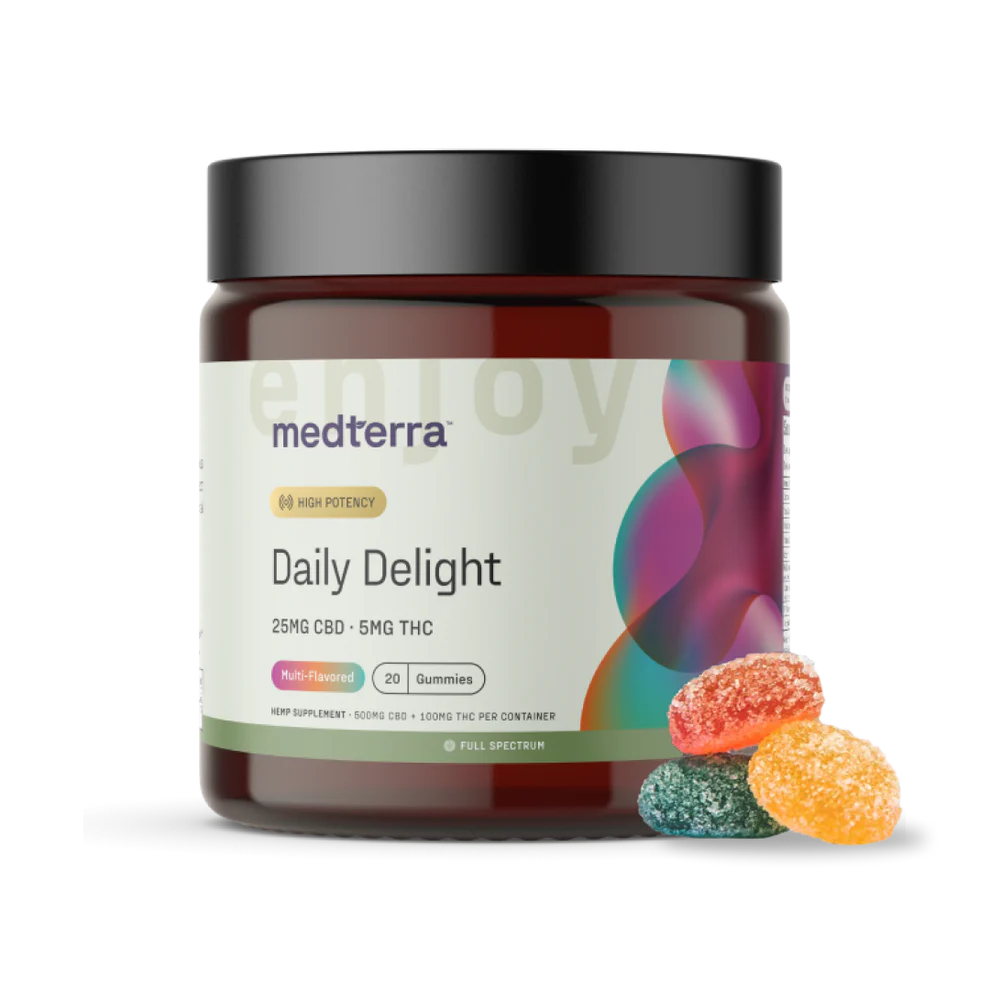
Medterra Daily Delight THC Gummies

4.5 CBD Oracle Rating

CBD Approval Badge

Medterra Daily Delight THC Gummies

  • Type: Full spectrum extract
  • Potency: 5 mg THC and 25 mg CBD per gummy
  • CBD:THC ratio: 5:1 
  • Top terpenes: Limonene
  • Price: $39.99 for 20 gummies/100 mg THC ($0.400 per mg THC)
  • Coupon: “THANKS30” for 30% off

Shop Now

4.5 CBD Oracle Rating

Medterra’s Daily Delight gummies are one of the best options out there for recreational use because they combine a truly full-spectrum hemp extract with solid cultivation and manufacturing.

While it isn’t USDA-certified organic, the hemp is grown according to organic practices and the extract is both consistent and free from contaminants. Medterra oversees the whole process from seed to sale, and everything is made in a GMP certified manufacturing facility.

The gummies themselves also mix in CBD, CBC, CBG and CBT, as well as the uplifting terpene limonene. This gives you a true full spectrum experience, and the 5 mg THC is strong enough to feel while not blasting you off with a single dose.

View our independent lab test.

Our independent lab test of Medterra’s Daily Delight gummies broadly agrees with the manufacturer’s COA, with close matches for CBD and THC but some differences for minor cannabinoids.

Our lab test showed 6.13 mg/g CBD and 1.16 mg/g delta-9 THC, closely matching the 6 mg/g and 1.2 mg/g in the manufacturer COA. 

The remaining cannabinoids showed small differences. CBDV, CBG and CBT were lower in our tests, while CBN, CBC and CBT were higher in our tests. These differences were all small, though.

  • Genuine full spectrum gummies
  • CBD, CBC, CBG and CBT as well as THC
  • 5 mg THC dose is well balanced
  • Contains limonene for an uplifting high
  • Made with organic ingredients
  • A little expensive
  • Only one terpene at detectable levels
  • CBD:THC ratio reduces the intensity of the high
Best Value

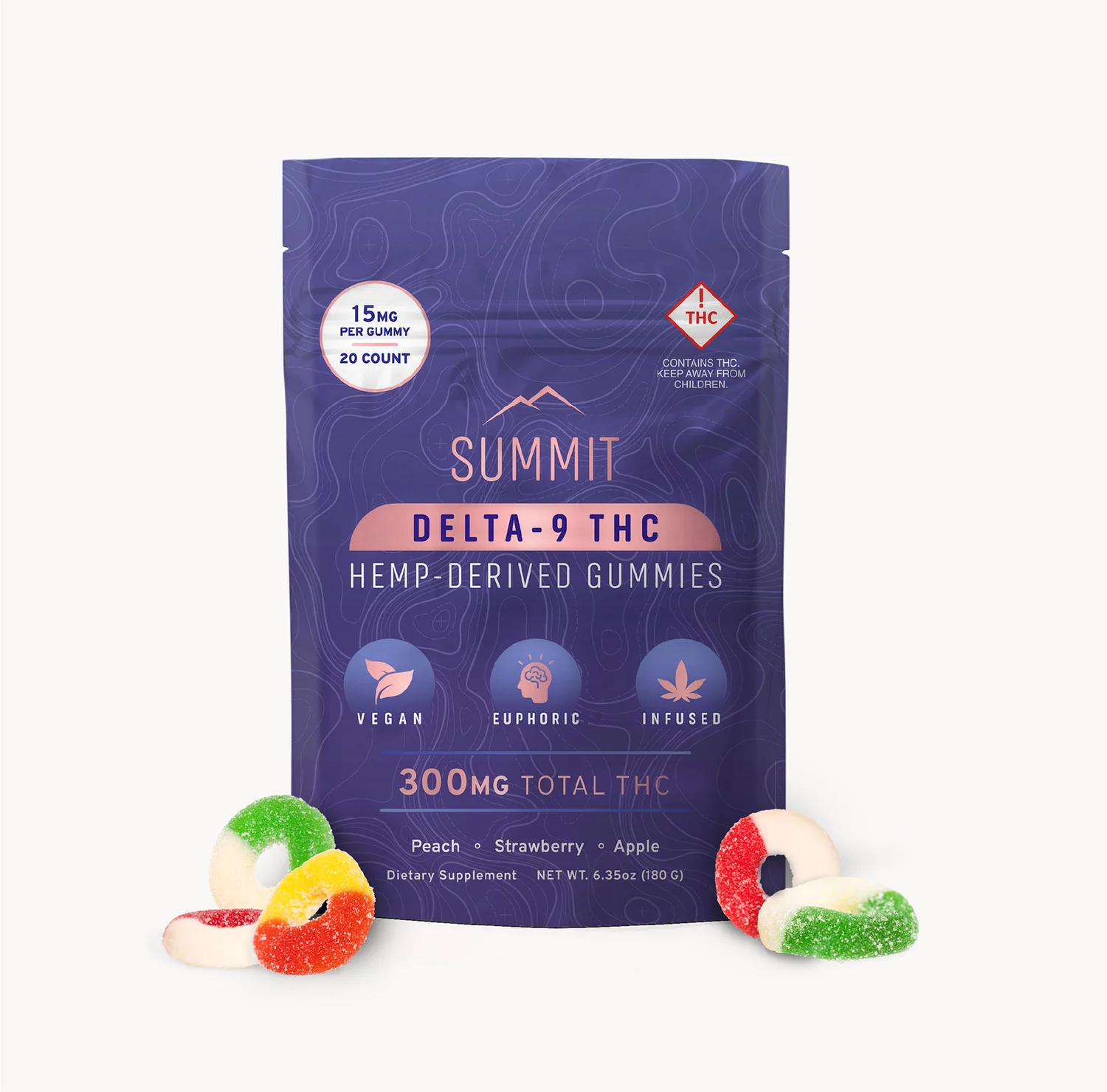
Summit 15 mg Delta-9 THC Gummies

4.5 CBD Oracle Rating

CBD Approval Badge

Summit 15 mg Delta-9 THC Gummies

  • Type: Full spectrum extract
  • Potency: 15 mg THC per gummy
  • CBD:THC ratio: ~1:150 
  • Top Terpenes: No detectable terpenes
  • Price: $49.99 for 20 gummies/300 mg THC ($0.167 per mg THC)
  • Coupon: “SUMMIT15” for 15% off

Shop Now

4.5 CBD Oracle Rating

Summit is the sister brand to R&R CBD, one of the consistently best-scoring brands based on our framework. And these gummies are just as good as any R&R product. 

Lab reports prove that not only are these gummies free from contaminants; they also pack a full spectrum of cannabinoids alongside a sizable 15 mg of THC. They’re perfect for more experienced users who are looking for something to really take them to the peak. 

The THC is joined by smaller amounts of CBG, CBC, CBN and CBD, offering a well-rounded high. While terpenes aren’t detectable in the mix, the cannabinoid blend does a great job on its own. The biggest risk is taking too much – approach with caution!

  • Colorado-grown hemp
  • CBG, CBC, CBN and CBD as well as THC
  • Excellent price – about $0.17 per mg THC
  • USDA Organic hemp
  • High-quality manufacturing
  • Strong, but possibly too strong
  • No detectable terpenes
Best Organic

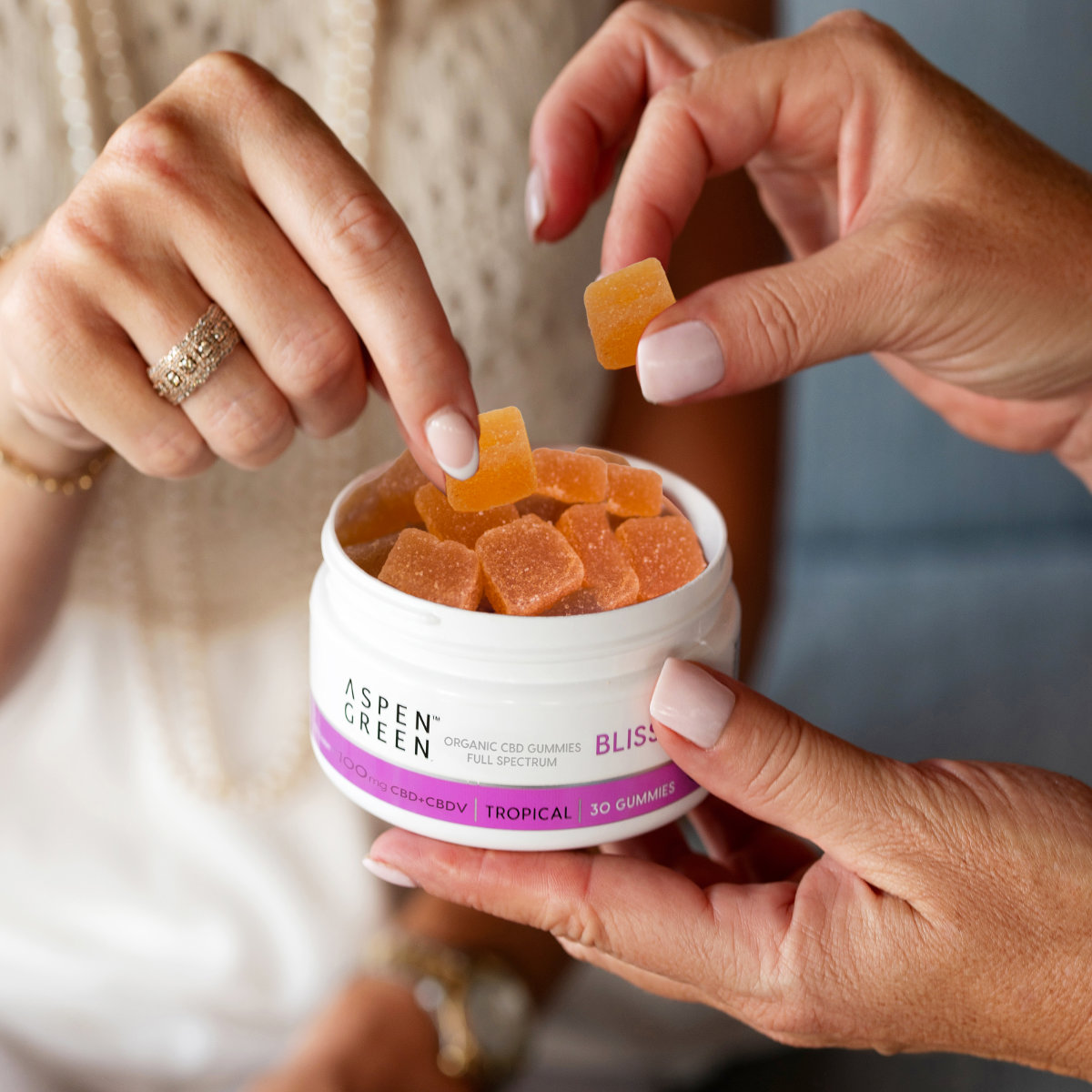
Aspen Green Bliss Organic Full Spectrum Gummies

4.4 CBD Oracle Rating

CBD Approval Badge

Aspen Green Bliss Organic Full Spectrum Gummies

  • Type: Full spectrum extract
  • Potency: 5 mg THC + THCV, 100 mg CBD + CBDV
  • CBD:THC ratio: 20:1
  • Top Terpenes: No detectable terpenes
  • Price: $89.99 for 30 gummies/150 mg THC ($0.600 per mg THC)
  • Coupon: “feelgood25” for 25% off

Shop Now

4.4 CBD Oracle Rating

Aspen Green knocks just about everything out of the park.

All of the relevant ingredients in their Bliss Organic Full Spectrum Gummies are USDA-certified organic, their extracts are produced cleanly from the flowering tops of single-strain hemp plants, their manufacturing facilities are GMP-certified and FDA-registered, and everything is tested by a reputable, accredited lab.

The gummies themselves are about as good as you’d expect given all this. With CBC, CBG and CBN in addition to the THC and CBD, they offer a rounded, balanced high and they’re also great if you’re looking for something to help you sleep.

The gummies do include THCV, which isn’t ideal in lower doses, but the overall quality is hard to fault.

View our independent lab test.

Our independent lab test of Aspen Green’s Bliss gummies shows a close match to the manufacturer’s COA on both major and minor cannabinoids.

Our test showed 15.6 mg/g of CBD and 0.653 mg/g of delta-9 THC, compared to 16.8 mg/g and 0.8 mg/g in Aspen Green’s COA. The THC difference amounts to around 0.7 mg per 5 g gummy, which is substantial. This also means 6 mg less CBD per gummy based on our test.

However, CBC, CBG, CBN and THCV are all fairly close across both reports.

  • USDA certified organic
  • Colorado-grown hemp
  • Flower-derived extract
  • Full spectrum: CBC, CBG, CBN, CBD and THC
  • Top-quality manufacturing
  • Also great as a sleep aid
  • Quite expensive per mg THC
  • Includes THCV
  • Less THC in independent lab test
  • No detectable terpenes
Best CBD:THC Ratio

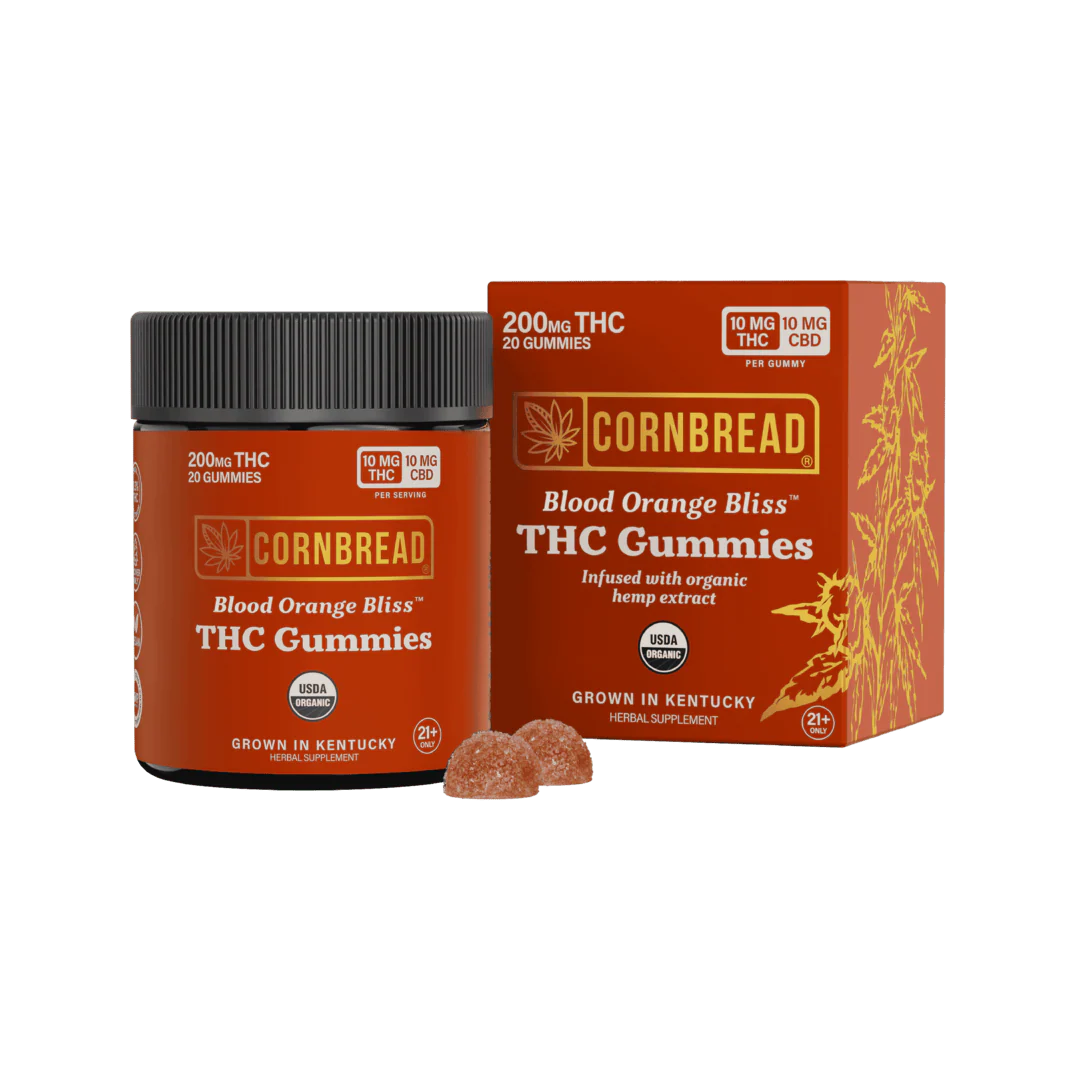
Cornbread Hemp Blood Orange Bliss THC Gummies

4.2 CBD Oracle Rating

CBD Approval Badge

Cornbread Hemp Blood Orange Bliss THC Gummies

  • Type: Full spectrum extract
  • Potency: 10 mg THC, 10 mg CBD
  • CBD:THC ratio: 1:1
  • Top terpenes: Limonene
  • Price: $49.99 for 20 gummies/200 mg THC ($0.250 per mg THC)
  • Coupon: “LADY” for 30% off

Shop Now

4.2 CBD Oracle Rating

Cornbread Hemp is one of the best companies in the industry, and their Blood Orange Bliss THC Gummies are a perfect example of why.

The gummies use a flower-only extract taken from Kentucky-grown, USDA organic hemp, and they’re made with organic ingredients in a GMP-certified facility. The 1:1 THC:CBD ratio expertly balances the high from THC with the calming, moderating effects of CBD.

Add in the CBC and D-limonene and it’s the perfect recipe for an uplifting THC gummy. The 10 mg dose is right in the sweet spot for more experienced users, and new users can take half (or less) and increase from there. The low price per mg is just the cherry on top.

  • Full spectrum: THC, CBD and CBC
  • USDA certified organic
  • Flower-derived extract
  • Good price per mg THC
  • D-limonene complements the THC perfectly
  • Well-balanced dosage
  • Fewer cannabinoids than other options
  • Not ideal for very low doses
Best Vegan

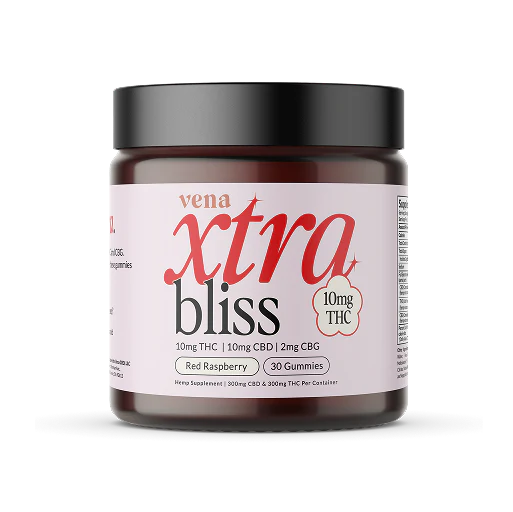
Vena Xtra Bliss

4.0 CBD Oracle Rating

CBD Approval Badge

Vena Xtra Bliss

  • CBD type: Full spectrum
  • Potency: 10 mg THC, 10 mg CBD, 2 mg CBG
  • CBD:THC ratio: 1:1
  • Terpenes: None detected
  • Price: $79.95 for 30 gummies/300 mg THC ($0.267 per mg THC)
  • Coupon: “BACK50” for 50% off

Shop Now

4.0 CBD Oracle Rating

Vena’s Xtra Bliss gummies combine a good selection of cannabinoids with a solid price per mg of THC, making it a great option if you’re looking for a balanced, blissful high.

Vena takes a lot of care over their ingredients, using all-natural flavors, avoiding preservatives, not using high fructose corn syrup, and making the gummies completely vegan.

The 10 mg:10 mg THC:CBD balance is ideal for most situations, offering enough THC for a pleasant high with the CBD to take the edge off. As well as 2 mg CBG, the gummies also include CBN and smaller amounts of CBC and CBT.

We’d have liked to see more transparency about their manufacturing, but overall the gummies are great.

View our independent lab test.

Our independent lab test showed a very close match with the one provided to customers by Vena. In one case, the results matched down to 0.003 mg per g.

Both the original Vena lab test and ours were conducted by InfiniteCAL, so perhaps it isn’t too surprising that the results match so closely. But it’s still impressive: for instance, THC (2.33 vs. 2.28 mg/g) and CBD (2.55 vs. 2.47 mg/g) both come in less than 0.1 mg higher per g in our test.

  • Full spectrum: THC, CBD, CBG, CBN and more
  • Even THC:CBD ratio
  • Independent lab test matches manufacturer COA
  • Good price per mg THC
  • Vegan gummies
  • Clean, natural ingredients
  • Contains THCV
  • No terpenes detected
Most Potent

cbdMD Vibe Max Dose Delta-9 THC Nano Gummies

4.0 CBD Oracle Rating

CBD Approval Badge

cbdMD Vibe Max Dose Delta-9 THC Nano Gummies

  • Type: Full spectrum
  • Potency: 18 mg THC
  • CBD:THC ratio: ~1:300
  • Top Terpenes: None detected
  • Price: $59.99 for 20 gummies/360 mg THC ($0.167 per mg THC)
  • Coupon: “WECARE40” for 40% off

Shop Now

4.0 CBD Oracle Rating

cbdMD has been in the industry since the early days, and you can always be sure of quality when you’re buying from the brand.

This experience comes through clearly in their new fast-acting “Nano Gummies” – so called because of the nano-emulsified THC which absorbs quickly. This is a big selling point for these gummies, and the 18 mg per serving THC dose means they’re the best option if you want to get really high.

There isn’t much CBD, and even though the small amounts of THCV present might control the effects a little, these are not the best for new users. But if the usual options don’t hit hard or quick enough for you, these gummies are an ideal choice.

  • Most potent gummies in this list
  • Fast-acting, nano-emulsified THC
  • Excellent price per mg
  • Top-quality manufacturing
  • Vegan gummies
  • Too strong for new users
  • No terpenes detected
  • Weak cannabinoid selection
Best Full Spectrum

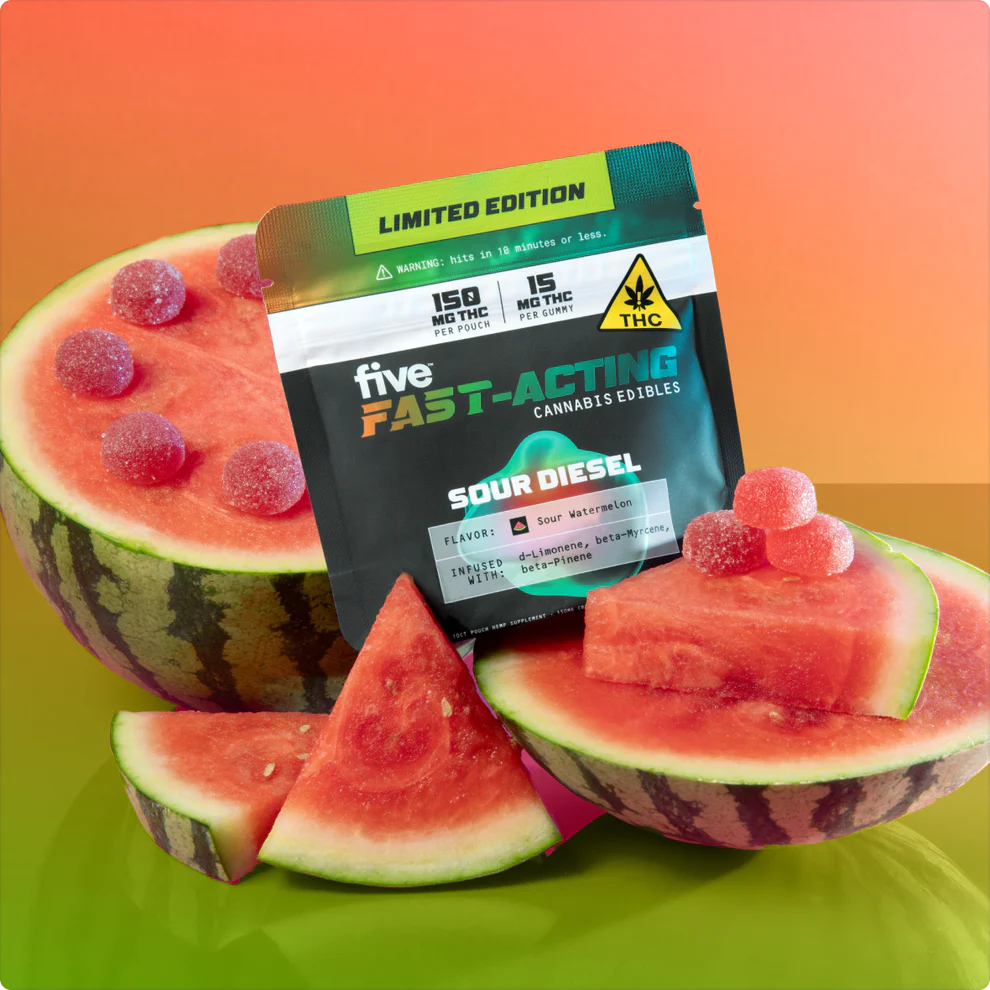
Five Sour Diesel Fast-Acting Gummies

3.9 CBD Oracle Rating

CBD Approval Badge

Five Sour Diesel Fast-Acting Gummies

  • CBD type: Full spectrum
  • Potency: 15 mg THC, 15 mg CBD
  • CBD:THC ratio: 1:1
  • Terpenes: Myrcene, alpha-humulene
  • Price: $62.98 for 20 gummies/300 mg THC ($0.210 per mg THC)
  • Coupon: “TRUST50” for 50% off

Shop Now

3.9 CBD Oracle Rating

Five’s Fast-Acting Gummies do just what they claim to: offer a substantial dose of THC that takes effect quickly.

Although 15 mg is a big dose for less experienced users, it is balanced by equal amounts of CBD, as well as CBG, CBN and other minor cannabinoids. This takes the edge off the experience, alongside the calming myrcene in the mix. These are genuine full spectrum gummies, terpenes and all.

The price is also fantastic, beating out most of the competition at just 21 cents per mg of THC (with additional savings if you choose a bigger pack).

They also use many organic ingredients, but they’re a little unclear about their hemp and their manufacturing, which cost them points.

  • Genuine full spectrum: THC, CBD, CBG, CBN and more
  • Contains myrcene, a calming terpene
  • 1:1 CBD:THC ratio
  • Great price per mg
  • Organic ingredients
  • Vegan gummies
  • Dosage not ideal for new users
  • Contains THCV
  • Unclear about hemp sourcing and manufacturing

Honorable Mention

R&R THC Gummies

Summit’s Delta-9 THC Gummies made the main list, but their sister brand R&R released a new THC gummy while we were working on this article. We’re only giving it an honorable mention, because the gummies weren’t tested for terpenes.

However, R&R is a consistent performer and their THC gummies are still excellent quality, made with USDA organic hemp. The 2:1 CBD:THC ratio offers a light high, balanced out by CBD and a whole spectrum of cannabinoids, including CBG, CBN and CBC.

The gummies are also made with real fruit juice, natural flavorings, and without added sugar, making them a solid option if you want an edible without unnecessary calories. The price is a little high, though.


Other THC Gummies We Considered

We started out with a list of 87 Delta-9 THC gummies, and trimmed the list down to the best candidates using some key criteria from our evaluation framework. Aside from just having a COA at all – which is a fundamental requirement – the main factors that discounted products were:

  • COA Over a Year Old: Having a lab report is good, but if it’s over a year old, then it’s unlikely to reflect the product still on the shelves. The THC and other cannabinoids could have degraded in storage or – more likely – there have been new batches released which have not been lab tested. 13 products were discounted solely on this basis.
  • No Full Panel Safety Test: Without full panel safety testing – including heavy metals, residual solvents, pesticides, microbials and mycotoxins – products cannot be confirmed to be safe to use. 22 products were discounted because they weren’t full panel tested.
  • No Terpene Testing: Cannabinoids are only part of the picture, and terpenes bring their own effects to the table. Without testing for terpenes, it’s hard to say a product is truly full spectrum or to be sure of all the likely effects. 37 products were discounted because of this.

Discounting four products that didn’t share COAs at all, this left 11 products to be scored. Only four of these products scored over 80%, but we also included the three next-highest scorers and one honorable mention in this list. You can check the full scoring here.

Generally, most of the points lost by these brands – Kiva Confections, Hemp Bombs, Cookies and Ayrloom – were related to aspects of cultivation (e.g. organic farming, single origin hemp and single-strain extracts) or manufacturing (GMP certification and FDA registration).


Methodology: How We Ranked the Best THC Gummies

Comparison of popular hemp delta-9 THC gummies products
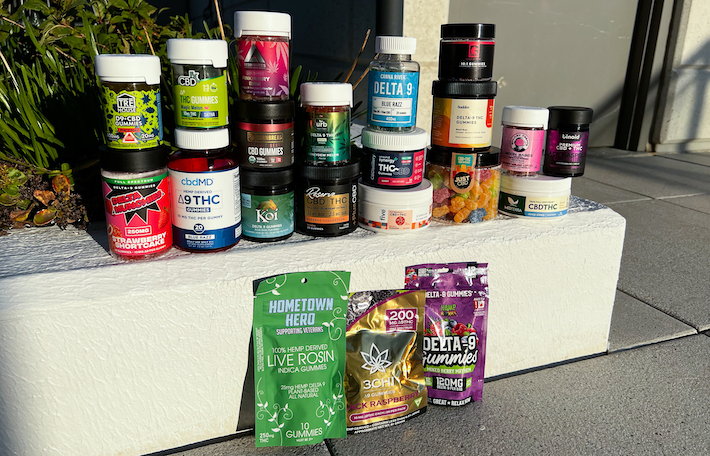
We analyzed 87 brands and spent three weeks testing and comparing 25 popular delta-9 THC gummies to find the best options for relaxing, sedating, and uplifting effects. Photo: Mell Green/CBD Oracle
  • Expert Interviews: We interviewed two experts on cannabis gummies specifically for this project, and used their insights, along with existing interviews and independent research to determine the key factors for a recreational gummy.
  • Market Research: We conducted an automated search (coded by CBD Oracle) of Google and DuckDuckGo for “THC Gummies” (with additional search terms to remove some articles simply listing products), taking the first 150 results from each and any internal links, before scraping the text from all pages. This was fed to ChatGPT, which suggested two products from each brand according to our criteria. This output was checked manually to confirm, and any brands in our database not included were added manually. This resulted in 87 products.
  • Product Analysis: We used the criteria described above to create a shortlist of products, which were then scored on our Product Quality Evaluation Framework.
  • Independent Lab Testing: Any products scoring over 80% on our framework were sent to InfiniteCAL for independent lab tests, to confirm manufacturer claims.
  • First-Hand Testing: These same products were tested first-hand by members of the Oracle team, who made notes on their thoughts and experience.
Quality testing popular delta-9 THC gummies
When testing each product, we rated and compared the gummies for things like overall effects, taste and texture, potency, and purity of ingredients. Photo: Mell Green/CBD Oracle

You can learn more about CBD Oracle’s product testing methodology here.


Expert Advice: How to Choose a THC Gummy for Recreational Use

Close up of THC gummy in hand
Photo: Medterra

We spoke to two experts in cannabis edibles to help us devise criteria and create this list. Their insights on key issues helped us throughout, and we’ve collected them here to help you choose your own ideal gummy from the multitude of options out there.

How Much THC to Look for?

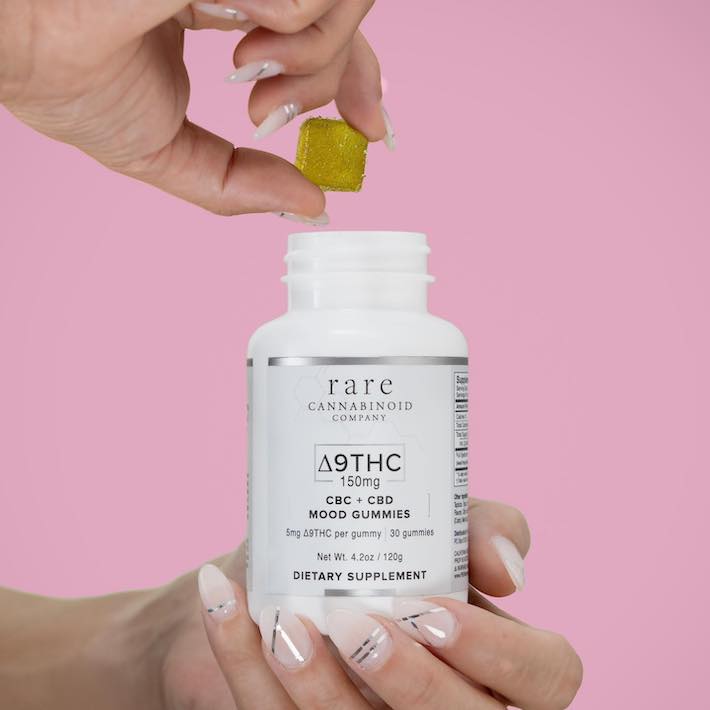
Woman holding a jar of delta-9 gummies
Delta-9 gummies typically contain 1 to 25 mg of delta-9 THC per gummy and are highly psychoactive. Photo: Rare Cannabinoid Company

The most obvious thing to look out for is dosage, but the experts we spoke to advised against simply choosing the highest dosage. Instead, they generally suggested that you “start low, go slow,” gradually increasing from below 5 mg to 20 mg or more as needed.  

Dr. Tanja Bagar, CEO and Expert Council Chairman at the International Institute for Cannabinoids, told us that:

The baseline of our endocannabinoid system is very individual and so are responses to different doses. People who have more cannabinoid receptors expressed on the cells surfaces will respond to lower doses. My suggestion would be to start with 3-5 mg dose and observe effects and then slowly increase.

And Dr. Erin Walsh, clinical pharmacist and founder/CEO at the Cannabis Compass, commented that while general guidelines usually recommend starting at 5 mg, she advises starting at closer to 2.5 mg in her clinical practice. This is especially true for older adults.

She explains, “This conservative approach is rooted in the way THC is metabolized: when ingested, it’s processed by the liver and converted into 11-hydroxy-THC, a compound that can be nearly 11 times more potent than inhaled THC.”

Adding that:

This difference in potency can catch new users off guard. Additionally, individual genetic differences—particularly in the CYP450 liver enzymes—can significantly impact how someone metabolizes THC. Depending on your genotype, you could be a poor, intermediate, regular, or ultra-rapid metabolizer. That’s why ‘start low and go slow’ is a golden rule for cannabis-naive individuals.

Other Cannabinoids and Terpenes

Buying marijuana gummies at a dispensary
Gummies might focus on THC, but other cannabinoids and terpenes add to the experience. Photo: MedMen

When you’re mainly interested in recreational use, there’s a temptation to ignore other cannabinoids and just focus on THCs. But the experts we spoke to suggested that this would be a mistake.

Dr. Bagar said:

From my perspective it’s a good idea to have non-intoxicating cannabinoids even in products intended only for recreational use. There are many benefits to ingesting CBD, CBG, CBC and other cannabinoids and besides giving a more wholesome recreational benefit, one also brings about a positive effect on the endocannabinoid system and neuroprotection.

And Dr. Walsh explained:

Cannabinoids such as CBD and CBG can help mitigate some of THC’s less desirable effects, such as anxiety, paranoia, or an overly intense high. This doesn’t mean they’ll eliminate THC’s effects entirely—just that they can help round out the experience and make it more enjoyable and sustainable.

She also pointed to some specific benefits for CBG:

For example, CBG has been shown to inhibit the uptake of anandamide, our body’s own ‘bliss molecule’ and endocannabinoid. By increasing anandamide availability in the brain, CBG may help elevate mood while also tempering THC’s intensity. So yes, if your goal is a good time, including these cannabinoids can help ensure it’s a good time and a safe one.

For terpenes, Dr. Walsh stressed that, “ultimately, it all comes down to the client’s goals. If they’re seeking mood elevation, pain relief, or sleep support, the cannabinoid and terpene profile should reflect that intent.

For instance, a gummy with linalool and myrcene might be better for relaxation, while one with limonene and pinene could be more uplifting.”

RELATED: Is Delta-9 the Same as Weed?

Just Delta-9, Or Other THCs Too?

Many gummies on the market blend multiple THCs into a single gummy. Our expert interviews suggested that this is generally OK, but not always a good idea.

Dr. Bagar, for example, pointed out that delta-8 THC can be a good option:

When different THCs are present it will usually give users a more well-rounded experience. Delta-8 THC gives less pronounced psychotropic effects, so the addition of this cannabinoid is very welcome in individuals that are prone to anxiety when using higher doses of THC.

Dr. Walsh made an important point about the many THCV-containing products out there, “As for THCV, it’s often misrepresented as a variant of THC, but it’s chemically distinct,” adding that:

Pharmacologically, THCV acts as a CB1 receptor antagonist at lower doses—meaning it can actually dampen the psychoactive effects of THC—and only becomes an agonist at higher doses. One small placebo-controlled crossover study found THCV reduced common THC effects like euphoria and altered perception. For recreational users seeking those very effects, I usually advise avoiding products that include THCV unless they specifically want a more clear-headed or muted experience.

Other Things to Look Out For

It should go without saying that you have to worry about more than just dosage and the range of cannabinoids in a gummy. Our framework is a great resource for this, but Dr. Bagar and Dr. Walsh covered most of the important ground when we spoke to them.

Dr. Bagar said:

“Regardless if we are using edibles for recreational purposes or medical, we want to ingest a product with known and tested quantity of cannabinoids and absence of contaminants. So I look for COA that is current (optimally tested in the last 6 month or max 12 month old), the lab reports need to be from an accredited lab, tested not only for potency, but also for terpenes and a broad spectrum of contaminants.”

And Dr. Walsh pointed to some less widely discussed issues:

“Beyond the basics like COAs and reputable sourcing, I look closely at the ingredients list—especially for additives that could be harmful or irritating over time. Things like artificial dyes, high-fructose corn syrup, synthetic sweeteners, excessive citric acid, and titanium dioxide are red flags for me.”

She also added that there are many good options beyond just gummies, “If someone doesn’t enjoy chewy textures—or if they’re wearing braces, have jaw pain, or simply want something different—alternatives like chocolate, lozenges, or hard candies can offer similar benefits with a different user experience.”

The Best Delta-9 Gummies: Final Thoughts

It wasn’t easy, but we couldn’t be happier with the top gummy brands that we’ve provided above. Each one of these cannabinoid companies offers gummies that your health and wellness deserve, and we’re glad to help you find which one is best. The next time you’re wanting to feel more giggly, comfortable, or maybe just relaxed, check out one of the brands on this list and let us know how much better the delta-9 makes you feel.


Related Picks

The post The Best THC Gummies For Euphoric, Tasty Highs appeared first on CBD Oracle.

Source link