High Times Greats: A Christmas Story – Which Real Meaning?

High Times Greats: A Christmas Story – Which Real Meaning?


High Times Greats: A Christmas Story – Which Real Meaning?

High Times Greats: A Christmas Story - Which Real Meaning?

For an article in the December, 1979 edition of High Times, late, great counterculture correspondent Glenn O’Brien examined the connections between Santa Claus and a specific kind of psychedelic mushroom known as the fly agaric, aka the toadstool that conquered the universe. In fact, the existence of Santa could be related to a shaman in Lapland who ate Amanita muscaria. Even the government supports the compelling association between Santa and the fly agaric. Was Santa a mushroom eater?


This year, as usual, you’re going to get a lot of reminders on the subject of the Real Meaning of Christmas. And, as usual, these reminders will just be reminders. They will say, “And don’t forget the Real Meaning of Christmas.” They won’t remind you what the Real Meaning is, they’ll just remind you to remember it. They will assume that you know what it is. And you do, don’t you?

The Real Meaning of Christmas goes something like this: Christmas is not just a time for spending vast sums on lavish gifts, eating and drinking heavily and observing a complex of celebration scenarios derived more from the Druids and Vikings than from the apostles. No, it’s not just that. First and foremost Christmas commemorates the birth of Jesus Christ. For Christians it is the holiest of holy days, marking the birth of a Divine Man. The first Christmas was the day God was made Flesh.

Now that is certainly something to bear in mind as you make your Christmas rounds this year. But don’t let it put a damper on your shenanigans. For unlike most of those who would like to remind you of the Real Meaning of Christmas, we are not suggesting that you have a solemn, meditative or restrained little Xmas. No, not at all. Maybe all of the wild partying and gift giving and the artificially good manners that have sprung up around the day and all of those funky old neopagan trappings like the mistletoe and the Yule log and that old elf Santa are not really so far removed from the most holy Real Meaning of Christmas after all.

High Times wants you to remember to do both things this Christmas—get wild and high and ponder the significance of this highest holiday. There may be more of a connection here than meets the first two eyes. Maybe there’s a Real Meaning of Christmas that’s even more real.

Let’s start with the basic Real Meaning: All of a sudden God is a man. That’s the first Christmas. And a first-class mystery. How did man become God? A tough question. The traditional religious answer is that God became man. But supposing it was the other way around. How did man do it?

That’s a very tough question—especially because there is very little agreement as to how man became man. But maybe the answers to both questions are similar, if not one and the same.

Most docs think that man got to be man by evolution. From apes. Then again the apes are still around. The mystery hasn’t been totally solved by science. Some researchers seek the key to the evolution of intelligence in the DNA molecule, some suggest it drifted here in virus form from other worlds. One evolutionary theory that gets better every day suggests that man became man through his apprehension of God through the ingestion of psychoactive plants—a phenomenon still popularly known as seeing God. And who knows, maybe man got to be God, or vice versa, in a similar fashion.

The first Christmas was two millennia ago, give or take a bit. Stories can change a lot in a week. So our search for the secret, inside story of the Real Meaning of Christmas won’t be easy. We’ll have to look at the facts. We’ll even have to keep thinking, What’s a fact? Above all, we’ll have to keep our inspiration level high and hope for a perfect coincidence of the scientific method and shamanism or pharmacological Gnosticism. So keep your eye on the interstice at all times. If this works, it might disappear.

The Secret Funk Gospels

To rehash, the basic premise: If a man takes drugs, he may see God. If an ape takes drugs, may he see man?

The case for psychoactive plants as prime catalysts in the evolution of human consciousness (“creation”) has advanced remarkably over the last 30 years, and what not long ago was lunatic-fringe thinking in academia is now a heavyweight contender of a theory. Its first great proponent was R. Gordon Wasson, who rediscovered in the ’50s the Mexican psilocybe-mushroom culture. He later published a landmark of scholarship called Soma: Divine Mushroom of Immortality (Harcourt Brace Jovanovich, 1971), in which he sought to prove that another psychoactive mushroom, the fly agaric (Amanita muscaria), was the lost drug of the gods mentioned in the Vedic scriptures.

Another significant contribution to the idea was made by Andrija Puharich, whose Sacred Mushroom: Key to the Door of Eternity (Doubleday, 1959) made an impressive case for a similar usage of the fly agaric in ancient Egypt—although Puharich, unlike Wasson, did not limit himself to traditional research methods, and most of his data came through a medium.

Although the questions raised by Wasson and Puharich may have been hot questions in certain academic circles, they didn’t bring about a full-scale furor, nor did they instantly revolutionize modem thought. But in 1970 John M. Allegro, a distinguished philologist and the world’s foremost authority on the Dead Sea Scrolls, exquisitely blew the finely tuned minds of his academic colleagues—philologists and theologians alike—with the publication of The Sacred Mushroom and the Cross (Doubleday).

R. Gordon Wasson, in Soma: Divine Mushroom of Immortality, had already presented a distinguished scientific case for the fly agaric’s being Soma, the God-Plant of the Rig-Veda. And the research of Wasson and others had already established the widespread role of mushrooms in other shamanistic religions. But Allegro’s serious, scholarly case for Christianity’s being the decadent and totally misunderstood remnant of a tremendously powerful magical fertility cult that used a mushroom called Christ-Crucified was quite simply too much for almost everybody. It was bad enough that Allegro smoothly traced the origin of Yahweh to “juice of fecundity,” but to interpret the life of Jesus Christ as an allegory concealing a drug cult was simply preposterous. But, as Jesus said, “the last shall be first.” Right? Maybe that’s true for theories, too.

Anyway, even if it’s preposterous, it’s great Christmas reading and it certainly sheds a whole new light on the whole Christmas story. Allegro’s key to the Gospels is built into the fact that Semitic writing before and after the Gospel writers is uniquely rooted in puns as conveyors of multiple levels of information.

Jesus and his followers are not walking mushrooms but priests who used the various divine plants to heal, anointing the sick with them and casting out demons or various illnesses in their names.

According to Allegro, the sacred mushroom is the manna that fell from heaven and fed the Israelites in the desert. It is also the sacrament, the body and blood of Christ, that Jesus fed his apostles. It is the unleavened bread.

The body of Christ was born in a stable—traditional birthplace of mushrooms. At night. Of a virgin. The virgin birth is of particular interest since it explains the peculiar form of reproduction in fungi.

And no less an authority than Pliny is quoted as characterizing the Magi as “the great drug peddlers of the ancient world.” (Their gifts to Jesus were medicines and drugs.)

Whether or not there was a historical Jesus remotely resembling the object of Christianity is besides the point this Christmas, as the stars glide by Bethlehem.

You can’t write everything down. You have to use your imagination. Keep your eyes on the crèche.

According to Allegro, the real Christians wrote the Gospels when their cult was imperiled by Roman repression of the Jewish revolt of A.D. 66. He wrote:

“Instigated probably by members of the cult, swayed by their drug-induced madness to believe God had called them to master the world in his name, they provoked the mighty power of Rome to swift and terrible action….The secrets, if they were not to be lost forever, had to be committed to writing, and yet, if found, the documents must give nothing away or betray those who still dared defy the Roman authorities and continue the religious practices.”

The Gospels were the secret handbooks of the cult, and Allegro describes their intent:

“To tell the story of a rabbi called Jesus, and invest him with the power and the names of the magic drug. To have him live before the terrible events that disrupted their lives, to preach a love between men, extending even to hated Romans. Thus, reading such a tale, should it fall into Roman hands, even their mortal enemies might be deceived and not probe farther into the activities of the cells of the mystery cults within their territories.”

Of course this literary plot failed miserably and the cultists were persecuted like nobody else in history. Until the secret had to be covered, until the whole thing was forgotten. Almost. The greatest cover-up in history. And the cover organization, the copy of the original cult, became the greatest religion in the history of the world and invented Christmas, the greatest religious holiday in history.

Sound farfetched? Of course it is. And so are you. Look at all the things you did this year. All the stupid, selfish, dumb things. Jesus, of course, will forgive you. But what about Santa?

The Santa Connection

When it comes to Christmas, Santa is the one cat who can give Jesus a run for his money. Christmas might be intended to commemorate the birth of Jesus, but for the kids it’s mainly the arrival of Santa.

Now who is this Santa Claus character, and what does he want?

Actually, Santa Claus, like most success stories of today, is a conglomerate personality. He is, of course, Saint Nick, the patron saint of Greek sailors. But his real popularity began in Holland, where, known as Santa Klaas, he was associated with Christmas because of his alleged generosity, and thereby inspired the custom of gift giving. But obviously the Santa of today bears virtually no resemblance to Saint Nicholas (bishop of Myra, persecuted by Diocletian), who remains one of the more obscure martyrs on the heavenly roster. But even the Saint Nicholas of today, the patron saint of Russia, bears little resemblance to the “jolly old elf” who runs Christmas.

Most of Santa Claus’s characteristics, in fact, seem to be derived from Thor, the thundering hearth god of ancient blonds, who also celebrates his birthday on December 25th. Santa Claus is a sort of Thor emeritus, who held the old pagan rituals together in Europe under Christianity. He rides through the sky on a sleigh drawn by flying reindeer. And, of course, he can levitate, after placing a finger to the side of his nose.

Santa’s workshop is located at the North Pole. And what would he be without his red and white Santa suit? And for that matter, where would the Salvation Army be?

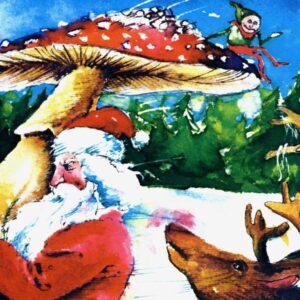
The truth of the matter is that the Santa suit depicts the Amanita muscaria (fly agaric) mushroom mentioned earlier. For one thing, his suit looks more like this mushroom than it does the suit of any other person, actual or fictional. If that isn’t enough, consider that Santa is the world’s largest employer of “little people.” It is well known that elves, gnomes, leprechauns and other diminutive types are often seen in the vicinity of these mushrooms, in the field and in children’s literature and interior design. And if that isn’t enough, what about the flying reindeer?

Well, anybody who knows anything at all about reindeer knows that there are two things in the world that reindeer crave: human urine and mushrooms, particularly the fly agaric mushrooms of the sort resembling Santa’s suit. It would seem that reindeer like to get off on amanitas as much as their Mongol owners do. No sane reindeer owner would consider whipping it out in front of one reindeer, much less ten, because the urine of the amanita user has the same potency as the mushroom.

Anyhow, this constellation of amanita clues could be laid to coincidence if it were not for the flying and the levitation, both symptoms of amanita eating in reindeers and humans.

It is also likely that Rudolph’s red nose comes from amanita consumption. And his ability to guide Santa’s sleigh through the densest fog in Christmas history is perhaps not from the actual illumination of his nose but from a sort of psychic radar. This same ability is perhaps what enables Santa to know when you are sleeping, to know when you’re awake, and to know when you’ve been bad or good.

And let’s not forget that you never see Santa without his cap.

As for living at the North Pole: Santa denies any connection with Hollow Earthers, Theosophists, the Nazi Party and UFOs. His only human contacts are a few neighboring Eskimo who trade in amanita and reindeer. Every once in a while they all get high and eat golden snow cones.

<p>The post High Times Greats: A Christmas Story – Which Real Meaning? first appeared on High Times.</p>


Source link

Even the Feds Say Teen Marijuana Use Is Declining

Even the Feds Say Teen Marijuana Use Is Declining

Even the Feds Say Teen Marijuana Use Is Declining

For years, critics of cannabis reform have leaned on the same warning: legal weed will lead to more teens using marijuana.

The data keeps telling a different story.

According to newly released, federally funded survey data compiled by researchers at the University of Michigan, teen marijuana use has continued its long-term decline and now sits at or near historic lows, even as more states regulate legal cannabis for adults.

What the latest numbers show

The findings come from the Monitoring the Future survey, one of the longest-running and most widely cited federal drug-use studies in the country, funded by the National Institutes of Health and conducted annually among 8th, 10th and 12th graders.

Between 2012 and 2025, the period that coincides with the rise of state-regulated adult-use cannabis markets, reported marijuana use among teens fell sharply across every age group.

  • Among 12th graders, lifetime cannabis use dropped 23%.
  • Among 10th graders, it fell 35%.
  • Among 8th graders, it declined 17%.

Past-year use fell even more steeply, while past-month use dropped between 25% and 45%, depending on grade level.

These aren’t marginal changes. They’re sustained, multi-year declines.

The federal government isn’t disputing this

In a press release accompanying the data, Nora D. Volkow, director of the National Institute on Drug Abuse, acknowledged the trend plainly.

“We are encouraged that adolescent drug use remains relatively low and that so many teens choose not to use drugs at all,” Volkow said, adding that continued monitoring remains essential.

Importantly, the data shows that from 2024 to 2025, cannabis use among teens did not increase in any grade level across lifetime, past-year or past-month measures. Among 8th graders, use actually declined further year over year.

Legalization didn’t reverse the trend

The timing matters.

Teen marijuana use has been falling steadily since 2012, the same year voters in Colorado and Washington approved the first adult-use cannabis laws. Since then, 24 states and Washington, D.C. have legalized marijuana for adults 21 and older.

If legalization were driving teen use upward, the signal would show up here.

It doesn’t.

Instead, today’s levels are far below the historic highs of the late 1970s, when more than half of U.S. high school seniors reported using cannabis in the previous year.

What about daily use?

Daily or near-daily cannabis use among teens remains rare.

Among 8th graders, daily use has hovered between 0.2% and 2% for decades. Among older students, daily use rose slightly during the pandemic years but has not returned to pre-2020 levels and remains statistically stable.

In fact, the percentage of 12th graders reporting daily cannabis use for a month or more over their lifetime declined significantly in 2025 compared to the year prior.

NORML’s takeaway

Commenting on the findings, NORML Deputy Director Paul Armentano was blunt.

“Sensational claims that adult-use legalization laws are linked with greater marijuana use by teens are simply not backed by government data,” Armentano said. “These findings ought to reassure lawmakers that cannabis access can be legally regulated in a manner that is safe, effective, and that does not inadvertently impact young people’s habits.”

That conclusion aligns with a growing body of peer-reviewed research from journals including JAMA Psychiatry, JAMA Pediatrics and The American Journal of Preventive Medicine, all of which have found no causal link between legalization and increased youth marijuana use.

The bigger picture

The Monitoring the Future survey also shows something broader at work: teens today are using fewer substances overall.

Rates of alcohol use, nicotine use and illicit drug use remain at or near historic lows, while abstention rates remain high. Researchers largely attribute the sharp drop that began in 2020 to pandemic-era changes in social behavior — but those lower levels have persisted.

In other words, legalization didn’t interrupt the decline. It happened alongside it.

What the numbers keep telling us

Teen marijuana use isn’t rising. It’s falling.

It has been for more than a decade, through multiple waves of legalization, retail expansion and cultural normalization. That doesn’t mean youth prevention efforts stop mattering. It means policy debates should start from reality, not fear.

The data is clear. The trend is steady. And the argument that legal cannabis inevitably leads to more teens using marijuana keeps losing its footing.

Photo: Shutterstock

<p>The post Even the Feds Say Teen Marijuana Use Is Declining first appeared on High Times.</p>

Source link

The Journey to the WIPO Treaty on Genetic Resources and Associated Traditional Knowledge

The Journey to the WIPO Treaty on Genetic Resources and Associated Traditional Knowledge

The Journey to the WIPO Treaty on Genetic Resources and Associated Traditional Knowledge

The Journey to the WIPO Treaty on Genetic Resources and Associated Traditional Knowledge Policy, Process and People Wend Wendland, Adjunct Professor, Faculty of Law, University of Cape Town, South Africa, former Director, WIPO Publication Date: 2025 ISBN: 978 1 03532 513 9 Extent: 288 pp This book recounts the colourful and eventful journey to the landmark WIPO Treaty on Intellectual […]

Source link

The U.S. Military Is Funding MDMA-Assisted Therapy Research for PTSD (For Real)

The U.S. Military Is Funding MDMA-Assisted Therapy Research for PTSD (For Real)

The U.S. Military Is Funding MDMA-Assisted Therapy Research for PTSD (For Real)

A Department of Defense (DoD)-funded clinical trial will study MDMA-assisted therapy paired with Massed Prolonged Exposure for PTSD in active-duty service members.

For decades, MDMA lived far outside the walls of official medicine. Let alone the U.S. military.

That wall just moved.

The U.S. Department of Defense is funding a $4.9 million clinical trial investigating MDMA-assisted therapy for post-traumatic stress disorder in active-duty service members, marking a notable shift in how far psychedelic research has traveled into the federal mainstream.

The study is led by researchers at Emory University and the STRONG STAR Consortium, and is examining the safety and potential benefits of MDMA-assisted therapy combined with Massed Prolonged Exposure, an evidence-based PTSD treatment commonly used in military settings.

A first for active-duty troops

While MDMA-assisted therapy has been studied for years in civilian PTSD populations, this trial is among the first to focus specifically on active-duty personnel within a Department of Defense-funded research framework.

That distinction matters.

Active-duty service members face unique barriers to mental health care, including stigma, career consequences and limited treatment options. A DoD-funded investigation signals growing institutional recognition that existing tools are not sufficient for everyone.

Filling a gap the grant didn’t cover

Notably, while the Department of Defense funded the research itself, the grant did not include funding to train therapists in MDMA-assisted therapy, a highly specialized and investigational approach that requires careful preparation.

That gap was filled by the Multidisciplinary Association for Psychedelic Studies (MAPS), which provided clinician training at no cost through philanthropic support.

MAPS’ role was limited but practical. Preparing therapists to safely participate in the study. The organization is not conducting the trial and does not maintain a formal relationship with the Department of Defense, according to its announcement.

“Training is foundational to the success and safety of psychedelic-assisted therapy research,” said Rick Doblin, founder and president of MAPS. “We saw an opportunity to help ensure that this study would begin with therapists better prepared to meet the needs of service members living with PTSD.”

What the training involved

The program included four days of live, online instruction, followed by additional asynchronous coursework. The curriculum drew from previous MAPS-sponsored trials and focused on safety, therapist readiness and core competencies for delivering MDMA-assisted therapy in a research setting.

The study itself is being led by Alan Peterson, Ph.D., at STRONG STAR and Barbara Rothbaum, Ph.D., at Emory University, both long-standing figures in trauma and PTSD research.

Why this matters beyond one study

MDMA remains an investigational substance under federal law, and this trial does not signal approval or widespread adoption. But the symbolism is difficult to ignore.

A compound once associated with prohibition-era panic and underground culture is now being studied, with Department of Defense funding, as a potential tool for addressing one of the military’s most persistent mental health challenges.

It reflects a broader shift across federal institutions, where trauma, mental health and treatment outcomes are increasingly driving research priorities more than stigma or ideology.

A cautious step, but a real one

This study will not rewrite military mental health care overnight. It will not answer every question about MDMA-assisted therapy, nor does it guarantee success.

But it does something important.

It acknowledges, at the highest levels of government, that new approaches deserve serious evaluation, especially when existing treatments fail too many of the people they are meant to help.

For an institution as conservative and risk-averse as the U.S. military, that alone marks a meaningful change.

Photo by Diego González on Unsplash

<p>The post The U.S. Military Is Funding MDMA-Assisted Therapy Research for PTSD (For Real) first appeared on High Times.</p>

Source link

After the Green Rush: The Sungrown Holdouts of Northern California

After the Green Rush: The Sungrown Holdouts of Northern California

After the Green Rush: The Sungrown Holdouts of Northern California

This article originally appeared in High Times Magazine’s 50th Anniversary Print Issue. Order yours here and get it delivered to your door.

The roads are quieter now in the Emerald Triangle. On stretches of State Route 299, the sight of logging trucks has returned. Humboldt County’s timber economy once defined the region—until environmental restrictions, overharvesting, and shifts in global trade forced its decline in the 1990s. Cannabis filled the gap. What followed was another cycle of boom, regulation, and retreat—weed and wood: two strands shaping the DNA of California’s North Coast.

Fishing faded. Mills closed. Tourism never quite arrived. The economy leaned heavily on cannabis—first underground, then medical, now licensed. Cal Poly Humboldt, once a forestry school, has shifted with the times, offering a cannabis studies minor, partnering with regenerative farms, and funding applied research. The pivot mirrored the plant’s deep roots here.

The change didn’t come all at once. Proposition 215 ushered in a medical gray zone in 1996, but the true “Green Rush” unfolded a decade later. From roughly 2007 until just before Prop 64 passed in 2016, growers, speculators, and capital poured in. Hillsides were cleared for hoop houses. Gas stations and garden centers overflowed. In Willow Creek, there were even traffic jams.

Amy and Jacques Neukom, who run Neukom Family Farm on the banks of the Trinity River, remember how dizzying it was. Their diversified organic farm has been rooted in Willow Creek for over three decades, featuring a CSA model that incorporates fruit, vegetables, livestock, and cannabis. “There were people everywhere,” Jacques says. “Gas stations, grocery stores, garden centers—everything was packed. We had two giant garden centers in town.”

Solstice potlucks and neighborly bartering gave way to bulldozers carving terraces into every slope. Dylan Mattole, who has farmed in Southern Humboldt for decades and now runs Mattole Valley Sungrown, recalls the churn. “It was crazy how fast it happened,” he says. “People cleared sites, put up plastic, failed, then rented to the next crew. It was a pyramid of collapse that kept recycling.”

By 2017 or 2018, the rush had come to an end. Permits grew more expensive, regulations multiplied, and wholesale prices collapsed. Most of the newcomers left. What remained were the farmers who had already built their lives here and had no intention of walking away.

“That’s when the paperwork started outweighing the plant,” Mattole says. “We used to walk into town and know who was trimming for whom. Now everyone’s just trying to make it through.”

For Mattole, survival has meant scaling back and leaning on neighbors. “All those people who showed up with money are gone,” he says. “The ones still here are scrappers. They’ll do whatever it takes to stay.” He compares the moment to the earliest back-to-the-land farmers. “Nobody was getting rich. They were just living a life. Now it feels like we’re back to that.”

The Neukoms came to the same conclusion. They weren’t just cannabis farmers—they were Willow Creek’s peach growers, melon growers, CSA stalwarts. Their flower was constantly rotated with livestock and vegetables, raised in native soil. “People come for peaches and melons,” Amy says. “And they ask about the flower.”

Also read: Trees Grow in Brooklyn: A Rooftop Cannabis Garden Grown in Living Soil

When Prop 64 passed, they weren’t sure how their neighbors would react. “We had a good reputation as food farmers,” Jacques says. “But we didn’t know if people would be okay with the cannabis.” They decided to be direct. “I told my neighbor, listen, it’s legal now. Who do you want growing it? Wouldn’t you rather it be me?”

It worked. “By the time our daughter graduated, the same parents who wouldn’t socialize with us were telling their kids, ‘Only smoke the Neukoms’ stuff,’” Amy says. “They knew it was clean.” At the farmer’s market, customers now ask about cannabis the way they ask about tomatoes or grapes. “There’s no stigma in that moment,” she adds.

The farm itself carries the lesson. For four years, the Neukoms tried a no-till system, planting rosemary, oregano, chamomile, and alyssum among the cannabis beds. The habitat attracted pollinators, but it also tipped the soil toward fungi, causing the cannabis to shrink each year, even as the herbs thrived. “We realized weed prefers disturbed soil,” Jacques says. “It’s like ditch weed—it wants bacteria, not fungi.” They tilled again, turned under the herbs, layered compost, and the crop recovered.

They bring in live beneficial insects every two weeks from an insectary in Redding—ladybugs, predatory wasps, lacewings—to avoid spraying. Subsurface drip puts water directly to the roots once a week, conserving groundwater and stimulating microbial life. “The plants love it,” Jacques says. “Four hours a week, that’s all.”

It shows at the farmstand. “We didn’t have peaches one week, just melons and tomatoes,” Amy recalls. “The line still wrapped around the market. People come for the food, and now they ask about the cannabis, too. That never would have happened ten years ago.”

Nik Erickson, who runs Full Moon Farms in Willow Creek and serves on the local water board, also witnessed the stigma fade. He remembers the Green Rush chaos—the traffic, the opportunists, the burnout—and the crash that followed. “There used to be tension between growers and townspeople,” he says. “People thought we were ruining the town. Now it’s different. We’re running the museum. We’re on the water board. We show up.”

For Erickson, survival isn’t about volume or price per pound—it’s about trust.

“I used to think we had to build a brand. Now I think we just need enough trust to last.”

Cannabis, once whispered about, has become part of civic life. “That normalization is more valuable than any marketing strategy.”

However, legalization also burdened farmers with paperwork. “We know how to farm,” Jacques says. “Suddenly we’re expected to be compliance officers and marketers.” Erickson puts it plainly: “We used to focus on the plants. Now it’s spreadsheets and politics. That’s the job.”

Across the county line in Covelo, Mendocino, Joey Gothelf of WildLand Cannabis describes the grind from his smaller perch. “If I’m doing a good job growing the plants, I’m doing a bad job somewhere else,” he says. “And if I’m doing a really good job at all the other things, the plants have aphids.”

Also read: Chaos in a Jar: Field-Testing Flower for Hash

Gothelf stresses he never wanted to build a brand. “It’s screaming into the void,” he says. “We didn’t ask for this. We were just farming, and suddenly the outside world decided everything was going to change.”

He leans on wholesale and white-label deals to survive but dreams of something closer to farming’s roots: a cannabis CSA. “If people bought in the way they do for vegetables, the stress would be off,” he says. “The weed would be better. Instead we grow more out of desperation, and it all has to be the best weed we’ve ever grown.”

Language evolved alongside practice. For years, “outdoor” was shorthand for bulk, cheap flower. “It sounds scrappy,” says Joseph Haggard, who farms with his family at Emerald Spirit Botanicals in Mendocino and is a founding member of Farm Cut, a cooperative brand that pools sun-grown flower from small farms under a shared label. “‘Sun-grown’ means something different. It says this was grown with attention to land and light.”

Emerald Spirit specializes in terpene-forward, balanced cultivars like Pink Boost Goddess and Royal Blueberry, bred for experience rather than THC percentages. “We’re talking about clarity, calm, uplift,” Haggard says. “Not just numbers on a jar.”

That approach resonates. Emerald Spirit has tripled its sales in three years, one of the few brand-level success stories in the current market. “We’re finding more people who say cannabis feels too strong,” Haggard says. “When you offer something functional, flavorful, smooth, they give it another chance.” Customers have told him that Pink Boost Goddess is the only flower they’ve smoked that hasn’t made them anxious. One called it “the strain that made my brain come back online instead of shutting down.”

Industry data backs him up. Headset reported that terpene-labeled flower is one of the fastest-growing segments in U.S. dispensaries, while BDSA found that lower-THC, effect-driven strains show higher repeat-purchase rates. It’s a small but telling counterpoint to the dominance of high-THC indoor cannabis.

Science supports what farmers see. Sun-grown cannabis tends to express broader terpene diversity and more minor cannabinoids than indoor cannabis. At the California State Fair, sun-grown cultivars have dominated terpene categories.

Farmers reach for wine as a comparison. “Nobody questions terroir in wine,” Jacques says. “Why should cannabis be different?” The Triangle’s diurnal swings, coastal influence, and decades of organic practices shape each harvest. “Indoor may look shinier,” Haggard says, “but sun-grown tastes like place.”

California has even created a cannabis appellations program, modeled loosely on wine AVAs, though rollout has been slow. Humboldt, Mendocino, and Trinity farmers hope terroir designations will one day give sungrown the same cultural and economic power that Napa achieved with grapes.

But buyers still chase high THC and glossy nug shots. “I’ve had people reject a batch without opening it,” Gothelf says. “It tests at 19 percent, the terps are loud. Doesn’t matter.” Erickson calls it a problem of education. “Most buyers never open the bag,” he says. “They read a number. But cannabis isn’t just THC. Like wine, your best bottle isn’t about alcohol percentage.”

That mismatch—between what small farms produce and what buyers accept—remains the sticking point. “It’s always ‘the market, bro,’” Gothelf says. “Like it’s some giant living in the hillside that comes down to visit the townspeople. Really, it’s just an excuse to pay us $250 a pound for weed they admit is incredible.” Wholesale prices had collapsed so far that $500 a pound now counted as “great.” For small farms, it became survival math.

Still, survival has depended on experimenting with new structures. Some farmers leaned on cooperatives, pooling their flower under shared labels. Others turned to certification schemes or lifestyle campaigns that could connect cultivation to values beyond THC. A handful of retailers, too, have carved out space for sungrown when most chains would not.

In Mendocino, Farm Cut brings together independent farms under one craft label, giving them the strength of numbers while still preserving their individual identities. Sun+Earth, launched in 2019, offers cannabis the equivalent of an organic seal: certifying flower grown outdoors in living soil, with regenerative practices and fair labor standards. California also created OCal, a parallel to USDA Organic, but farmers note that without meaningful retail support, it remains a more expensive regulatory stamp than a market driver.

In Humboldt, the model most often cited is Humboldt Family Farms. A coalition of legacy cultivators—including the Neukoms in Willow Creek—the group jars, markets, and distributes flower while telling the provenance story of Humboldt sun-grown. “They get scale,” Erickson says, who also works with the group. “They understand what 5,000 square feet can and can’t do.” Farmers recall earlier attempts, most notably Flow Kana, which tried to unite small farms under a single distribution umbrella. It collapsed under debt, a cautionary tale of how investor promises can outpace farmer realities.

Humboldt Family Farms has already produced measurable results. According to founder and chair Scott Vasterling, who also serves on California’s Cannabis Advisory Committee to the DCC, sungrown flower and prerolls rose from 4 percent of sales in June to 11 percent in August across all Embarc stores, following a Surfer Magazine campaign celebrating the sungrown lifestyle. For farmers long boxed out, it is proof that education, storytelling, and collective branding can move the needle.

Retail partners are part of that momentum. Embarc has been one of the few larger chains to consistently support sungrown, dedicating shelf space and providing consumer education. Solful, a boutique chain in Sebastopol, Santa Rosa, and San Francisco, has built its entire reputation on championing small farms and sungrown flower. In Southern California, Catalyst—better known for its tax activism—now carries a dedicated sungrown brand on its shelves, a symbolic but important signal in the state’s most indoor-driven market. Independents like SPARC in San Francisco and Farmacy in Santa Barbara have carved out similar space. Farmers point to these shops as rare partners willing to educate customers, rather than chasing THC numbers.

Other legacy outfits remain visible as well. Sol Spirit Farm in Trinity has paired regenerative cultivation with on-farm eco-tourism. Emerald Queen in Humboldt has built a reputation for terpene-rich flower, while Ridgeline Farms continues to bring home Emerald Cup trophies with its sungrown cultivars. These farms, such as the Neukoms or Mattole Valley Sungrown, demonstrate that survival is possible when cultivation is tied to place and identity.

None of these models—Farm Cut, Sun+Earth, Humboldt Family Farms, CSA experiments, sympathetic retailers—represents a silver bullet. But they are replicable. Each one shows that with storytelling, provenance, and cooperation, sungrown can find its footing.

Meanwhile, the national context continues to squeeze. Federal prohibition blocks interstate commerce, although both California and Oregon have passed “interstate compact” laws that state legislatures could activate if federal law were to change. Banking reform has stalled for years, keeping farmers locked out of basic financial services. Retail consolidation has concentrated power in chains that dictate shelf space and payment terms, thereby influencing the market.

Even so, California sungrown finds its way east. Much of the flower fueling New York’s gray market, historically, was outdoor, from the Emerald Triangle. Consumers already smoked it, even if they don’t know it. The challenge is less about quality than perception.

The attrition has been brutal. According to the Humboldt County Growers Alliance, more than 75 percent of small farms in the region closed or were absorbed. In 2021, California counted over 7,000 licensed farms. By mid-2024, fewer than 3,000 remained—those who survived scaled back, diversified, and held on to what mattered.

“This used to be a whisper network,” Amy says. “Now we’re visible. That brings new risks, but also new ways to connect.” Erickson agrees. “The Green Rush was a blur. What we’ve got now is more intentional. Smaller, slower, harder—but more human.”

The rush is over, and the speculators are gone. What remains are families who rotate cannabis between rows of melons, who fix irrigation lines on weekends, who serve on water boards, who sell peaches and joints at the same stand. They have moved past the chaos of the boom years into something steadier, if leaner.

The lumber trucks on 299 rumble past fields, some of which have changed hands or gone quiet. Others are still planted, still walked, still harvested. Still producing up on the hill. The canopy is smaller. The roots grow deeper.

Outdoor survived the Green Rush; sungrown will decide what comes next.

This article originally appeared in High Times Magazine’s 50th Anniversary Print Issue. Order yours here and get it delivered to your door.

Photos by Ryan Johnson Bitar

<p>The post After the Green Rush: The Sungrown Holdouts of Northern California first appeared on High Times.</p>

Source link

Cannabis at Music Events: Rules and Realities

Cannabis at Music Events: Rules and Realities

Cannabis at Music Events: Rules and Realities

The integration of cannabis into music events is a growing trend, reflecting evolving societal attitudes and legal landscapes. These events aim to provide a unique experience where music and cannabis consumption coexist within defined boundaries. Understanding the nuances of this environment is crucial for both organizers and attendees. For those who engage with cannabis, the accessibility of products is a key consideration. For instance, the term “cannabis online” highlights the digital avenues through which consumers can acquire products, which often influences their choices and expectations when attending events where cannabis is permitted. This shift towards regulated, cannabis-friendly spaces at music festivals and concerts presents both opportunities and challenges for event management.


The Concept of Cannabis-Friendly Events

Cannabis-friendly music events are designed to allow attendees to consume cannabis products legally and safely within designated areas. These events range from small, private gatherings to large-scale festivals, all operating under specific rules that align with local cannabis regulations. The goal is to create an environment where cannabis use is normalized and managed, similar to alcohol consumption at traditional events.

This concept differs significantly from past practices where cannabis use at public events was often clandestine and unregulated. The move towards official cannabis zones reflects a broader acceptance and a desire to integrate cannabis into mainstream entertainment responsibly.


Regulatory Frameworks and Compliance

The primary challenge for cannabis-friendly music events is navigating complex regulatory frameworks. Event organizers must comply with local, state, and sometimes federal laws regarding cannabis cultivation, sale, and consumption. This often involves obtaining specific licenses and permits that dictate where, when, and how cannabis can be consumed on-site.

Regulations typically cover aspects such as:

  • Designated Consumption Areas: Specific zones where cannabis use is permitted, often separated from general public areas.
  • Sales and Distribution: Rules for on-site vendors, including licensing, product types, and purchase limits.
  • Age Restrictions: Strict enforcement of minimum age requirements for entry and cannabis consumption.
  • Impairment Protocols: Measures to identify and manage intoxicated individuals, similar to alcohol policies.
  • Product Testing: Requirements for all cannabis products sold on-site to be tested for potency and contaminants.

Compliance with these regulations is paramount to ensure the legality and safety of the event.


Operational Challenges for Event Organizers

Organizing cannabis-friendly music events presents unique operational challenges. Event planners must consider logistics related to cannabis sales, security, and public health. This includes setting up secure vendor booths, managing inventory, and ensuring that all transactions comply with legal requirements.

Security personnel need to be trained to enforce cannabis-related rules, identify unauthorized consumption, and manage any issues related to overconsumption. Public health considerations involve providing access to water, first aid, and educational resources about responsible cannabis use. The integration of cannabis also requires careful planning to avoid conflicts with existing alcohol policies and to manage potential cross-contamination.


Consumer Experience and Expectations

For attendees, cannabis-friendly music events offer a novel experience. Consumers expect a safe and enjoyable environment where they can openly consume cannabis without fear of legal repercussions. The availability of diverse cannabis products, from flower to edibles and vapes, within designated areas enhances the overall festival experience for many.

However, consumers also expect clear communication regarding rules and regulations. Understanding what products are allowed, where they can be consumed, and what the purchase limits are is crucial for a positive experience. The quality of on-site vendors and the overall atmosphere of the cannabis consumption zones significantly contribute to attendee satisfaction.


Economic Impact and Market Growth

The emergence of cannabis-friendly music events has a notable economic impact. These events can attract a new demographic of attendees, boosting ticket sales and generating revenue for local businesses. On-site cannabis sales contribute to the overall event economy, creating jobs and tax revenue.

The trend also signals a maturing cannabis market, where businesses are exploring innovative ways to integrate cannabis into mainstream entertainment and lifestyle events. This market growth is driven by increasing consumer demand and evolving legal frameworks that support such initiatives.

  • Key aspects of cannabis-friendly music events:
    • Designated Consumption Zones: Specific areas for legal cannabis use.
    • Licensed On-Site Vendors: Regulated sales of various cannabis products.
    • Strict Age Verification: Ensuring compliance with minimum age requirements.
    • Security and Safety Protocols: Managing consumption and preventing unauthorized use.
    • Public Health Measures: Access to water, first aid, and responsible use education.
    • Diverse Product Offerings: Availability of flower, edibles, vapes, and other forms.
    • Clear Communication of Rules: Informing attendees about permitted activities.
    • Economic Benefits: Increased attendance, sales, and tax revenue.
    • Brand Integration Opportunities: Cannabis brands sponsoring or participating in events.
    • Evolving Social Acceptance: Reflecting changing attitudes towards cannabis use.

Future Outlook and Evolution

The future of cannabis-friendly music events is likely to see continued expansion and refinement. We expect an increase in the number of such events as more jurisdictions legalize cannabis. Organizers will continue to innovate in how they integrate cannabis, focusing on enhancing the consumer experience while maintaining strict regulatory compliance.

We can anticipate more sophisticated consumption zones, a wider variety of on-site products, and improved educational resources for attendees. The industry will also likely see greater collaboration between event organizers, cannabis businesses, and regulatory bodies to establish best practices and ensure long-term sustainability.


Final thoughts

Cannabis-friendly music events represent a significant shift in how cannabis is consumed and perceived in public settings. The complicated interplay of regulations, operational challenges, and consumer expectations is key to their success. As these events continue to evolve, they will play an important role in shaping the future of both the cannabis industry and the entertainment sector.

Source link