Virginia Lawmakers Weigh Putting Marijuana Sales Legalization Into Budget Bill Next Month To Force Governor’s Hand Following Veto
Virginia’s governor may have vetoed bills to legalize recreational marijuana sales last week, but that doesn’t mean it can’t still happen this year. Top lawmakers are openly discussing the possibility of including provisions to enact the cannabis reform in still-outstanding budget legislation that they are due to pass by July 1.
Senate Majority Leader Scott Surovell (D), for example, said the issue is not “dead” for 2026 yet.
“It is possible for us, however, to put policy like that into the budget and adopt it in the budget and then put that on the governor’s desk,” Surovell, who also chairs the Courts of Justice Committee, told WJLA-TV on Tuesday. “So I wouldn’t say that the cannabis retail market is totally dead yet for this year.”
The governor’s office did not respond to the news outlet’s request for comment about whether she would sign or veto a budget that includes provisions to legalize adult-use marijuana sales despite her recent veto.
Meanwhile, Senate President Pro Tempore Louise Lucas (D) said that the governor’s vetoes of legislation on marijuana sales and other issues means that the state is “further off” in generating revenue that those reforms would have provided toward the
He Fell 40 Feet, Bounced 20 More And Had To Learn To Walk Again. Cannabis Helped Him Sleep Through The Pain.
A paragliding crash in Colombia shattered Joey Coleman’s L1 vertebra and put paralysis on the table. The road back included a Colombian hospital, opioid withdrawals in a hotel room, a Grand Junction lottery, and the plant that finally let him sleep through the pain. He now runs KAI Dispensary in Colorado.
The vultures showed up almost every afternoon. Joey Coleman would catch a thermal, climb a column of warm air, and find one of them already riding next to him, wing tip to wing tip, gliding silently over the green hills outside Bucaramanga, Colombia. It was his 21st paragliding flight. He was still a novice. He was also, by his own account, in love with the sport.
“Flying was magic,” Coleman said. “People tend to compare paragliding to other air sports like skydiving, but in reality, much of paragliding isn’t an adrenaline rush; it’s peace and serenity.”
That afternoon, after nearly an hour in the air with a vulture off his wing, Coleman began his descent. He realized he was overshooting the landing zone. At the end of the strip, there were power lines. He made the call to circle back to the start of the strip. He was losing altitude faster than he thought. The turn became a pendulum. The pendulum became a fall.
He hit the ground from 40 feet, legs extended in front of him in a sitting position. Then he bounced. About 20 feet, he says, until he came to rest under a tangle of lines and the colorful fabric of his wing.
“I learned something I never hoped to,” he said. “When you hit the ground hard enough, turns out you bounce.”
His instructor’s voice came in over the radio, asking if the landing was safe. Coleman knew right away it was not. His upper and lower body felt disconnected, like everything had taken a turn somewhere and nothing lined up. Then he tried to move his legs.
“I couldn’t move my legs. I couldn’t move my legs,” he remembered repeating in his head. His wife, Kelsey, who had been paragliding with him on the trip, came running with the rest of the crew.
Excruciating Doesn’t Do It Justice
Coleman was rushed to the Hospital Internacional de Colombia, a then-newly built facility outside Bucaramanga. He could move his toes. Not his legs. The first crisis was simply getting him from the gurney into the MRI machine.
“It was only a two-foot move in which they picked me up and laid me back down, but it felt like someone had just driven a red-hot knife directly into my spine and begun twisting,” Coleman said. “Excruciating doesn’t do it justice.”
The MRI told the story. His L1 vertebra had not broken or compressed. It had burst. The nerves running down to his legs had taken severe trauma. The surgeons told him his spinal cord was unstable. Paralysis from the waist down was on the table.
“Hearing those words is what finally broke me,” he said.
An emergency spinal fusion was scheduled. Coleman remembers being wheeled down corridors, ceiling lights flying past, his wife squeezing his hand. He remembers crying. He remembers being asked, in the operating room, to count to ten. He remembers reaching three.
He still calls himself lucky. If he had needed to be air evacuated, family contacts at top U.S. hospitals later told him, the odds of his ever walking again would have been, in his words, abysmal.
Despite everything I have been through, I AM SO LUCKY.
Joey Coleman
‘You Can Fucking Do This’
Coleman woke up on morphine, already trying to plan future trips with Kelsey before he understood what had happened. He spent the next month in the hospital.
The milestones were small in a way that humbled him. A man who had climbed Mount Elbrus, the highest peak in Russia and one of the Seven Summits, now had the goal of sitting up without help. The first time the nurses sat him up, he nearly passed out. He was drenched in sweat and ready to quit in under a minute. He didn’t.
From sitting came leg raises while still on his back. Toe points. Every movement was agonizing. But the medical logic was relentless: the longer the body stays still after a spinal injury, the worse the long-term outcome. He had to move.
He went from bed to wheelchair to walker. The day he stood up came with a script he repeated in his head.
“Ok, you can do this,” Coleman remembered telling himself. “You can fucking do this!”
He gripped the walker. He took one step. Then another.
Somewhere along the way, the word recovery changed meanings for him. Full Recovery had been the goal. Back to who he was before the crash. He came to understand that that version of him was gone, and that what was left to him was building the best version possible going forward.
“At the time,” he said, “I would break down in tears just thinking of who this new version of myself may be.”
The Ninja Turtle Suit
Coleman was transferred from the hospital to a hotel, where Kelsey took on the role of full-time nurse. She helped him get out of bed. She helped him get to the bathroom. She celebrated milestones that, to anyone outside the room, would not have looked like milestones. She cried with him when he needed it.
“It is not an exaggeration when I say I owe my life to Kelsey,” Coleman said.
There was a miscommunication on his way out of the hospital, and he was discharged without any pain medication. He had been on a heavy morphine drip for weeks. He now found himself coming off it cold turkey, with a fresh spinal fusion still in his back and the agony of the injury still raw.
He shook in bed with cold sweats. His emotional regulation came apart. He broke down without warning. He was terrified of never walking normally again. He was also terrified of becoming an anchor on his wife.
“It would have been enough to wrestle with regardless,” he said. “But dealing with it all in the grips of withdrawals were some of the darkest times in my entire recovery.”
He spent months in a hard plastic shell that locked his spine in place. He nicknamed it his “ninja turtle suit.” Inside it, step by step, he covered more ground. From bed to bathroom. From bathroom to across the hotel room. From the room to the lobby.
What he could not seem to do was sleep.
‘I Could SLEEP’
The pain medication doctors prescribed numbed the pain but left him worse off in other ways. Digestion problems. No appetite. Foggy days. He needed rest more than anything, and he could not find it. He would shift positions trying to escape the pain, the night would shred itself into broken hours, and he would wake up exhausted.
Coleman had used cannabis recreationally before the crash but had never thought of it in any kind of therapeutic frame. He didn’t know much about minor cannabinoids. He had not tried edibles. Flower was what he knew, and that’s where he started experimenting.
The difference, he says, was sleep.
I could SLEEP. And I didn’t have the side effects of the opioids.
Joey Coleman
He does not describe it as a cure. He still had plenty of pain. Nothing about his body got fixed overnight. What changed, he says, was being able to rest. Once that was possible, the rest of the recovery had room to happen.
From flower, he started reading deeper into the plant, into minor cannabinoids and how different compounds work together. Back home in Colorado, that interest accelerated.
The Old Joey and the New One
Before the crash, Coleman’s life had been built almost entirely on motion. He had coached tennis professionally in Australia, New Zealand, Singapore and California. He had run a charter sailing business in Nicaragua, after he and Kelsey lived for a year on a 50-foot sailboat they had renovated themselves. He had climbed Mount Elbrus while fundraising for an orphanage in Mongolia, where he later spent a summer taking the kids camping and living in a ger.
The accident did not just damage his spine. It pulled the floor out from under his sense of who he was.
“My life had been defined by constant movement, by chasing the horizon,” he said. “And now, suddenly, it felt like that might all be a dream of the past. That the life I loved may be gone, but what scared me more is that the person I believed I was may be gone as well.”
He still mountain bikes. He still snowboards. By any external measure, he has come back further than the surgeons in Bucaramanga thought possible. The part he describes as ongoing is internal.
“It took me a long time to stop constantly comparing the old me to what I was capable of now,” Coleman said. “That comes with a lot of time and acceptance, and it’s something I’m still always working on.”
The 4 Percent Chance
When Coleman and Kelsey came back to the United States, they came home to Western Colorado, where Joey grew up in a family of nine kids. He wanted to be near family. He wanted to keep recovering. He also wanted to get into the cannabis space.
His hometown of Grand Junction did not yet allow recreational dispensaries, so he started in the legal hemp and CBD market. He learned about the plant from the ground up: cultivation, extraction, product development, cannabinoid profiles. The boom in that market eventually went bust in his region, but it left him standing where he needed to be when Grand Junction finally moved on adult-use cannabis.
In 2023, the city held a lottery for 10 recreational cannabis licenses. Coleman had spent more than a year showing up at city council meetings to help shape the process, with no guarantee that licenses would be granted at all, much less that one of them would land in his name.
The lottery itself was theater, Coleman says. Thirty-one ping pong balls in a gold cage. A city employee spun the cage between draws. Each ball had a number that corresponded to an applicant.
Seven applicants got called. Then eight. Then nine. Coleman’s number was not among them. In his head, he put the odds at 4 percent.
“One ball left,” he said. “A 4% chance of winning. Well, that’s that.”
The cage turned. The tenth ball dropped.
It was his.
What KAI Became
Coleman opened KAI Dispensary in Grand Junction. The building was designed by his brother, an architect. The space includes a gallery that rotates a new local artist every month.
But Coleman is quick to step away from the architecture.
“We could have the coolest building in the world,” he said, “but if people come in and have a bad experience, they’re not coming back.”
He is open about what the place owes to the years before it. The crash. The hospital. The hotel. The walker. The flower that helped him sleep. The lottery. All of it sits inside the building somewhere. The hospitality reflex picked up running boats in Nicaragua. The patience learned in a wheelchair. The bud tender training built around how he wished he had been treated, back when he was the guy in the ninja turtle suit trying to figure out how to sleep.
KAI, he says, is what those years became.
Coleman’s account reflects his personal experience with cannabis as part of his recovery and is not medical advice. Individual results vary. Anyone considering cannabis for similar purposes should consult a qualified physician.
Cannabis Pricing Trends 2026: State-by-State Dispensary Price Data
Cannabis Pricing Trends in 2026: State-by-State Breakdown for Market Entry Planning
Cannabis prices in the United States have never been lower, and that fact alone is reshaping how B2B companies think about market entry, expansion timing, and sales strategy. For a detailed look at how data drives those decisions, see our cannabis business intelligence guide.
7 Risks of Relying on Assumptions Instead of Evidence
Assumptions are mental shortcuts. They help us move quickly, reduce uncertainty, and make decisions without waiting for perfect information. In fast-moving environments, that can feel like a superpower. But assumptions have a hidden cost: they quietly replace what’s true with what’s plausible. And “plausible” is often just a story your brain finds comfortable—shaped by past experiences, […]
There are tons of places to buy CBD online. With the cannabinoid enjoying federal legality through the Farm Bill, it could barely be easier to find CBD in basically any form. It’s so widely available, in fact, that the main problem is choosing somewhere reliable and high quality from the multitude of options out there.
The best online CBD stores have fast delivery, good prices and a wide range of different CBD products available, and there are plenty of options out there that tick all of these boxes. While it’s hard to produce an exhaustive list, here are our picks for the best places to pick up CBD online, based on personal experience and user reviews.
8 Best CBD Stores
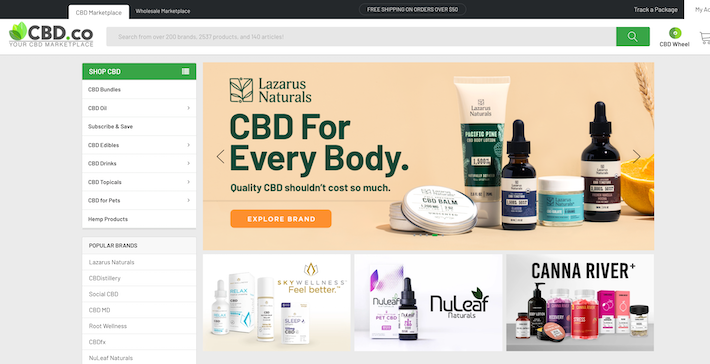
1 – CBD.co
CBD.co is one of the best online CBD stores largely thanks to their massive selection of products and generally stellar reputation. The store separates their main offerings into six types: oils, edibles, drinks, topicals, vaping and for pets, with tons of options in each group. If you’re not sure where to start, they also offer bestseller lists, recommendations and bundles tailored to specific purposes for using CBD (e.g. muscle and joint pains or foot care) or just for specific brands.
The store also carries products from some of the biggest brands in the industry, including CBDfx, Canna River, Koi, Lazarus Naturals, CBDistillery and Charlotte’s Web. They offer free shipping on orders over $60 in 48 states (not Idaho, Kansas, Nevada and South Dakota), and can ship internationally in some cases.
Pros
Excellent selection of products
Wide range of cannabinoids including CBD, CBN, CBG, CBC, Delta-8 THC, Delta-9 THC, Delta-10 THC, HHC, and THC-O
Most major brands available
Great prices all-round
Lab reports available on product pages
Free shipping on orders over $60
Plenty of products in each category
Cons
International shipping requires contacting customer service
2 – Super Chill Store
Super Chill Store is an online CBD superstore, offering a huge selection of both CBD and THC-containing hemp products from some of the biggest brands in the industry. They’re based out of New York, and offer free shipping on all orders over $75 to 48 states (not including Idaho, Kansas, Nevada and South Dakota).
You can pick up pretty much any type of hemp product from the store, including CBD oils, edibles, vapes, topicals and flower. They also have delta-8, delta-9, delta-10 and HHC products if you’re looking for something a little stronger.
The store includes products from big-name brands such as CBDfx, cbdMD, Charlotte’s Web, JustCBD and their own Super Chill line. They’re one of the best stores out there if you’re looking for vaping products or gummies.
Pros
Excellent selection of vape products
Most types of CBD products available
Delta-8, delta-9 and delta-10 THC options
Includes pet products
Browse by cannabinoid, brand and type of product
Good prices overall
Free shipping on orders over $75
Lab results on each product page
Cons
Some brands’ offerings are sold out
Some product types don’t have many options
3 – CBD Market
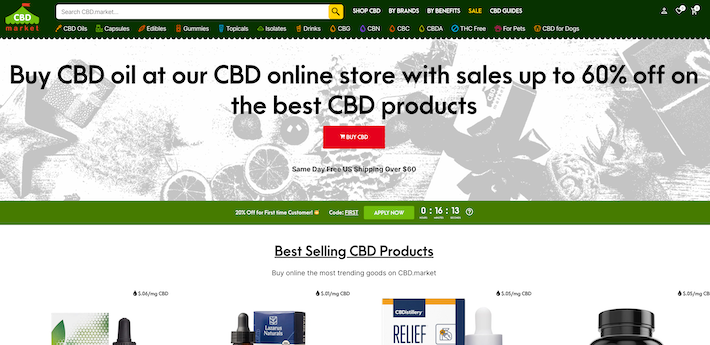
CBD Market is a San Diego based online CBD store, with a huge range of CBD products on offer and free delivery on all orders above $60. The store lets you browse by type of product, including oils, capsules, edibles, gummies, topicals, isolates and drinks, as well as having specific sections for alternative cannabinoids such as CBG, CBN, CBC and CBDA.
If you want something totally THC-free, there is also a section for that. The products cover the vast majority of popular brands as well, with huge names like CBDistillery, Charlotte’s Web, cbdMD and CBDfx among the options available. They also give everything a price per mg of CBD, which is an invaluable little extra for people looking for the best deal.
Pros
Huge selection of products
Lab certificates for each product
Same day free US shipping for orders over $60
Alternative cannabinoid products available
Browse by type of CBD, brand or intended use
Excellent prices all-round
Cons
Website can be a little buggy
Test results not linked to from product pages
4 – Delta Extrax Marketplace
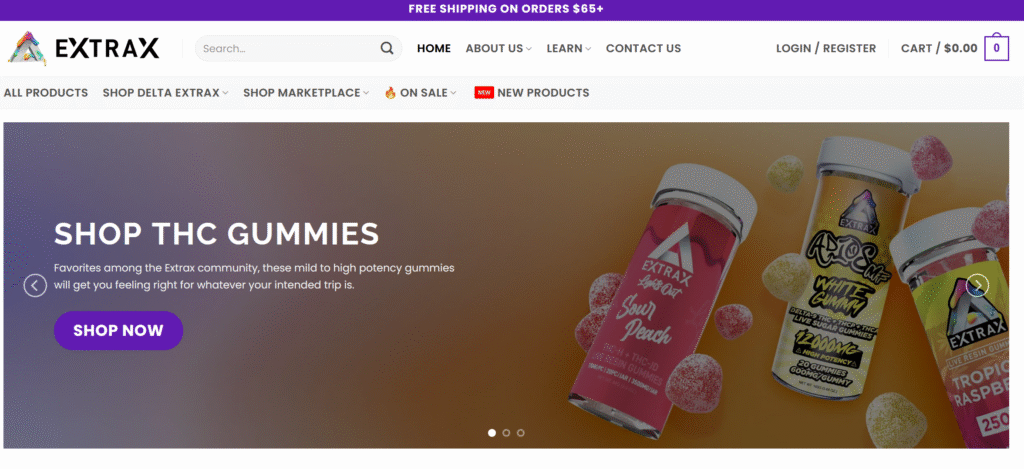
Delta Extrax may be a brand in its own right, but they also have a solid CBD marketplace on their website for products from other companies. They ship to most states (where it is legally possible), offering free shipping on orders above $65 and flat rate $5.99 shipping on all other orders.
The brand selection isn’t the biggest – including cbdMD, Xite, Code Red, Pure Ohms, Green Roads, MitWellness and Flowerpot – but they’re great when it comes to vapes and gummies. They also offer some beverages and flower, but with much fewer options.
Third-party lab results are available directly on the site, which are easy to locate based on the type of product. The marketplace and Delta Extrax own products are separated, so you can easily look for a specific brand, or search by product category (e.g. disposable vapes, cartridges, flower or gummies).
Pros
Free shipping on orders over $65, flat rate otherwise
Excellent for vapes and gummies
Some well-known brands covered
Extensive range of own-brand products too
Lab tests available on site
Browse by brand or type of product
Great prices with regular sales
Cons
Not many brands covered
Some product types are less common
Can’t easily search by cannabinoid
5 – CBD Mall
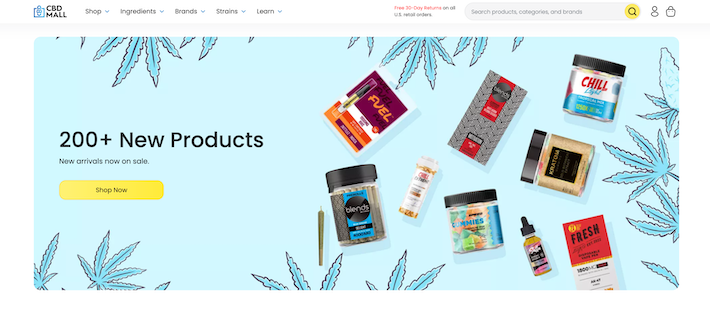
CBD Mall is an online CBD store that offers a variety of cannabis products with a number of different strains, potencies, flavors, shapes and sizes. With all of the CBD products available today, finding high-quality ones can be a real hit or miss depending on where you buy. Many are discovering there are a lot of snake oil sellers out there in the market. Luckily CBD Mall is in the business of providing cannabis consumers what they love and more importantly, what they need.
In our vetting process, we found this company to uphold a high standard of lab testing and provide a range of beneficial cannabinoids (D9, D8, D10, etc.), made in a number of forms, including gummies, vapes, capsules, pre-rolls, topicals – they even have a little something for your furry pet friends.
While some of the featured brands may not be well known, this shouldn’t turn you away, because there’s a reason CBD Mall’s customers keep coming back again and again. If there’s a certain product, ingredient, strain or lab report you’re looking for, you can simply find all of the information you need by searching the navigation bar or footer menu of the website.
Pros
Includes sex performance and pet-friendly cannabis items
Offers full product info
Plethora of strains available
Features new and upcoming brands
Frequent sales and discounts
Offers lab results and FAQs on every product page
Cons
Psychoactive product selection is limited
6 – Discover CBD
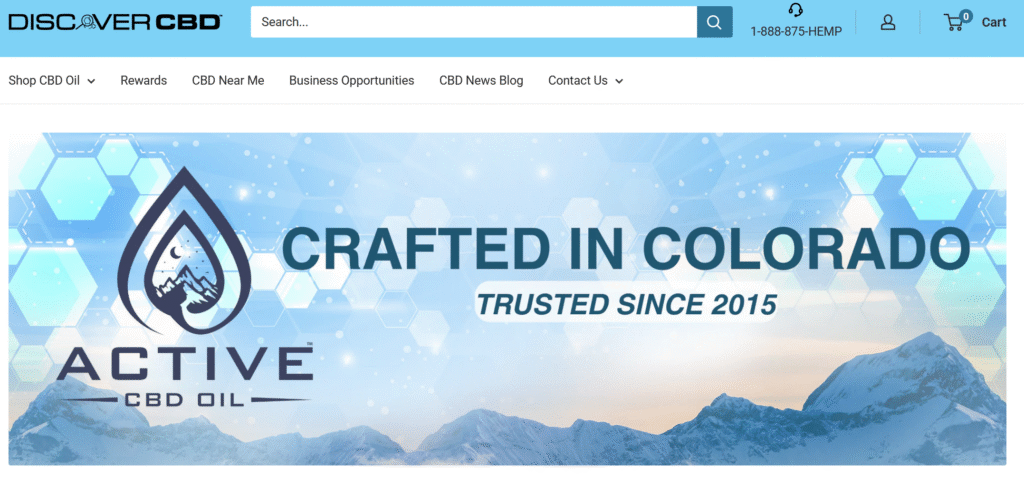
Discover CBD is a small but high-quality hemp store based out of Colorado, with a focused selection of brands, high-quality products and lab tests linked form each product page. They have their own brand – Active CBD – but they also carry products from other brands including CBDfx, CBD Living and Strain Snobs.
While it can’t compete with other stores such as cbd.co or CBD Market in terms of product selection or the number of brands covered, you can still pick up most types of CBD product from the store. They have CBD oils, capsules, edibles, vapes, topicals and even pet products, searchable by product type. For THC-focused products, Strain Snobs has its own category page, and you can also specifically browse THC-free products.
There’s free shipping on orders over $99, and they even have some brick and mortar stores in Colorado, Minnesota and Texas.
Pros
Free shipping on orders over $99
In-house brand plus other big names like CBDfx
Searchable by product type, and THC or THC-free
Offers CBD oils, edibles, vapes, topicals, pet products and capsules
Lab results available on website
Brick-and-mortar stores in Colorado, Minnesota and Texas
Cons
Small brand selection compared to other stores
Not as easy to browse as other stores
7 – CBD Genesis
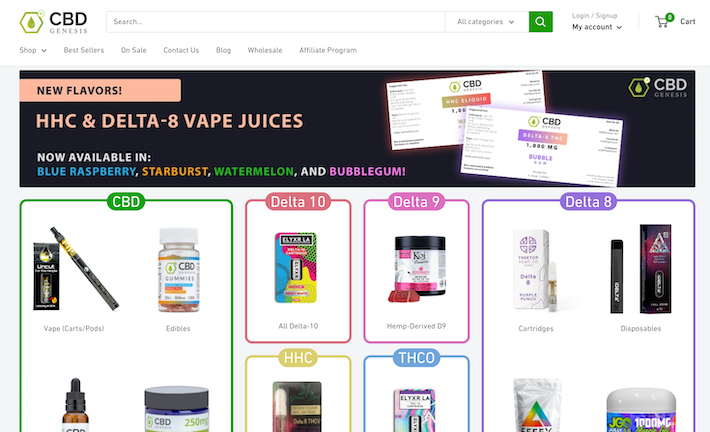
CBD Genesis is an online CBD store based out of Florida, with a selection of CBD products from their own brand and others, as well as plenty of other products with things like delta-8 or THCO. Their CBD collection includes edibles, capsules, flower, concentrates, tinctures, e-liquids, cartridges, pods and CBD for pets, covering brands such as Koi CBD, Active CBD, CBD for the People and Pinnacle CBD, in addition to their own branded products.
There are also plenty of options for delta-8, essentially covering all of the same product types as the CBD selection and also with a good selection of brands. You also get free shipping on orders above $50.
Pros
Big selection of CBD products in mostl types
Delta-8, delta-10 and other alternative cannabinoid products available
Good range of vaping products in particular
Free shipping on orders over $50
Lab reports for Genesis products available on product pages
Good prices
Cons
No lab reports for other brands
Smaller selection than many other stores
8 – Mana Botanics
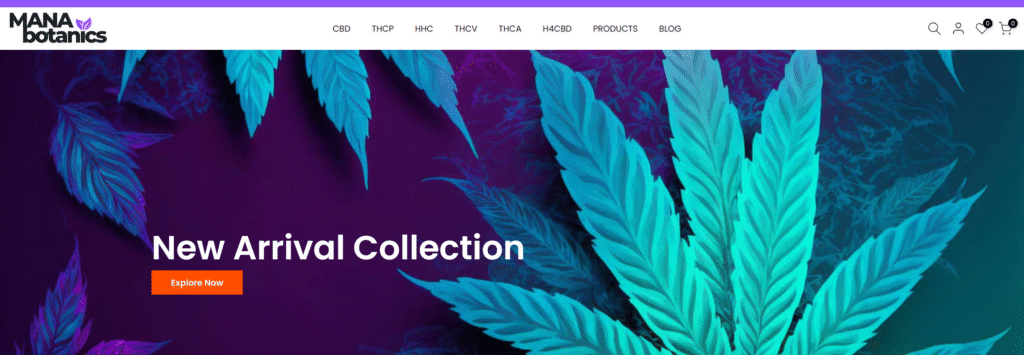
Mana Botanics is a smokeables-focused hemp marketplace based out of Hawaii, offering a wide range of hemp-derived products to ship across the country. The marketplace works a little different from most, though, since they partner with individual stores and send you to their websites to complete your purchase.
This has its upsides and its downsides. The benefit is that it’s a single storefront that you can use to find products from a wide range of popular brands, including Binoid, Tre House, Secret Nature, Bloomz and Plain Jane. The downside is that the store doesn’t do much beyond curating the selection and offering a nice storefront – prices and shipping still depend on the individual brand.
However, if you’re in the market for hemp flower, pre-rolls or vapes, their curated selection can introduce you to many products you might have never found otherwise, either browsing by cannabinoid or product type.
Pros
Curated selection of smokeable hemp products
Some big-name brands, including Binoid and Secret Nature
Especially good for flower and pre-rolls
Good selection of intoxicating cannabinoids and CBD
Browse by cannabinoid or product type
Cons
They don’t actually sell products – you buy on brand’s website
Still not a huge selection
No edibles available
Conclusion
If you’re buying CBD for the first time and are looking to try a few things, picking a store like this is the perfect solution. You can shop around different brands and types of CBD easily, before you find something that works well for you. If you settle on something specific you like, it’s often easier to just go to the brand’s website and buy direct, but there are still plenty of advantages to sticking with a company that carries a variety. The list above doesn’t cover all of the options out there, but it should give you more than enough reliable retailers to find something that works for you.
Editor’s note: We updated this list on May 15, 2026, to remove three of our initial recommendations from Direct CBD Online, SmokeCartel, Online CBD Store and Hemmfy, which no longer carry a wide selection of CBD products. We added new recommendations to replace them.
Trimmigrant Nightmares: The Side of California Cannabis No One Talks About
Ana Bacigalupo left her office job in Argentina and flew to California to trim cannabis. What she found was the part of harvest season nobody brags about.
“I remember crying inside the tent at night, saying: ‘What am I doing here? I’m completely alone. If something happens to me, where do I run? Where do I go?’”
California trim season has its own folklore: cash, freedom, plants, mountains, community. Ana Bacigalupo lived the other version.
This article does not suggest that every cannabis farm in California operates this way. Many do not. But Ana’s story reflects a side of trim-season labor that is real, recurring and far less publicly documented than the mythology that surrounds it.
She was a secretary at a private medical clinic in Buenos Aires, Argentina. She did her nails every day. Stable job, neat life, nothing about her profile that said she was built for six months in a tent in the Central Valley. But the story was convincing. She crossed.
What she found was the part nobody tells you before you buy the ticket.
Night One
The hotel reservation had fallen through by the time she landed in Los Angeles. No room. They tried to rent a car. That didn’t happen either. They waited on the floor of the Greyhound terminal from three in the afternoon until midnight, when the first bus toward the Central Valley left.
They arrived at two in the morning at a town in California’s Central Valley, forty minutes from the ranch where she was supposed to start work the next day. At that hour, in that area, there is no Uber, no taxi, nothing. A man they didn’t know saw them standing there and offered to drive them.
“I told him: ‘I’ll pay you whatever it takes for you not to kill me,’ because I didn’t know who he was,” Ana says. “I’ll give you whatever you want, just please take me to the place.” He didn’t charge anything. He drove them there and left.
The ranch appeared in the darkness: a fence, open field, a lantern over empty tents. The boss’s house was locked. Everyone else slept in the brush.
That was night one of the dream.
Six Months
For months, that was life: a tent, the dark, the cold, the middle of nowhere. Coyotes circling at night. Bears. Getting up at three in the morning to go to the bathroom outside, as a woman, alone, in the dark. Part of the routine.
“You get used to it,” Ana says. And that’s the problem. What seems impossible to endure becomes normal. One day, you realize nothing surprises you anymore.
It is solitary work. You show up with your tent and it is you against everything else. And out there, “everything else” can get very large very fast.
When the offer to become a grower came, she said yes without thinking. A boss offered four greenhouses, a hundred plants each, no fixed salary but a house, a shower, a bed and twenty percent of the harvest. After months in a tent, a bed was a real luxury. She signed up.
What she found inside that world rarely makes it into the mythology of trim season.
The world Ana describes moved across the legally precarious edges of California cannabis: a mix of informal work, unlicensed grows, unstable arrangements and, at times, legal operations. The point is not that every licensed workplace looks like this. It is that this labor ecosystem has long included forms of risk and precarity that rarely make it into public-facing cannabis storytelling.
“You wake up for breakfast and you see five Mexicans and four Americans talking about missing pounds, making plans, saying the cops are coming. And you never live in peace.”
Ana Bacigalupo
That’s the part the folklore leaves out.
Being a Woman Out There
She ended up living with seven men she didn’t know. Fourteen hours a day in the fields with men who didn’t care if she was menstruating. No privacy, no minimum conditions, nothing designed with a woman in mind.
“As a woman you have a terrible disadvantage,” she says. From the body. From the days when something as basic as hygiene became a problem with no solution.
And underneath that, always, something heavier.
“You’re in the middle of nowhere and you’re on someone else’s territory. They can do whatever they want with you.”
Ana Bacigalupo
There are things Ana still can’t talk about. Her voice doesn’t let her. Maybe she hasn’t finished processing them. “There are many things that to this day are hard for me to process,” she says. “And many others I still can’t bring myself to think about.”
The Ferrari and the Fall
The first harvest came out well. Twenty percent of the crop. Enough to go home comfortable. Then the pandemic hit and the borders closed. The math was simple: spend the money waiting, or go back to cultivating. She went back.
This time with her own grows. Knocking on doors, offering to rent a backyard, plant, harvest, give a percentage at the end. By hand. The neighborhoods where this happened were not what anyone pictures. “Usually very rough. It’s very common for them to have crack or meth operations nearby,” she says.
In the middle of that came an offer to work the farm of Ky-Mani Marley, Bob’s son. Legal operation. 89,000 autoflowering plants outdoors. Head trimmer position. She took it.
Up at four in the morning. Marley farm until midday. Then her own grows until ten at night. “I felt like I was in a Ferrari,” she says.
It didn’t last.
She was about to harvest one of her plots when the caretaker called. “Ana, they’re raiding everything. I just escaped running through the field. They came in with a bulldozer.” When she got there, police were everywhere and a truck was waiting to haul everything away. Plants left on the ground with bulldozer tracks across them.
She harvested two of the remaining plots. The partner who took the product was also her boyfriend. He came back four hours later empty-handed.
“We got robbed,” he said.
“I believed him because he was my partner,” Ana says. The people who’d also been ripped off told her afterward they weren’t going to do anything to her because they knew she hadn’t realized who she was dealing with. That she was a good person.
He went to Canada. He bought a Lamborghini.
She held on to the one grow she had left. Two days before the final harvest, she opened the greenhouse door and found every plant beheaded. Four guys, two trucks, one night. They left only the smallest buds on the floor.
She went to Miami broke. Christmas 2021. And it was there, alone, that she found out she was pregnant.
The Way Back
Her family told her to fly straight home. Ana said no. Her situation was already very fragile and leaving directly could close doors she might need later. She found another way out. Through Mexico.
Pregnant, alone, broke. From San Diego to Tijuana on foot. From Tijuana to Mexico City. From there to Bogotá. From Bogotá to Buenos Aires.
She describes herself in that moment as “a tiny being who can’t even drag a single suitcase.”
“Wow. I’m thirty minutes from stepping on home ground, from being safe and hugging my mom.”
Ana Bacigalupo, when the pilot announced forty minutes to landing in Buenos Aires
That pregnancy didn’t make it. Her body had already been through too much. “That baby was lost along the way,” she says. Today, she has a son who she says is the best thing that ever happened to her.
What Nobody Calculates
The market doesn’t pay what it used to. When Ana was in California, a pound went for $1,500 to $2,000. Today it’s $200 to $400. The market broke.
The price of a pound of cannabis in California When Ana was there: $1,500 to $2,000 Today: $200 to $400 The market broke. The math no longer works.
“There’s no point going to trim for $15 or $20 an hour. You end up with tendinitis for years, your back wrecked, your eyes wrecked, and your heart broken on top of it.”
And then, simpler: “The time you lose doesn’t come back. The time away from the people you love, the emotional damage, the body broken from such a brutal pace — it’s not worth it.”
‘I Try to Save Them the Trip’
Today Ana has a son. She watches her mother be a grandmother every day. She went back to working with the plant, legally, in Argentina, from a healthier, more honest and safer place.
Every time someone messages her on Instagram asking how to go trim or grow in California, she tries to respond. If she knows someone who needs workers and the person is already there, she tries to get them somewhere safe. If not, she tells them directly: don’t go. “I try to save them the trip.”
She knows not every story ends like hers. She knows people who came back fine, with money, with good memories. But she also carries years of messages from strangers writing from the other side of the world to tell her the same thing in different words.
And there is something else, she says now. It’s not only that people lived something similar and never told it. There may be people who never made it back to tell anything at all.
“After the experience, we all come back a little broken.”
Ana’s story first appeared in an interview with Argentine cannabis channel Doña Huana. This piece is based on an in-depth interview conducted for High Times.
Editor’s note: This publication shares stories and information about real-life events, including criminal activities. Everything you read here is based on reliable sources, public records, or personal accounts, but it is not meant to be the final word on what happened. Only a court of law can decide someone’s guilt or innocence. We do not support or promote any illegal actions, and we encourage readers to approach these topics with care and respect.
Compliance in Wellness: How to Turn Regulations Into a Competitive Advantage
Most wellness brands treat compliance like weather, something to endure, work around, and complain about. You can’t say this, you can’t advertise there, you can’t make that claim. For them, the compliance in wellness feels like a ceiling on what’s possible.
That’s where they are wrong. In-fact, compliance in wellness is your hidden advantage, as-long-as you understand the opportunity. What looks like a ceiling for one brand, is a floor for another. The brands that scale in regulated markets aren’t the ones who find clever ways around compliance. They’re the ones who build compliance into their positioning so deliberately that it becomes a reason to choose them over everyone else.
That’s your competitive advantage.
Why Most Wellness Brands Get This Wrong
The instinct in regulated wellness is to minimize the compliance conversation. Don’t lead with what you can’t say. Keep the messaging positive. Focus on the product. The result is a sea of brands saying the same things with the same vagueness. “Natural.” “Effective.” “Premium.” “Trusted.” Words that mean nothing because everyone uses them and nobody can prove them.
Your buyer, particularly in supplements, CBD, and functional wellness, is educated, skeptical, and slow to trust. They’ve been burned by overclaimed products before. They’re reading ingredient labels. They’re Googling your brand before they buy. They’re looking for a reason to believe you specifically, not your category.
Vague messaging doesn’t give them that reason, so why should they choose your products?
How to Use Compliance in Wellness for Your Advantage
The ‘compliance moat’ is built when a brand takes its regulatory constraints and makes them visible, specific, and central to its positioning. Instead of hiding that you can’t make certain health claims, you explain why, and in doing so, signal that you understand the science and the regulation well enough to have an opinion about it. That’s a credibility signal most competitors never send.
Instead of treating third-party testing as a checkbox, you publish the results, explain what they mean, and make them part of the buying conversation. Average brands don’t bother to do it, so the ones that do immediately occupy a different tier in the buyer’s mind.
Instead of apologising for what you can’t advertise, you build content and community channels that don’t depend on paid reach, but on exact positioning and in doing so, create an audience relationship that no algorithm change can take away.
True, each of these moves costs something. Money, time, attention and work, but unless you do so, you will never outperform your competitors. This is a high risk you should never take, as in the wellness industry, being average is not an option.
The Three Layers of a Compliance Moat
Layer 1: Authority
The most powerful thing a regulated brand can do is demonstrate that it understands its regulatory environment better than anyone else. Not in a legal disclaimer way, but in a substantive, opinion-having, here’s-what-this-actually-means way.
When you publish a piece explaining why a specific regulatory change matters for your category, or what the science behind a restricted claim actually shows, you’re signaling something important, something most brands never do: that you’ve done the work and that you care about the quality of your products. Buyers remember that. So do journalists, investors, and potential partners.
Layer 2: Verification architecture
Every regulated brand says it’s trustworthy, but only a few understands that trust is hard to earn and easy to lose.
Third-party testing, transparent supply chains, published formulation rationale, these aren’t just compliance tools. They’re positioning tools when you surface them in the right way. The brand that makes its verification process visible and legible becomes the default choice for buyers who’ve been burned by brands that made claims they couldn’t back up.
Layer 3: Channel independence
Regulated brands face advertising restrictions that their unregulated competitors don’t. Google and Meta limit what you can say and where you can appear. This feels like a disadvantage, and it is, tactically.
Strategically, it forces you to build channels that are more durable: email lists, communities, organic search presence, word of mouth, etc. These channels compound over time in ways that paid advertising doesn’t. A brand that’s been forced to build an owned audience because it couldn’t rely on paid reach is often in a stronger position three years later than a brand that spent the same period buying traffic.
The constraint becomes the advantage, but only if you allowing yourself to change and to be proactive.
Where to Start
The ‘compliance moat’ isn’t built in a day and it isn’t built with a single piece of content. It’s built by making a series of small, consistent choices about how your brand communicates, choices that, over time, add up to a positioning that’s genuinely hard to replicate.
The place to start is the question your buyer is most skeptical about. What claim in your category do buyers most distrust? Address it directly. Explain the science, the regulation, the nuance. Don’t deflect, go toward the hard question. The brand that answers what everyone else avoids earns a trust that compounds.
Most of your competitors won’t do this. That gap is your advantage.