

Parsonsfield Showed up for Silver Cannabis Company Grand Opening Weekend
February 13, 2026
Published by toker


 Over 18,000 South Dakotans are currently registered in the program, with participation having increased greatly in recent years.
The post South Dakota: Lawmakers Reject Bills That Sought To Dismantle State’s Voter-Initiated Medical Cannabis Access Program appeared first on NORML.

The Shinnecock Nation is one of the oldest self-governing tribes in New York state, so it’s only fitting the people became the first to operate a tribal-owned dispensary in the Eastern Long Island region. Opened in 2023 and licensed by the Shinnecock Cannabis Regulatory Division, vertically integrated Little Beach Harvest is a testament to the resilience of the Shinnecock Nation and its members. The dispensary’s spatial design and organic aesthetics are a reflection of the tribe’s values and culture.
Characterized by wood cladding and large glass windows, the building encompasses about 6,000 square feet and boasts a bright, natural, and comfortable atmosphere. The large wood-framed structure features a sloped, shed-type roof that imbues the building with a modern vibe and maximizes the natural light entering the building.
The interior, also lined with light-colored raw wood, is decorated with beadworks, jewelry, and a collage of images photographed by tribal members. The photos depict a wide variety of valuable plant medicine found in the local area, from cedar and sage to cannabis.
The images display “all the things that encompass what we’ve used traditionally as medicine here,” said Sean Boyd, a Shinnecock tribal member and brand specialist for the store.
While the cultural and traditional-medicine tidbits are integral to the dispensary’s big picture, they’re not the main focus.
“At the end of the day, we are selling medicine — cannabis — more than we are selling our culture,” Boyd said. “We are a business, and our business isn’t to sell our culture. It’s to offer plant medicine and provide an experience. But we also want to remind visitors of where they are and the space they’re stepping into.”
Located on tribal land in the present-day Hamptons, the store enjoys significant traffic during the spring and summer months when vacationers are abundant; traffic slows down during the off-season. Regardless of the time of year, though, the dispensary’s design reflects a “Hamptons summertime” aesthetic with its open layout, natural light, extensive space, and airy displays.
The name Shinnecock roughly translates to “people of the stony shore,” hence the natural stone flooring and other design features that elicit a seaside ambiance. Flow is a key aspect of the store’s floor plan, as it reflects the tribe’s ever-evolving nature while also calling out the beachside location.

“We have lots of flowing things, like tall glass display cases,” said Jay Wright, a Shinnecock citizen and product marketing manager for Little Beach Harvest. “We have shells and lots of beach scenery to flow in with everything.”
The dispensary’s massive size stands out from the everyday cannabis-shop experience. Two-story-high ceilings catch customers’ attention immediately upon entry. Wright explained the team can always tell when it’s a person’s first time visiting, because their gaze travels upward to take in the sheer volume of the space.
“Rays of sun shine through the building for natural lighting,” Wright said. “Everything about this building is natural, because that’s who we are as a people and what we’ve always been accustomed to.”
While the top floor of the building currently is used as an office for the team, work is underway to convert the space into a consumption lounge and events venue. (Little Beach already has hosted several events, from live musical performances to cookouts and art exhibits featuring Shinnecock and Long Island artists.)
In addition to the curated art pieces sprinkled throughout the sales floor, Little Beach also incorporates a twelve-foot mural: a live painting gifted from a local Shinnecock artist and cultivator known as Taboo. Wright and Boyd said visitors regularly ask about the mural, providing an opportunity for the team to support and uplift their community. Taboo’s brand, Peshaun Exotic Flowers, is on the shelves at the store.

“This building has a lot of community involvement inside of it,” said Wright. “We don’t care if guests even end up buying something as long as they leave with a piece of knowledge and understanding about where they are and who’s in their area. That’s what we’re aiming for.”
Boyd and Wright explained the importance of disparate groups bonding over the plant’s vast potential. While the two men are proponents of medicinal use, they also advocate for cannabis bringing people together socially and opening doors for artistic expression and the free-flowing exchange of ideas. The two explained they often push back against the stigma associated with cannabis use, especially among tribal communities. The store’s design plays a crucial role in challenging preconceived notions about what it means to be someone who uses cannabis.
A recent Gallup poll found 15 percent of Americans identify as cannabis smokers, consistent with an overall upward trend in recent years. Despite the plant’s growing acceptance and accessibility, stigma can carry a lot of weight in tribal communities. A key aspect of Little Beach Harvest’s design is the creation of a safe, comfortable space for customers from all walks of life to explore.
“I can’t even tell you how many times people have asked us when we’re going to put up a casino,” Wright said. “The stigma that [indigenous] people just get drunk or gamble—that’s what we’re trying to break down. We can do other things. That’s what this building means to us.”
Little Beach Harvest’s team also was intentional when they created large, open displays that don’t overwhelm or intimidate visitors.
“There isn’t just cannabis everywhere,” Boyd said. “It’s there when you look for it, but it’s not very bold or in your face. Customers come up to our budtenders and ask for knowledge, seek knowledge, and receive knowledge in a way that’s different from some other dispensary experiences.”
Wright explained many of the dispensary’s customers are either novices or haven’t engaged with the plant for decades. These types of consumers often don’t know where to start on their personal journey.
“Having nice, open, comfortable sceneries and displays that are meaningful to what people are looking for and curated the right way gives people a sense of ease,” Wright said.
While plenty of customers may seek a sense of ease and access to education, Little Beach Harvest also welcomes customers who know exactly what they like and prefer an in-and-out experience. For this demographic, kiosks are a handy tool for quick selection and checkout. For an even quicker experience, customers may also utilize the store’s drive-thru window.
“We have early-morning rushes with people who are on the go and don’t want to get out of the car,” said Wright, adding that such customers may place an order on their phone and pick up their selections at the drive-thru shortly thereafter. “It’s all about keeping it sleek, fresh, and intuitive.”
Keeping things fresh and adapting to needs are recurring themes for the dispensary and the indigenous nation behind it. Both qualities are deeply embedded in the Shinnecock people, who have resided on Long Island for thousands of years. The tribe’s evolution has not been easy, Boyd and Wright admitted, but the tribe is strong and resilient. For the Little Beach Harvest team, the mere existence of the dispensary is a powerful reminder of the people’s vigor.
“The building itself, the whole process of getting this structured and done, is a testament to the resilience of our tribe,” said Boyd. “It’s a testament to staying true to our culture, to preserving what it is to be Shinnecock, which changes over time. It changes in situations. But at the end of the day, who we are—the people—that doesn’t change. That’s what we wanted to establish within this building.”
He explained the Shinnecock people have always been community-centered, so creating a building that serves as a community hub was only natural.
“This project and the idea of us moving forward as a people resonates within this building and within the culture of this company,” Wright said.
The building’s open floor plan also highlights the values of the Shinnecock people. Boyd described his tribe as “very open and hardworking. The whole idea of the building being open and free flowing was there from the beginning. We are resilient, steadfast, and everchanging and growing. We have been here since the founding of this town.”
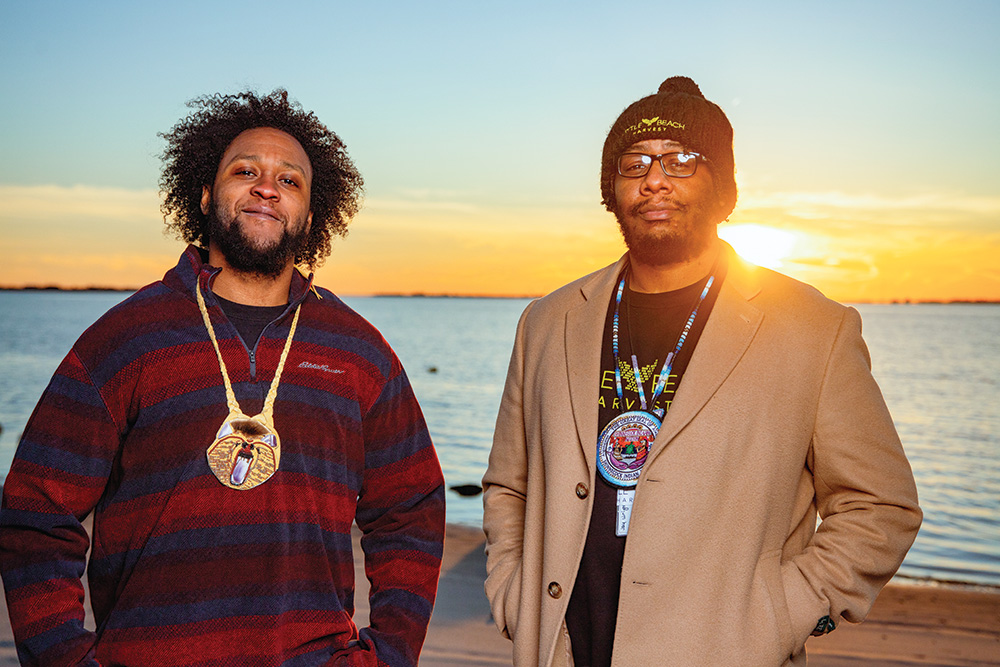
Although Boyd and Wright care deeply about their tribal community, they are also dedicated to the larger Southampton and cannabis communities.
“Yes, we are Shinnecock members, but we’re also members of the larger community,” Boyd said. “We went to Southampton High School, and we grew up in this town.”
Consequently, when the Little Beach Harvest team began to develop the dispensary, they sought input from all stakeholders to inform the plan. Setting a structure that reflected sometimes-diverse values was important to the team, as they knew the interior could always change and adapt, but the exterior would be permanent.
“We were blessed with this building, and then we had this freedom where we could curate it on the inside in different ways as we change through the seasons and with our customers,” said Boyd. “We’re fortunate that the building is beautiful and does its job in attracting people here.”
Little Beach Harvest’s strong presence in the community, large building, and open interior design act as powerful symbols and a reminder that the Shinnecock remain a growing, autonomous nation with its own territory and ancestral traditions. Even the building’s location tells a compelling story of resilience.
“Right in front of our building is a foundation of a building that was once an opportunity to encroach on our land, not too long before there was structural and economic development on the front side of the territory,” Boyd said. “Builders wanted to take parts of our land to do what they wanted with it. And it took a group of elder women and the support of the community to go out there and protest, to fight for our land and establish a solid boundary.”
The story almost had been forgotten until development for the dispensary began. When a bulldozer preparing the site for the next chapter in Shinnecock history uncovered the buried remains of the old battleground, it seemed a fitting coda for the attempted betrayal.
“We rediscovered that foundation, and we left it there as a sign and remembrance of what it took us to be able to actually build this and to be here,” Boyd said. “And the fight that our ancestors put up for us. The fight that we continue to take forth to exert our sovereignty.”


Europol reported the discovery of an international network involved in smuggling cocaine from South American countries to Iceland. According to Ukrinform, the information was published on Europol’s official website. Timeline of the operation and its consequences According to investigators, profits from illegal trafficking reached about 4 million euros. As part of the special operation earlier […]
Source link


“The scourge of all Soviet Russia is cocaine,” Tatiana Kuranina, a Russian noblewoman, wrote sometime after the Bolshevik Revolution of 1917. “Although Russia is reduced to a state of complete impoverishment and needs decisively everything – there is cocaine, and there is enough for everyone…”
Many in the West today imagine the Soviet Union as it’s portrayed in Call of Duty games: a land of prisons and labor camps, where every citizen marched to the tune of the Party and its all-seeing security state. In truth, there were many aspects of Soviet life that the Soviet government failed to control, from the import of Western film and music to the sale and consumption of illegal drugs.
Just how widespread the latter was is difficult to say. While the War on Drugs in the US has filled a library’s worth of books, studies, articles, and documentaries, the USSR spent much of its existence pretending that substance abuse was a thing of the bourgeois past, cured by the healing powers of Communism. But was there really enough cocaine for everyone?
In czarist times, definitely not. Back then, alcohol was Russia’s drug of choice – courtesy of a state monopoly on vodka sales that dates back to the late medieval reign of Ivan the Terrible. Where European and American doctors prescribed narcotics for nearly everything from toothaches to hay fever, their Russian counterparts judiciously reserved the strong, addictive stuff for true medical emergencies. It also helped that for a large portion of the 19th century, Russia counted just 14 pharmacies, limiting demand by way of supply.
Supply increased when the Russian Empire ventured into Central Asia, exposing its population to Chinese opium and Indian hashish. Bans on alcohol and tobacco, implemented during the First World War and maintained throughout the Russian Civil War of 1917-1922, set many in search of alternatives. As in Europe, soldiers became addicted to the medications they were given after being wounded on the battlefield, while civilians turned to drugs to escape their war-torn realities.
As drug abuse increased, so did efforts to understand and combat its causes. Before the Soviets came to power, addiction of any kind was considered a kind of moral failing, resulting first and foremost from a lack of decency and self-control. Under Communist rule, experts began to look at the problem through a Marxist lens. Addiction – then called “narcotism” or “narcomania” – was blamed not on a person’s character, but the material circumstances in which they grew up.
“The basis of narcotism,” one Soviet doctor wrote in 1923, “is the socio-economic conditions of the public. On this basis arises the necessity to forget, to become numbed with something (…) difficult economic conditions do not permit ‘corrective’ substances to play their role: tea, coffee, small doses of wine or beer will not satisfy.” Another doctor wrote of a group of boys who began snorting cocaine not because they were bored, but because it made them feel like they “did not need to eat.”
During the 1920s, the Soviet Union’s policy on illegal drugs was equal parts punitive and preventative. The government reasserted control over the country’s handful of pharmacies, tightened rules on the prescription and storage of narcotics, and made drug dealing of any kind and quantity punishable by multiple years of jailtime. Not prohibited, to the chagrin of some and presumably the relief of others, was the consumption of hashish.
This period also saw the rise of rehabilitation clinics. Inspired by the sanitoria that treated people afflicted with syphilis, tuberculosis, and other infectious diseases, these clinics (“narco-health centers,” early Soviet rehab facilities) temporarily isolated addicts from the outside world and its bad influences. Now-questionable treatments, including subcutaneous injections of arsenic and strychnine – both highly toxic – coexisted alongside more reasonable-sounding interventions like warm baths, psychotherapy, and supervised museum trips. Clinics for underage addicts had their patients follow structured daily regimens, with two hours of bedrest after lunchtime.
What little data there is available suggests that drug abuse in the Soviet Union fell during the 1930s, but can those numbers really be trusted? By this time, Joseph Stalin had taken over, and many of the USSR’s early attempts to tackle societal issues in earnest had given way to sycophancy and propaganda: one medical text touted that while Europe’s exploited factory workers continued to numb their sorrows with drugs, the Soviet state had “nearly liquidated” its narcotic woes – all thanks, of course, to its “wise” Stalinist leadership.
Under Stalin, a fan of forced labor, plans were drawn up to replace clinics with workshops. Aside from medication and entertainment, addicts were to be given jobs and monthly quotas, just like any other member of society. They would still receive various forms of therapy – hydro, psycho, and more – “but the basic therapy,” as one historian put it, “was work,” the purpose of which was to “contribute to the Soviet economy” as much as the recovery of the patient.
The effects of the Thaw – a period of relaxed censorship following Stalin’s death in 1953 – did not extend to discourse on illicit drugs, and scientific writing on the subject remained sparse for many more years to come. Not until Mikhail Gorbachev’s famous glasnost and perestroika campaign of the mid-eighties, further curtailing censorship along with corruption, did drug use begin to receive the kind of public attention it had enjoyed in the years immediately following the Civil War.
According to a research memo from the CIA, Gorbachev’s administration turned drug addiction from a non-issue into a national issue, one that required increased awareness and mass mobilization to solve. After decades of virtual silence, narcotics were talked about everywhere, from medical conferences to youth newspapers. “Soon the poppy harvest will start pouring into the city,” a concerned mother wrote in a letter to the editor of a periodical, her tone as ominous as Princess Tatiana’s.
The CIA memo claimed that drug addiction in the USSR was on the up – a development it attributed, among other things, to a “general waning” of ideological belief and public morale, more leisure time and disposable income paired with sustained consumer shortages, and greater contact with the West, whose own drug habits “have given impetus [to] Soviet youth infatuated with Western trends and fashions.”
Gorbachev’s equally fervent campaign against alcoholism – driving up prices and reducing availability – is also listed as a likely factor, promoting drug use in the same way that prohibitions had done at the start of the century. This time, young Russians were turning to poppy extract, paint thinner, and prescription medication.
Finally, there was the Afghan-Soviet War, unleashed in 1979 when the USSR invaded Afghanistan to help its struggling communist government stave off an Islamist insurgency. If the memo is to be believed, drug abuse among Soviet troops stationed in the country reached “epidemic proportions.” There was evidence that drugs were impacting the soldiers’ performance, and fear that – when sent home – they would take their bad habits back with them.
Sources claimed that as many as 50% of soldiers habitually used hashish and heroin. Both were readily available in the bazaars of Kabul and other Afghan cities, and were considerably cheaper than alcoholic beverages – important considerations as, unlike decorated officers, regular conscripts did not receive a monthly alcohol allowance. Worse, a liter of vodka was said to cost as much as an entire month’s wages.
Reports of soldiers trading their military equipment for drugs, or accepting drugs as bribes from locals seeking to cross checkpoints, or helicopter pilots crashing their vehicles because they took too many opiates, were so common that the Soviet army tried to pressure the Afghan government into eliminating its own supply. When this proved futile, the army promised instead to incarcerate anyone who was caught swapping their rifle for a reefer.
Gorbachev’s efforts to reform the Soviet state ultimately led to its demise. The political and economic turmoil that followed the collapse of the USSR in 1991 provided a golden opportunity for all manner of criminal activity in Russia, the drug trade included. Some criminals were so successful, they joined the ranks of Russia’s new ruling class: the oligarchs.
Regrettably, ascertaining the scale and scope of Russia’s drug problem remains as difficult as it was in Soviet times. As then, many of the agencies and research institutions that gather information on the topic are under strict government control. The same question returns: can the numbers be trusted?
One organization, the Russian Civil Society Mechanism for Monitoring of Drug Policy Reforms, suggests the answer is “no.” As early as 2015, a year into the Russian occupation of Crimea, it filed a complaint with the UN that characterized the Kremlin’s drug policy as overly reliant on punitive restrictions, indifferent to human rights, and anti-scientific.
More so than his Soviet predecessors, Vladimir Putin and his followers have turned drug addiction from an economic and public health issue into a political one. Where the Soviets regarded addicts as victims of poverty and hardship, Putin’s state rhetoric often frames addiction in punitive, moralized terms, pairing enforcement with political messaging in ways that can blur public health goals and state power.
As in the Philippines under Rodrigo Duterte or the US under pretty much every president from Richard Nixon onward, drug war frameworks can function as a tool of domestic control: expanding police powers, intensifying surveillance, and normalizing harsh punishments. Whatever the stated intent, the effect is often the same: fear becomes policy, and enforcement becomes a stage on which states demonstrate strength. It’s a logic Stalin would have surely approved of.
Photo: RIA Novosti archive, image #644463 / Yuriy Somov / CC-BY-SA 3.0, CC BY-SA 3.0 https://creativecommons.org/licenses/by-sa/3.0, via Wikimedia Commons
<p>The post Inside the Soviet Union’s War on Drugs — And Why Its Logic Never Really Ended first appeared on High Times.</p>