
Two arrested after £1.6m cannabis cultivation found in Dundee
February 13, 2026
Published by toker

The Cannabiz Media team will be at booth 224 on the expo floor during the 10th annual CWCBExpo in New York City at the Javits Convention Center from June 5-6, 2024. The 2024 CWCBExpo in New York will feature two days of hands-on workshops, educational sessions led by world-renowned experts, an expo floor where exhibitors are poised to showcase innovations for the cannabis industry, and high-end networking opportunities like rooftop & yacht parties. © CNB Media LLC dba Cannabiz Media
Source link



A practical online head shop buyer’s guide covering quality, reviews, bongs, dab rigs, vaporizers, and what really matters when shopping for cannabis gear online.



Planet 13 was supposed to revolutionize legal cannabis. The marijuana superstore opened five years ago in Orange County with fanfare and predictions that its walls of TV screens and massive footprint would change how everyone bought weed.
Instead, it has crumbled under the weight of its own eight-tentacled statue.
The store’s parent company, Planet 13 Holdings, announced in November that it was selling the 55,000-square-foot Santa Ana store, known as Planet 13 Santa Ana, after millions of dollars in losses. California cannabis chain Catalyst Cannabis took over the store this week, CEO Elliot Lewis told SFGATE, ensuring that the fate of California’s largest cannabis retail store was sealed.
To Read The Rest Of This Article On SF Gate, Click Here
The post California’s Biggest Cannabis Shop Is Dead After Burning Cash For Years appeared first on Marijuana Retail Report – News and Information for Cannabis Retailers.


Tax revenue from marijuana sales has gradually decreased in Colorado over the past five years as more states have enacted legalization and as intoxicating hemp products have grown in popularity, state officials say in a new report. Nonetheless, cannabis is still bringing in more tax dollars compared to alcohol or cigarettes.
In a memorandum from the Colorado legislature’s nonpartisan Legislative Council, staff sought to answer “common questions about how revenue from the marijuana industry fits into Colorado’s state budget.” That includes the $231.1 million in cannabis revenue the state collected in the 2024-25 fiscal year.
Adult-use marijuana is taxed at three levels in Colorado: A 15 percent excise tax, 15 percent special sales tax and 2.9 percent state general sales tax. As one of the first states to legalize marijuana for recreational use, Colorado saw revenue from those sales grow “consistently for the first eight years of legalization, peaking at $424.4 million FY 2020-21.”
Following that, however, “revenue fell for the first time in FY 2021-22, and has declined each year since,” the Legislative Council said. “Marijuana tax revenue fell to $231.1 million in FY 2024-25, 45.5 percent below its FY 2020-21 peak.”
Notably, the memo says that the declining tax revenue from marijuana in more recent years is “has largely been due to low prices and falling demand as other states across the country legalize marijuana, and alternatives like intoxicating hemp become more widely available.”
Early on Gov. Jared Polis (D), a longtime champion of cannabis reform, was perceptive to the potential economic impact of the spread of legalization, poking fun about how he hoped states like Texas would continue to stall on the issue so Colorado could continue to reap the marijuana tourism dollars.
Texas might still remain a prohibitionist state, but with cannabis now legal for adult use in nearly half of the states in the U.S., that broader shift has evidently contributed to the revenue decline.
But the new report also says the rise of intoxicating hemp products is diverting tax dollars. Whether that changes when a federal ban on such products takes effect in November is yet to be seen.
Even with the spread of state-level legalization and increased consumer demand in the intoxicating hemp market, however, Legislative Council released data showing that marijuana remains a more potent revenue generator compared to other vices, including alcohol and cigarettes.
In the 2024-25 fiscal year, marijuana sales generated more tax revenue than alcohol ($54.3 million), tobacco products ($68.2 million), nicotine products ($91.6 million) and cigarettes ($213.9 million).

Via LCS.
To that point, surveys have consistently found that Americans are increasingly choosing marijuana and cannabis-infused beverages over alcohol and cigarettes.
Meanwhile, in 2025 alone, Colorado saw over $1 billion in marijuana sales—a milestone the governor touted in December. And while Legislative Council attributed part of the decline in cannabis sales to intoxicating hemp product sales, Polis also recently said the pending federal ban will “stifle growth and innovation” in the market.
—
Marijuana Moment is tracking hundreds of cannabis, psychedelics and drug policy bills in state legislatures and Congress this year. Patreon supporters pledging at least $25/month get access to our interactive maps, charts and hearing calendar so they don’t miss any developments.
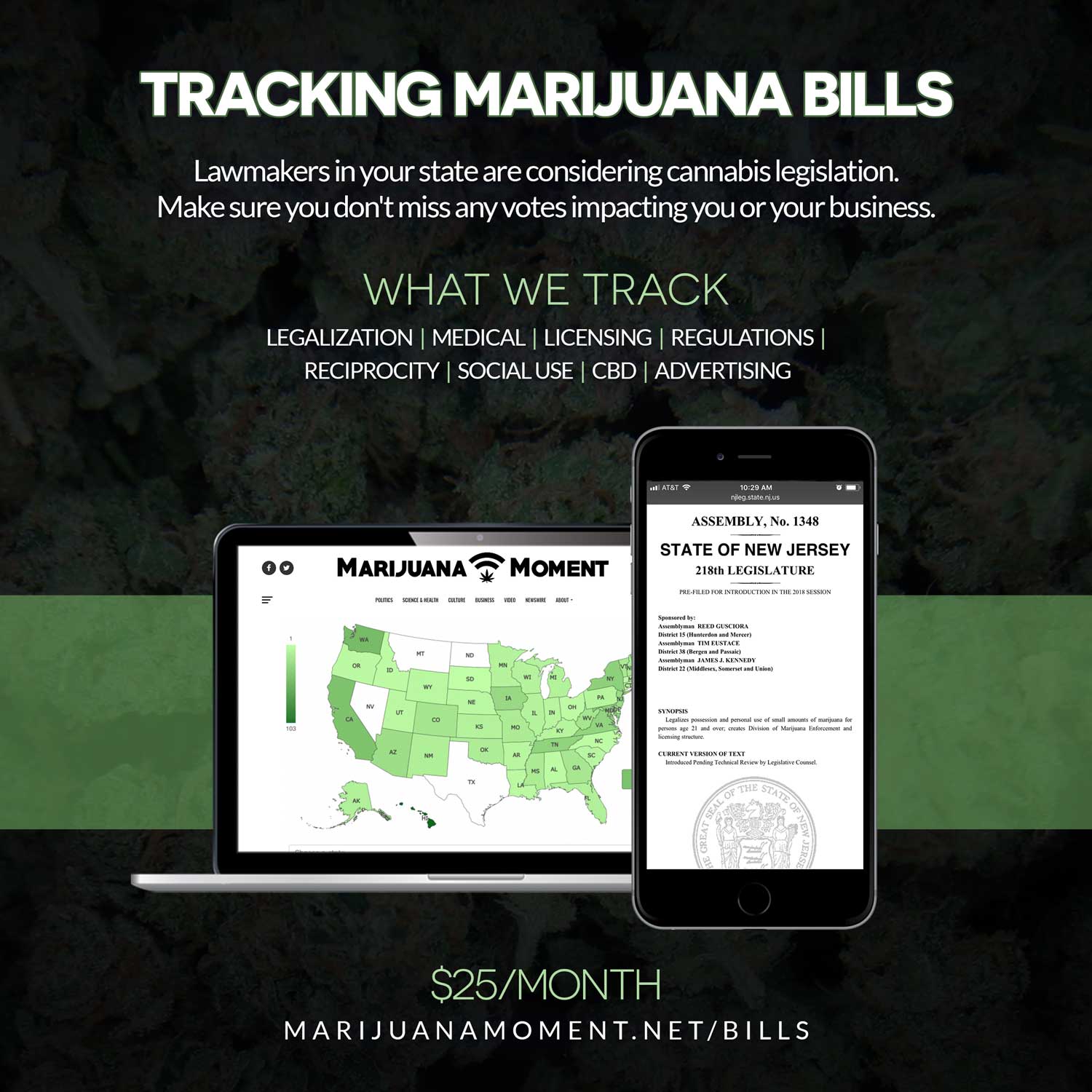
Learn more about our marijuana bill tracker and become a supporter on Patreon to get access.
—
Meanwhile, the governor said last week that his state should not have joined a lawsuit supporting the federal ban on gun ownership by people who use marijuana that’s now before the U.S. Supreme Court—and he personally opposes the state attorney general’s “legal position on this.”
The post Colorado Marijuana Revenue Is Declining As Other States Legalize, But It Still Outpaces Alcohol Taxes, Report Shows appeared first on Marijuana Moment.

An inversion in the spirit of Dr. Strangelove: confronting hard truths head-on by following bad logic to its inevitable conclusion.
Every year, the same parade of boardroom lifers, policy priests, donor-approved experts, and cannabis industry elites shuffle onto stages across California like it’s a loyalty program they can’t quit. And they all deliver the same breathless speech for the umpteenth time:
What can we do to save the cannabis industry?
Save it?
Brother, have you looked around? This thing is coughing up dust. It’s limping through the desert with a knife in its back, and a state tax bill duct-taped to its chest. “Saving it” is the wrong question now. That ship sailed, hit an iceberg, and sank.
If we’re being honest—brutally, spiritually honest, no incense or LinkedIn platitudes—the better question is:
How do we kill it?
How do we put it out of its misery, Old Yeller–style?
Quick, efficient, and merciful.
Call it an act of charity. Because we love cannabis too much to stand there nodding politely while it chokes under the dead weight of its own bureaucratic bullshit.
Sometimes you skip the rebuild. You burn the mother down and let the rot finish collapsing so you can finally see the ground underneath. Sometimes collapse is the only clear-eyed option left on the table.
So here it is: the blueprint. The field manual.
The seven-step recipe for a clean, elegant kill.
And the good news? We’re already halfway through the steps. We’re making great fucking progress. Really. Let’s pat our leadership gently on the head for a job exceptionally well done.
The system followed the plan to the letter.
If the goal is total annihilation, taxation is your Hattori Hanzō.
California has engineered a tax system so dense, so convoluted, so cosmically hostile to the concept of “profit” that you’d think it was designed by a medieval torture guild that moonlights in public finance. The legal market is getting waterboarded.
You tax the grower for existing, the distributor for touching the product, the retailer for breathing oxygen, and the consumer for being gullible enough to buy legal.
It’s a punishment pyramid scheme.
In practice, California’s legal cannabis businesses routinely face effective tax burdens north of 40 percent—before rent, payroll, and utilities. A structure that would be considered unreasonable in nearly any other agricultural industry.
A farmer in Trinity can spend a year coaxing world-class herb out of a hillside that once held gold miners and Native communities before them, only to be told they owe more in taxes than they generated in revenue.
That’s a slow bleed. A state-sponsored bloodletting where the plant is sacrificed and the revenue disappears into a void straight out of Under the Skin.
If collapse is the goal, the tax plan alone could do it. And the best part? The illicit market suffers none of it.
Confusing. Expensive. Functionally impossible.
You build a system so riddled with contradictory demands, so staggeringly inconsistent from county to county, that anyone who attempts to navigate it starts aging in dog years.
You want farm-friendly licensing? Too bad.
You want consistency? Grow up.
You want predictability? Touch grass.
California turns licensing into an existential ordeal of paperwork, penance, and self-flagellation—a test of endurance designed to see who breaks first.
If you’re applying for permission to grow a plant, you’re embarking on a spiritual pilgrimage across a permit-hellscape wasteland. And at the end of it, some county clerk with a three-day migraine looks up and says, “Actually, you filled out the old version of the form. You’ll need to start over.”
You can almost hear the filing cabinets whispering: Give up, farmer. Let the corporations handle it.
And that’s exactly the point.
To kill an industry from the inside out, start by killing trust.
Want trust to die fast? Let the labs lie.
Let THC scores float upward like helium balloons at a kid’s birthday party. Let 29% magically become 35%. Let COAs turn into fantasy novels that would make Robin Hobb blush.
Once consumers stop believing what’s printed on the label, they stop believing the industry itself—the hype, the claims, the brands.
More importantly, they stop believing the science. Historically, that’s always gone great. Hell, shout loudly enough about not believing in science today and you might even get elected president tomorrow.
Walk into a dispensary right now and you’ll find hundreds of strains all claiming to be 36%.
That’s performance art with a barcode.
Labs that consistently report lower THC numbers don’t lose credibility. They lose clients. The system becomes a feedback loop of delusion: growers inflate expectations, labs inflate numbers, brands inflate marketing, and consumers inflate enjoyment just enough to justify the receipt.
At the center of it all sits the belief that cannabis must keep climbing a potency ladder—a treadmill to nowhere, powered by ego, insecurity, and the fantasy that quality fits into a single number.
If collapse is the goal, this is genius. Every purchase becomes a question mark.
When the numbers turn into a circus, everyone looks like a clown.
Let’s talk about culture.
Culture dies when you starve the people who built it.
Branding decks and venture capital didn’t build the Emerald Triangle. It was built by people who risked prison, asset forfeiture, and federal raids. People who treated cannabis like a sacrament, something you respected before you sold it.
So naturally, the most efficient way to kill the legal market involves alienating those exact people.
Make compliance so expensive that they drown in debt. Make regulations so inflexible they crack under pressure. Crush them with taxes. Lock distribution behind monopolies.
Push them off the cliff, then pave over the bodies with warehouse grows. Once the legacy farmers disappear, the culture goes with them. The terroir, the lineage, the ethics.
The memory.
Kill the soul and all that’s left is non-recyclable mylar.
Under no circumstances should anything improve.
Make an eighth of cannabis worse for the planet than the Exxon Valdez. Make brands spend more on plastic than soil. Turn every jar into an escape room designed to defeat fully grown adults with college degrees.
California took a simple agricultural product and wrapped it like a cursed talisman meant to contain a demon—layered, sealed, child-proofed, tamper-evident, joy-resistant.
A triumph of form over sense.
In many cases, the legally required packaging for an eighth—designed to keep your weed from aging like fresh-baked bread—weighs more than the flower itself.
If collapse is the goal, packaging law is the sleeper agent. Quiet. Expensive. Suffocating.
Retail is the beating heart of the legal market. Cauterize it.
Keep margins razor thin.
Keep landlords bloated on dispensary rent.
Keep staffing requirements sky-high and resources rock-bottom.
Even the best-run dispensaries sprint on ice—paying every tax, following every rule, operating on margins thinner than a King Size Element while carrying exponentially more regulatory risk.
And still, the numbers refuse to cooperate.
The equations are cooked. The system is closed. Retail treads water or drowns quietly while the city mails another bill to the corpse.
When a dispensary closes, it severs a community artery and pushes consumers back to the illicit market. Trust, education, and access go with it.
If this industry feels like a collapsing coal mine, retail is the canary.
And right now, that fat little bird is coughing up kief while everyone insists it’s seasonal allergies.
Treat the person smoking the weed like an afterthought.
Don’t teach terpenes.
Don’t explain cannabinoids.
Don’t reward curiosity.
Don’t correct misinformation.
Just shove 37% THC at them like a coked-up snake oil salesman and keep it moving.
Treat cannabis like fast food: cheap slogans, loud numbers, zero substance. Supersize the hype, cut the quality, and act shocked when people stop trusting the menu.
This is industrial-grade stupidity, and it’s fantastic. If the consumer doesn’t believe in the product, the legal market is already dead.
No ethics. No advantage. Zero justification.
If people don’t believe legal weed is better, safer, cleaner, or more honest, then it’s more expensive weed with no trust attached. Just more friction. More bullshit.
So you gut belief.
Condition them—slowly, efficiently, and without mercy—that no one cares what they like. That quality is unguarded, and no one is telling the truth.
Grind them down. Strip the experience of any dignity. Make every visit feel like paperwork and DMV breath.
At that point, you’re not competing with the illicit market. You’re actively recruiting for it. Once belief is gone, loyalty follows. Then patience. Then habit. Then they crawl back to their dealer.
Don’t lose the customer.
Hand them back.
Gift-wrapped and uninsured.
The exit is already full.
Don’t let the door hit you on the way out.
Every step of this blueprint is already in motion. The machine is buckling under its own weight. The spark has reached the oil.
There’s relief in admitting it. Freedom, even. Drop the act and see it clearly. Denial is the real villain here. Babying this industry won’t save it. It’s a monster built wrong at the skeleton level, and pouring money, emotion, and hope into it won’t change that.
Nobody needs to finish the job.
It’s dying on schedule. State, counties, labs, landlords, corporations, market forces. Everyone showed up for the execution.
Sometimes the system deserves to die so the culture can live. Clear the wreckage so something real can grow.
If this industry falls—if it truly crumbles—my hope is it won’t be a tragedy, but a controlled demolition. A chance to rebuild something worthy of the plant and the people who love it.
Anyone hunting for tidy solutions won’t find them here. But reversing every step in this field manual would be a decent place to start.
Until then?
Pass the matches, baby. Daddy’s a pyro.
This article is from an external, unpaid contributor. It does not represent High Times’ reporting and has not been edited for content or accuracy.
<p>The post How to Kill the California Cannabis Industry first appeared on High Times.</p>