Marijuana Consumers Overwhelmingly Back Trump’s Rescheduling Order, Poll Shows As Advocates Await DOJ Action

Marijuana Consumers Overwhelmingly Back Trump’s Rescheduling Order, Poll Shows As Advocates Await DOJ Action


Marijuana Consumers Overwhelmingly Back Trump’s Rescheduling Order, Poll Shows As Advocates Await DOJ Action

President Donald Trump’s executive order directing the attorney general to finalize the marijuana rescheduling process is overwhelmingly popular among cannabis consumers, according to a new poll.

The survey from the cannabis telehealth platform NuggMD asked people who use marijuana to share their perspective on the order, which was signed in December but has yet to be followed through on by Attorney General Pam Bondi. The pending plan would move cannabis from Schedule I to Schedule III of the Controlled Substances Act (CSA).

About 83 percent of respondents said they support the order, compared to 7 percent who expressed opposition and 10 percent who said they didn’t have an opinion about the proposed reform.

Q: “Do you support or oppose the executive order to reschedule cannabis?”
n: %
Support 379 82.9%
Oppose 34 7.4%
No opinion 44 9.6%
457

NuggMD also included a follow-up question about the practical impacts of rescheduling, pointing out that while it would not federally legalize cannabis, it’s expected to “lead to more medical research into cannabis and for cannabis companies to realize the tax benefits available to most other businesses.”

About two-thirds (73 percent) of cannabis consumers said they care a “great deal” about those policy outcomes, while 22 percent said they care “some” about them and 3 percent said they care “a little bit.” Only 2 percent said they don’t care at all.

Q: “While rescheduling is not legalization, it is expected to lead to more medical research into cannabis and for cannabis companies to realize the tax benefits available to most other businesses. To what extent do you care about those outcomes?”
n: %
A great deal 334 73.4%
Some 99 21.8%
A little bit 15 3.3%
Not at all 7 1.5%
455

“The EO from President Trump that tells the attorney general to finish the rescheduling process in the most expeditious manner is different from the 2022 statement from President Biden that requested [the U.S. Department of Health and Human Services, o HHS] begin the process,” Andrew Graham, head of communications at NuggMD, told Marijuana Moment. “I would argue that the EO has more force, if only because of how this administration seems to operate compared to the last one.”

“I don’t see an avenue for the attorney general to openly defy the president’s order while also maintaining her power and proximity to it, which is why I think rescheduling will indeed happen this year,” he said. “I know a lot of stakeholders are still trying to talk themselves into believing that this time, with rescheduling, it’s different. But I do think that perspective is appropriate, even thought it is far from a done deal and things could still go awry.”

The NuggMD survey involved interviews with 457 cannabis consumers living in legal states from January 8-28, with a +/4.58 percentage point margin of error.

Despite Trump’s call for the attorney general to complete the rescheduling process “in the most expeditious manner” more than a month ago, that has not come to fruition at this point. And a top Justice Department spokesperson told Marijuana Moment last week that they have “no comment or updates” to share on the topic.

DOJ has been notably silent on the issue in the weeks since Trump signed the order—even as the White House recently touted the president’s order as an example of a policy achievement during the first year of his second term.

Former Rep. Matt Gaetz (R-FL), Trump’s first pick for attorney general this term who ultimately withdrew his nomination, raised eyebrows last week after posting on X that he’s been told the Drug Enforcement Administration (DEA) is actively drafting a rescheduling rule and intended to issue it “ASAP.”

There’s some confusion around that point, however, as a rule is already pending before the Justice Department—and a new rule would presumably be subject to additional administrative review and public comment.

Last week, meanwhile, the White House declined to comment on the status of the rescheduling process, deferring Marijuana Moment to the Justice Department.

A Democratic senator told Marijuana Moment earlier this month that it’s “too early to tell” what the implications of Trump’s cannabis order would be—saying that while there are “things that look promising” about it, he is “very concerned about where the DOJ will land.”

“The ability of the Trump administration to speak out of both sides of their mouth is staggering,” Sen. Cory Booker (D-NJ) said. “So I’m just going to wait and see right now. Obviously, there’s things that look promising—to end generations of injustice. I really want to wait and see.”


Marijuana Moment is tracking hundreds of cannabis, psychedelics and drug policy bills in state legislatures and Congress this year. Patreon supporters pledging at least $25/month get access to our interactive maps, charts and hearing calendar so they don’t miss any developments.
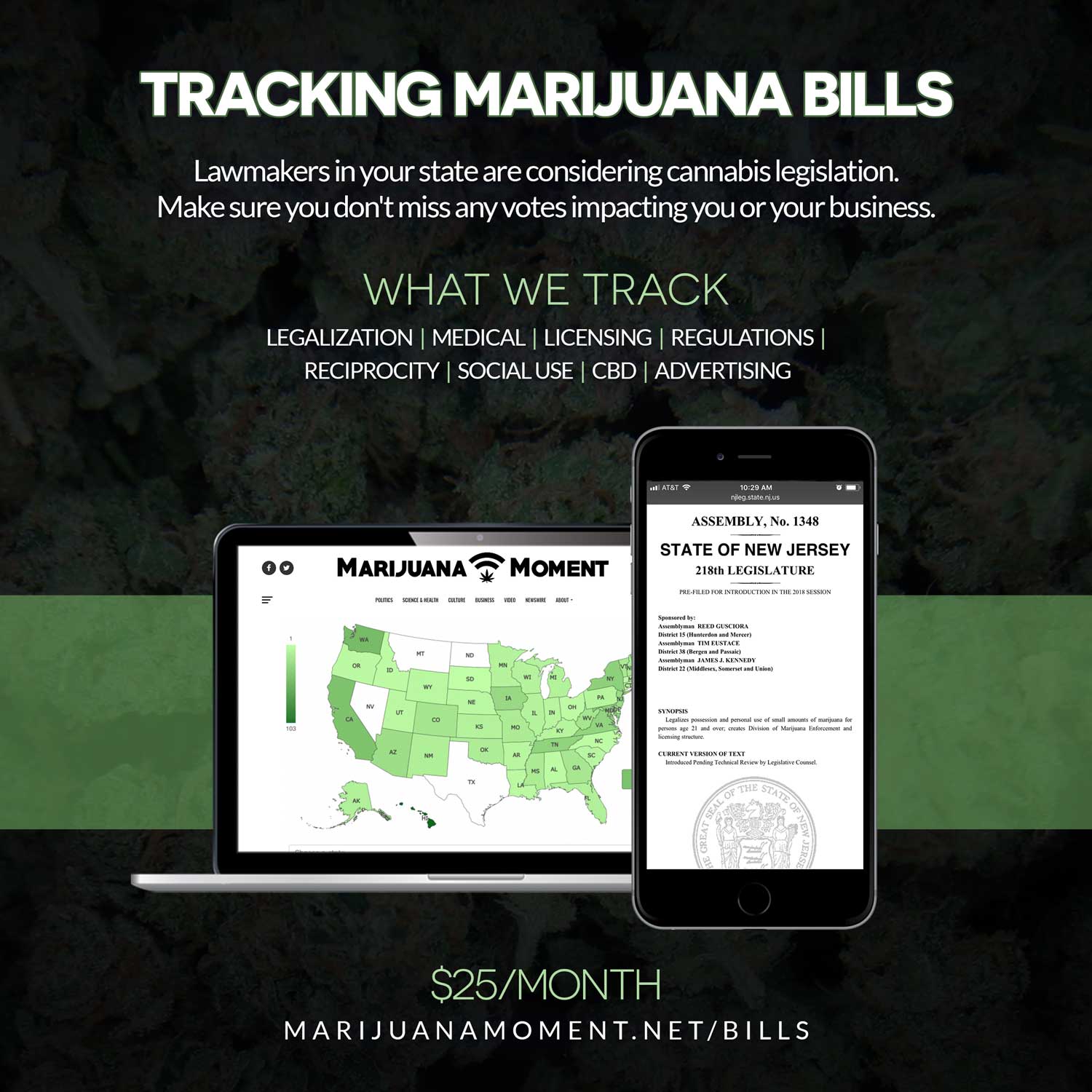

Learn more about our marijuana bill tracker and become a supporter on Patreon to get access.

Also last month, two GOP senators filed an amendment to block the Trump administration from rescheduling cannabis, but it was not considered on the floor.

Meanwhile, last month, DEA said the cannabis rescheduling appeal process “remains pending” despite Trump’s executive order.

A recent Congressional Research Service (CRS) report discussed how DOJ could, in theory, reject the president’s directive or delay the process by restarting the scientific review into marijuana.

Bondi separately missed a congressionally mandated deadline last month to issue guidelines for easing barriers to research on Schedule I substances such as marijuana and psychedelics.

The post Marijuana Consumers Overwhelmingly Back Trump’s Rescheduling Order, Poll Shows As Advocates Await DOJ Action appeared first on Marijuana Moment.

Source link

Think Democrats Can't Look Anymore Incompetent Right Now?—Trump Says 'Hold My Beer' and Reschedules Cannabis

Think Democrats Can't Look Anymore Incompetent Right Now?—Trump Says 'Hold My Beer' and Reschedules Cannabis

Think Democrats Can't Look Anymore Incompetent Right Now?—Trump Says 'Hold My Beer' and Reschedules Cannabis

Trump’s executive order reclassifying weed as a Schedule III substance is breakthrough news for patients, researchers, and the cannabis industry as a whole. It doesn’t legalize weed nor does it legalize recreational use, but by removing federal barriers to research, it helps us progress so much faster.

Source link

Wait, What Actually Happens When The US Finally Does Reschedule Marijuana?

Wait, What Actually Happens When The US Finally Does Reschedule Marijuana?

Wait, What Actually Happens When The US Finally Does Reschedule Marijuana?

One of the most immediate ways we’ll experience the benefits of rescheduling cannabis is on medical and scientific research. Keeping cannabis in the Schedule I category imposed massive regulatory barriers that made it difficult to study the plant, even for renowned and established clinical or scientific researchers. Strict DEA requirements and severely limited supply of cannabis that could be studied, were all major hurdles for researchers.

Source link

Your browser is not supported

Pennsylvania House Lawmakers Slam Senate Over Marijuana Legalization Inaction As Governor Again Calls For Reform

Pennsylvania House Lawmakers Slam Senate Over Marijuana Legalization Inaction As Governor Again Calls For Reform

Pennsylvania House Democratic lawmakers are calling on the GOP-controlled Senate to come to the table and pass a bill to legalize marijuana, as proposed by the governor once again as part of his budget latest request.

At a press conference on Wednesday, three Democratic members of the House who have championed adult-use legalization stressed the need to move on reform, laying blame for inaction on the Senate where even supporters of the policy change have so far been unable to deliver on the issue.

Reps. Rick Krajewski (D) and Dan Frankel (D), who sponsored a bill to legalize with state-run shops that advanced through the House last year, said they understand that the novel regulatory approach they envisioned may be “controversial” to some members, but that’s all the more reason for the Senate to bring their own ideas to the conversation to finally get the job done.

Gov. Josh Shapiro (D) didn’t call for a state-run model in his budget request that was unveiled this week; rather, his plan reflected a more traditional, private market that could still be a starting point for negotiations over the reform, the lawmakers said.

“This week, we heard from our governor: Pennsylvania must stay

The post Pennsylvania House Lawmakers Slam Senate Over Marijuana Legalization Inaction As Governor Again Calls For Reform appeared first on GrowCola.com.

Source link

[Video] Corporate Weed Has a Problem. This Maine Field Might Be the Answer

[Video] Corporate Weed Has a Problem. This Maine Field Might Be the Answer

[Video] Corporate Weed Has a Problem. This Maine Field Might Be the Answer

A 15-minute film follows one season of sun-grown cannabis in Maine and a partnership built to survive outside the corporate model.

In King’s Field, the story begins with a simple problem. King Bishop cannot grow enough cannabis to keep his shop stocked. The solution does not arrive through expansion capital or industrial infrastructure. It arrives through trust, experience, and a shared understanding of the land.

Directed by Joe Carter, King’s Field – A Maine Cannabis Story is a 15-minute short documentary that follows one full outdoor season of sun-grown cannabis in Maine. It is observational, unhurried, and grounded in the daily realities of cultivation. There is no narration guiding the viewer. The people involved speak for themselves, and the plants do the rest.

Bishop introduces himself, standing just outside Belfast, where his dispensary sits on the city dock. He traces his cannabis life from early caregiver days, when plant counts were tightly capped, through the transition to a dispensary model that finally allowed him to grow without artificial limits. Even then, demand outpaced supply.

“I ran out of cannabis every year,” he says plainly.

The film follows his partnership with Matt of Northern Sol, a sun-grown farmer who has spent years acclimating genetics to Maine’s specific climate. That process is explained not as branding but as survival. Humidity, mold pressure, cold weather, and short seasons demand plants that belong where they are grown. Genetics bred for California or Colorado do not automatically thrive in New England.

Over the last decade, Matt refined Maine-adapted genetics built to handle local pressures like humidity, mold risk, and the realities of a short outdoor season. The result is a densely planted field without traditional walking rows, designed to be planted and largely left alone until harvest. It is a shift from hands-on horticulture toward a more agricultural approach.

The scale is striking without feeling inflated. King argues a single person can manage an acre planted with roughly 12,000 to 15,000 plants. Harvest moves fast with a small crew, measured in days, not weeks, and the crop is processed into biomass that he says will show up in edibles and vape pens within about three weeks.

What gives the film weight is not scale, but restraint.

Carter’s camera captures moments that feel almost accidental. Jokes about surfing trips timed around early harvests. Quiet walks through the field. A pool beside the greenhouse, where the view is nothing but cannabis plants stretching to the horizon. There is humor, pride, and disbelief, especially when Bishop reflects on how, not long ago, this same field could have meant prison time.

“If this was my last grow,” Bishop says near the end, looking out over the colas, “I could retire on this note.”

That line lands because the film has earned it. King’s Field is not framed as nostalgia or resistance. It is presented as a working model for how small operators might survive a future dominated by corporate cultivation. Dense planting, region-specific genetics, low labor overhead, and deep familiarity with the plant.

There is a moment when Matt explains his philosophy simply. The path forward is found by working with present circumstances, not fighting them. Focus on the plant in front of you. Trust the genetics you have bred. Accept the scale of the task without being overwhelmed by it.

For High Times readers, King’s Field feels like a reminder of something essential. Cannabis did not start as a corporate product. It started as a plant shaped by place, people, and patience. This film does not argue that this way is the only way. It simply shows that it is still possible.

Sometimes the most radical thing a cannabis story can do is slow down, watch the season unfold, and let the field speak for itself.

<p>The post [Video] Corporate Weed Has a Problem. This Maine Field Might Be the Answer first appeared on High Times.</p>

Source link

Introducing Cannabiz Media's Newest Innovation—Sync

Introducing Cannabiz Media's Newest Innovation—Sync | Cannabiz Media

Introducing Cannabiz Media's Newest Innovation—Sync | Cannabiz Media

Cannabiz Media introduces Sync, a revolutionary feature allowing users to transfer cannabis operator data to over 50 platforms like Salesforce, HubSpot, and Zoho CRM. With real-time updates and customizable data mapping, Sync enhances workflows by seamlessly migrating license, company, and contact data at the click of a button. Offering significant productivity boosts, Sync makes data management easier than ever. © CNB Media LLC dba Cannabiz Media

Source link