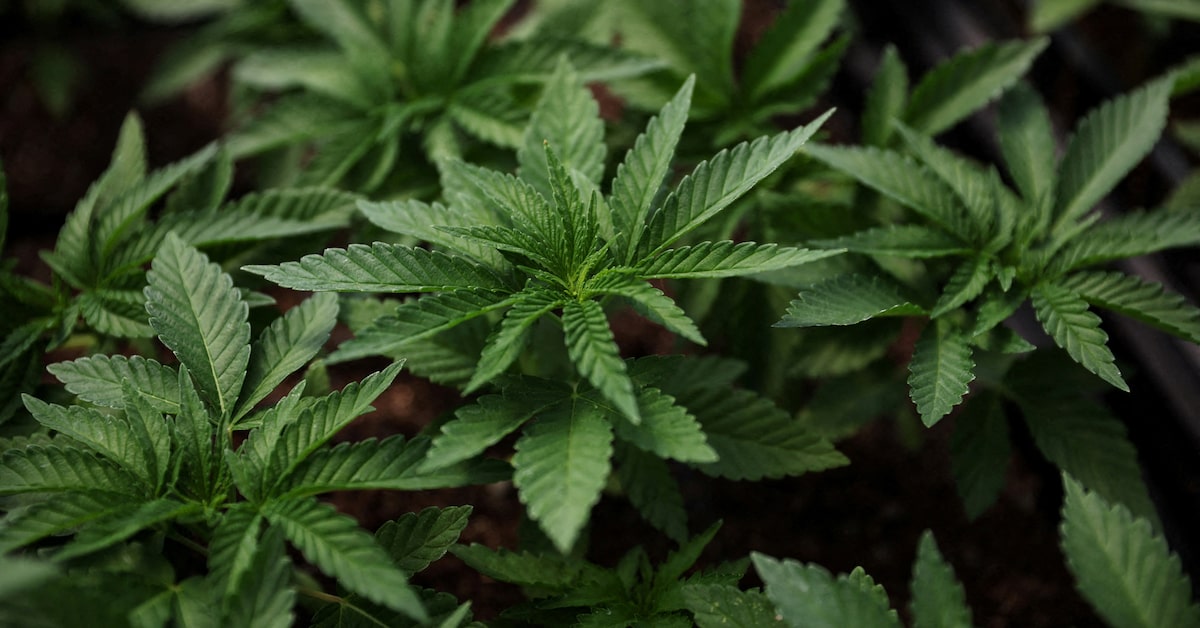
Marijuana plants are seen in a greenhouse in New York, U.S., July 15, 2022. REUTERS/Shannon Stapleton
LONDON, July 14 (Reuters Breakingviews) – The weed sector is not as high as it used to be. A slow revenue grind and relentless regulatory hits have left Big Cannabis facing a chronic funk. Budding opportunities, like the flowering German market, may see some North American groups cough up for a deal to plant a foreign seed. Yet a mellow mood, and puffed-out stock valuations, are probably baked-in for the foreseeable future.
Back in 2021, the much-hyped movement seemed to be sparking into life. Nearly 18 million Americans admitted to using the herb on a daily basis, overtaking the near-15 million daily drinkers, according to a survey published in the journal Addiction, opens new tab. New York, Virginia, Connecticut and New Mexico legalised recreational cannabis, as Alabama did for medical use.
Hopes abounded that then-President Joe Biden might breathe life into federal reform, making it easier for companies to access financial services and manage inventory across state lines. The ambient buzz saw the combined value of Curaleaf (CURA.TO), opens new tab, Green Thumb Industries (GTII.CD), opens new tab, Tilray Brands (TLRY.O), opens new tab and Trulieve Cannabis (TRUL.CD), opens new tab peak at $37 billion in February 2021. The same quartet, whose operations span everything from growing to packaging and selling weed and related products, at the time had an eye-watering average valuation multiple of 15 times forward sales, according to Breakingviews calculations based on LSEG Datastream figures.
The dreams behind those numbers, however, have gone up in smoke. That much was evident at an industry gathering at the Barbican Centre in London last month, where top investors, CEOs and bankers bluntly hashed out the sector’s biggest risks and opportunities. Attendees of Cannabis Europa, opens new tab, some bleary-eyed after wading through plumes of smoke, heard that right-leaning governments worldwide are blocking the opening up of new recreational markets. Sticky corporate debt burdens and low valuation multiples, meanwhile, have made expansion tricky.
It’s reflected in the stock market. Curaleaf, Green Thumb, Tilray and Trulieve are now collectively worth just $4 billion, LSEG data shows, with an average forward revenue multiple of just over 1. On aggregate, they’ll make a loss this year and next, based on analysts’ forecasts gathered by Visible Alpha. One long-term problem is that legalisation in the United States and Canada sparked a rush of supply, leading to a glut of marijuana and therefore much lower prices amid cutthroat competition. In New York, the number of registered dispensaries has exploded since legalisation in 2021 to 300 now, according to the Office of Cannabis Management. Average U.S. retail prices have declined by 32% over the same period, according to Cannabis Benchmarks, opens new tab.
Companies are also facing the stark reality of a total addressable market that looks stagnant at best. As U.S. state laws criminalising the herb fell like dominoes, investors once thought other countries would eventually succumb too. That now looks like a pipe dream. Not a single U.S. state has legalised recreational cannabis this year or in 2024. President Donald Trump’s government seems unlikely to do much. The Drug Enforcement Administration last year indicated that it might downgrade weed from the schedule one category under the Controlled Substances Act to schedule three, which could ease some federal restrictions and make more expenses tax-deductible. The process now seems stalled, however. In other markets, progress is being stubbed out. Last month, Thailand moved to ban recreational use amid concerns about addiction in younger users, having taken the drug off its narcotics list only three years earlier.
Amid the haze, boosters are finding solace in an unlikely place. Germany last year decriminalised cannabis possession and small-scale production, while stopping short of allowing wholesale cultivation. Bankers and investors at the London conference giddily talked up the prospects of inbound Teutonic M&A, as companies in the U.S. and Canada look to take advantage of potential growth in Europe’s biggest economy.
Privately owned Demecan or Cannamedical could be prime targets. The legal German cannabis market could grow by 14% each year until 2030, according to a report from Research and Markets, opens new tab. But it’s starting from a low base. Last year, the market was worth just $37 million. And there are other obstacles. Planned licences for pot shops and pharmacies, for example, have failed to materialise amid concerns from European leaders about a surge in illegal exports.
It’s all a far cry from the multibillion-dollar global dreams of a few years ago. But there’s not much else to get excited about. Amid a drought of optimism, even the most unpromising of buds can seem like salvation.
Aimee joined Breakingviews in 2017 and writes about pharmaceuticals, consumer goods groups, retail and insurance. She is also co-host of the Breakingviews podcast The Viewsroom. Based in Ireland, she previously spent three years at The Sunday Times as banking correspondent. Prior to that, she was a senior reporter covering the bond market at IFR, a financial trade publication published by Thomson Reuters. She holds a degree in English and History from the National University of Ireland, Galway, and a diploma in journalism from the London School of Journalism.