Shop Co-founded by Woody Harrelson, Bill Maher, and John McEnroe Targeted
The high-profile cannabis dispensary co-owned by actor Woody Harrelson, comedian Bill Maher, and tennis great John McEnroe, and others was targeted in a smash-and-grab burglary over the weekend, with the entire incident captured on surveillance video.
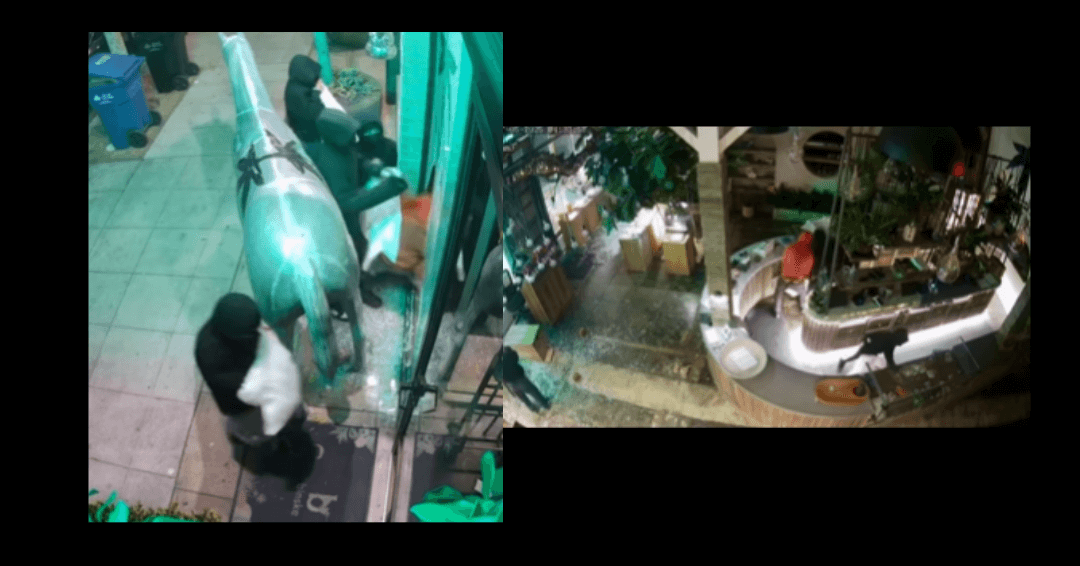
The burglary occurred at The Woods WeHo, located on Santa Monica Boulevard, early on Sunday morning. Security footage shared by fellow dispensary owner Elliot Lewis on Instagram shows five masked individuals wearing hoodies exiting a vehicle, shattering a glass window to gain entry, and swiftly loading bags with products before fleeing the scene.
The amount of merchandise that was stolen is unknown.
The video also claims to show a second dispensary burglary at Erba in Santa Monica the next night. However, the closest Erba location to Santa Monica is in Sawtelle, which was the site of a break-in on May 15 when a security guard opened fire at a group of thieves at 4:20 a.m. This was the second attempted robbery at the West Los Angeles Erba location after a security guard shot and killed a suspect in the early morning hours of March 10.
The Woods WeHo, which opened in 2022, was founded by Harrelson and his wife, Laura Louie, alongside Maher, McEnroe, and two additional business partners. The upscale dispensary has drawn attention for its celebrity backing and boutique-style cannabis retail experience.
ROCHESTER — Olmsted County commissioners moved forward with plans to hold lotteries this summer to determine which potential cannabis retailers will be registered for local operations.
“This has been a long process,” County Board Chairman Mark Thein said Tuesday evening as commissioners unanimously approved lottery-related updates to the county’s cannabis ordinance.
The decision came after more than a month of tweaks to the proposed process, which continued Tuesday afternoon.
Among recent changes was a clarification of retail categories the county can limit.
The county has capped potential retailers in three state-licensed categories at 14, leaving the potential for additional medical cannabis combination businesses to sell both marijuanna for medical and recreational uses from a single storefront.
With the Minnesota Office of Cannabis Management reportedly seeing six applications for the combination licenses, county staff had proposed reserving a single registration for the category but later determined the category fell outside the local limit.
“The medical cannabis combination businesses are not subject to our cap, but they are subject to our registration,” Olmsted County Public Health Associate Director Sagar Chowdhury said.
As a result, the county plans to issue eight microbusiness registrations, which would allow a business to grow, buy and sell cannabis from a single site. A lottery for those registrations is targeted for July, with state license holders expected to have at least two week’s notice when applications are due.
Another eight retail cannabis registrations within the county will be reserved for businesses able to sell cannabis from up to five locations statewide. The state licenses don’t allow the businesses to grow cannabis for sale.
Two county registrations are also planned for mezzobusinesses, which are licensed to grow, buy and sell cannabis from up to three outlets statewide.
Chowdhury has said the county anticipates more than 14 businesses to seek local registration, but if applications fall short in any category, the remaining slots are expected to be available for the category with the most demand.
Since retail cannabis and mezzobusiness licenses are capped at the state level and subject to
the county lotteries for those registrations are expected after the state licenses are issued. Chowdhury said the local drawings could occur in late July or early August.
Once the county issues a registration, businesses are expected to open within six months, but will be allowed a 90-day extension, if requested.
The original plan called for allowing a one-year extension, but commissioners opted to reduce the time to ensure a potential registration isn’t tied up for more than nine months.
“It’s really unfair to the businesses that might be waiting for one,” commissioner Bob Hopkins said.
If a business fails to open or gives up its registration, the county plans for reserves to be drawn during the lotteries, which will provide the alternate business a chance to secure the vacated registration. Reserve slots will be held for up to 18 months.
With county commissioners approving lottery plans, Chowdhury said more changes to the local cannabis guidelines are expected to be discussed in the wake of discussions with potential retailers and changing state-level guidelines.
He said input from eight potential business owners was largely supportive of steps being taken, but the retailers voiced some concerns regarding the lack of a social equity component in the county lotteries and zoning restrictions related to cannabis businesses.
At the state level, Chowdhury said legislative changes could point to a need for county review of existing local policies for low-potency hemp products and temporary cannabis events as it continues to update and tweak the local ordinance.
“We may have to come back here and amend a few things in the near future,” he said.
Randy Petersen joined the Post Bulletin in 2014 and became the local government reporter in 2017. An Elkton native, he’s worked for a variety of Midwest papers as reporter, photographer and editor since graduating from Winona State University in 1996. Readers can reach Randy at 507-285-7709 or rpetersen@postbulletin.com.
Among adolescents, both with and without asthma, those who vape or smoke nicotine or cannabis are more likely to experience respiratory symptoms than those who do not. These were among study findings presented at the American Thoracic Society (ATS) 2025 International Conference, held May 18 to 21, in San Francisco, California.
Researchers conducted a prospective cohort study in late 2022 to assess the use of inhaled substances (vapes, nicotine, and cannabis) and associated respiratory symptoms in adolescents with and without asthma.
The researchers surveyed 3453 adolescents from Southern California, asking them about their use of inhaled substances (ie, vape, nicotine, or cannabis use) over the past 30 days, the past 6 months, and their total lifetime. Participants were also asked to self-report any asthma diagnosis and respiratory symptoms (eg, current cough) they had experienced. Odds ratios (ORs) for the association of asthma diagnosis and/or respiratory symptoms with vaping or smoking were adjusted for socioeconomic demographics.
Overall, 18.2% of participants reported asthma diagnoses. Participants with asthma diagnoses vs those without were more likely to report respiratory symptoms (61.5% vs 26.2%; OR, 4.49; 95% CI, 3.75-5.38).
“
[W]hen respiratory symptoms were reported it was more likely there had been vaping and smoking of nicotine or cannabis behavior.
Adolescents who reported respiratory symptoms (with or without asthma diagnosis) mostly had higher odds of reporting past 30-day, past 6-month, and lifetime vaping compared with adolescents without respiratory symptoms and no asthma diagnosis (ORs, 1.32-2.43; all P <.05). The notable exception related to cannabis vaping in the past 6 months (P =.11).
Among those with no respiratory symptoms, having asthma (vs not having asthma) was not associated with increased odds of any vaping or smoking behavior.
The investigators concluded, “In this adolescent cohort, when respiratory symptoms were reported it was more likely there had been vaping and smoking of nicotine or cannabis behavior in the last 30 days, 6 months, and ever (lifetime) use.”
Three medicinal cannabis genotypes provided by Cann Group Ltd (https://www.canngrouplimited.com/, accessed on 22/03/2024) were employed in this study. These genotypes included one high CBDA strain, “Cannatonic,” and two high THCA strains, “Hindu Kush” and “Northern Lights” (previously referred to as “CBD1,” “THC6,” and “THC1,” respectively)42. These genotypes had also been previously used in the same growth system in our study on photoperiod responses25. These lines were initially chosen because they were all popular medicinal cannabis cultivars but phenotypically and genetically distinct, thus provided information directly relevant to the industry while also providing an indication of the genotype-specificity of observed responses.
All plants were cultivated in a secure facility approved by the Australian Government Department of Health and Aged Care Office of Drug Control (ODC). The experiments were carried out under a Commonwealth license and associated permits. Temperature and humidity were maintained at 25 °C and 50%, respectively. The plants were grown in controlled environments (CE) throughout their life cycle, and they were moved within the CEs on a weekly basis during the flowering period to account for any environmental variations.
The cloning and propagation method used has been previously documented42. Experimental plants were cloned from donor mothers. Approximately 15 cm of new growth stems were excised from the mother plants. All leaves on the stem sides were removed, leaving only the top leaf bunch. The bottom of the stem was cut diagonally across a node, creating a clone approximately 12 cm in height. The top leaf bunch was trimmed to the height of the smallest emerging leaf to reduce water loss and prevent overlapping in the propagation dome. The bottom 1 cm of the stem, where roots would form, was lightly scraped with a scalpel, dipped in hormone gel (Clonex Purple, Yates, DuluxGroup, Clayton, Australia), and placed in an organic propagation cube (Eazyplug CT12, Goirle, The Netherlands, eazyplug.nl).
Once the propagation tray was filled with new clones, it was positioned in a propagation dome (Smart Garden heavy-duty 3-piece propagation kit, Epping Hydroponics) for 14 days. The clones were subjected to an 18-hour light/6-hour dark (18 L:6D) photoperiod in a growth cabinet (Conviron A2000, Conviron Asia Pacific Pty Ltd, Grovedale, Australia) at a light intensity of 100 µmol m² s⁻¹ and a temperature of 25 °C. Humidity was gradually reduced over the 14-day propagation period. Plants with established roots were then transplanted into 1.8-litre pots containing a 30:70% blend of perlite and coco-coir with an electrical conductivity (EC) of < 0.5 mS/cm (Professors Nutrients, Australia). Subsequently, the plants were transferred to controlled flowering environments under a photosynthetically active radiation (PAR) of 600 µmol m² s⁻¹ (Heliospectre Grow Light, LX602C) and maintained under an 18 L:6D photoperiod for an additional 5 days as a hardening period to acclimate to the new environment. After the additional 5 days, the photoperiod was switched to one of the 6 treatments described below and flowering was initiated. The temperature ranged from 20 oC (night) to 26 °C (day), and blackout curtains prevented light leakage. The plants were watered and fed using a commercial fertigation recipe with an electrical conductivity (EC) of 2.2 mS/cm and a pH of 6. As there was an odd number of plants (21) within each treatment, plants were spaced 10 cm apart in 40 × 50 cm grid with an extra plant on the end of the row. As plants were kept small (see Peterswald et al. 2023), this setup assured that plants did not shade each other. To avoid edge effects plant positions were shifted in the chambers twice per week during watering.
Treatments
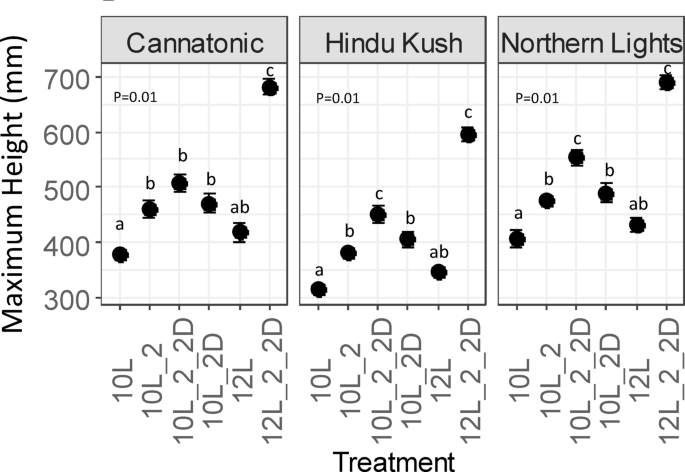
Each treatment contained 7 replicates of each of the 3 genotypes in a fully randomised design. The six zones were programmed to one of each of the following photoperiods with different timing applications of FR as presented in Table 2. All plants were maintained in these treatments for 40 days, which was the day after cloning (DAC) 70, which is the end point of the flowering treatments.
The 6 programmed zones were controlled using Heliospectre Software (heliospectra.com). A description of each six light spectrum treatments is described in Table 3. The light intensity drops for all treatments from hour 8 because the maximum power (µMol m2 S-1) of the red light band (660 nm) is more powerful than the maximum of the FR band (735 nm) therefore, in order to achieve a low ratio, the FR had to be turned up and the red band down. Treatments not receiving FR in the light period were treated the same to ensure that the daily PAR was consistent between treatments. The height of the plants from the lights was not periodically adjusted because our experiments were designed to represent conditions in commercial facilities in which the bench height and lighting infrastructures are typically fixed. The temperature within the treatments at canopy height was 26 oC under the full spectrum lights and 24 oC under FR only and 20 oC with all lights off.
Table 2 Six treatments applied. Seven replicates per genotype were included for each treatment.
Table 3 The PAR, % of each colour in the total spectrum and ratios for the treatments.
Measurements
Photosynthetically active radiation (PAR) and the PAR of blue (460 nm), red (660 nm) and white (5700 K) light was measured using a LightScout Quantum Meter and Far Red (735 nm) was measured using a LightScout Red/Far Red Meter (spec-meters.com)/ (accessed on October 19, 2023).
Flowering development was assessed on a weekly basis starting from Day After Cloning 37 (DAC 37) to ascertain the presence or absence of pistils (scored as 1/0) and trichomes (scored as 1/0). Plant height was measured weekly, commencing from DAC 30.
The harvest took place on DAC 70. Plants were excised at the base, and then the whole plant was weighed (whole plant FW). The large fan leaves were removed, and the flowers were manually stripped from the stem and trimmed using a mechanical trimmer (TrimPro ROTOR, Canada). The trimmed flowers were re-weighed (trimmed flower fresh weight) and placed into a foil tray. The flowers were dried in a dedicated drying room at 21 °C and 50% humidity until no further reduction in weight was observed (9 days). The samples were then re-weighed, and the total flower dry weight (g plant− 1) was calculated.
Analytics
The methodology for quantifying cannabinoids has been previously documented28. For each of the 6 treatments and control groups, 4 biological replicates were analyzed for THCA and THC (in the cases of Hindu Kush and Northern Lights) and CBDA and CBD (for Cannatonic), encompassing three different genotypes. Total THC and CBD was then calculated with the following formulae: Total THC = THC + (THCA*0.877) and Total CBD = CBD + (CBDA*0.877).
From each individual plant, three florets were randomly selected from the dried subsample of flower material and finely ground into a powder using liquid nitrogen. A 0.1-gram sub-sample was employed for cannabinoid quantification, which involved sonication in 100% ethanol using a SONICLEAN instrument (Soniclean®, Dudley Park, Australia) operating at 50/60 Hz for 30 min, followed by centrifugation at 10,000 rpm for 10 min. The resulting ethanolic extracts were preserved at -10 °C until needed. Subsequently, these extracts were diluted and subjected to analysis through high-performance liquid chromatography coupled with quadrupole time-of-flight mass spectrometry (UHPLC-QToFMS, Agilent Technologies, Santa Clara, CA, USA). Separation was achieved using a reversed-phase column (Agilent Infinity Poroshell 120, HPH-C18, 2.1 × 150 mm, 2.7 μm, narrow bore LC column, Agilent Technologies, Santa Clara, CA, USA) with mobile phases consisting of methanol-water-acetonitrile and acetonitrile, both containing 0.1% formic acid (v/v). The analysis was executed using Quant Analysis Software 10.2 (Agilent Technologies, Santa Clara, CA, USA), and cannabinoid peaks were identified based on their mass-to-charge (m/z) values and retention times by calibration against cannabinoid standards (Novachem, VIC, Australia).
The total yield of each cannabinoid in g per plant (g plant− 1) was calculated as follows:
((%Cannabinoid/100) x Total flower dry weight in grams) = g cannabinoid plant− 1.
Power use calculations
The kWh used by each of the treatments was calculated using an amp meter (Hioki AC Clamp Meter 3280–10 F, Hioki, Singapore), with a resolution of 0.01 A. The lights were LEDs so there was no “ramp up” or down period and so the amperage requirement for a single setting (e.g. 12 L–2 h of FR in the dark) does not change. At a single timepoint, the amp meter was fitted to each light treatment and the current draw (power drawn from the grid) was recorded. Amps were then converted to kW and multiplied by the photoperiod duration (e.g. 12 h at full spectrum + 2 h of far-red). The carbon emissions per kWh for New South Wales (NSW) Australia were sourced from The Australian Greenhouse Accounts Factors 202229.
Statistical analyses
All graphics and statistical analyses were performed in R 3.143. One way ANOVA’s were performed per variety and Tukey HSD tests were used to identify pair-wise differences between treatments significance for all tests was set at ≤ 0.05. In circumstances were the ANOVA returned a significant statistic but the Tukey HSD test could not identify difference at the ≤ 0.05, a Least Significant Differences (LSD) test was performed using the agricolae package in R43,44.
The Minnesota House on Saturday passed the omnibus cannabis policy bill that makes changes to the state’s adult-use cannabis law and will set up the marketplace, moving it to Gov. Tim Walz (D) for his signature. The bill passed the state Senate on May 5.
The bill creates a lower-potency hemp wholesaler license, allows individuals with adjudicated cannabis-related sentence to be social equity applicants, allows vendors to provide samples at cannabis events, allows manufacturers in Minnesota to export low-potency hemp products out of the state that aren’t compliant in Minnesota, allows testing facilities to begin testing while in the accreditation process, and allows a beverage to be one serving with no more than 10 milligrams of THC.
In a press release, state Rep. Nolan West (R), who collaborated with bill sponsor state Rep. Zack Stephenson (D) on the legislation, pointed out that Ohio legalized cannabis six months after Minnesota in 2023, but Minnesota doesn’t yet have a licensed adult-use cannabis store.
“We could do a lot better. Thankfully, this bill does help. We have a hopelessly convoluted regulatory system based on this fantasy that you can create a craft cannabis market based on government regulation.” — West in a statement
State Sen. D. Scott Dibble (D), the Senate sponsor, called the bill “a big win” for the Senate. However, state Sen. Jordan Rasmusson (R) said promises made in the 2023 law legalizing adult-use cannabis have fallen short and that the bill is missing items that would protect consumers.
Among the Senate proposals that weren’t included in the agreement was label requirements for cannabis packaging warning that children shouldn’t consume cannabis products.
Walz signed the bill legalizing cannabis for adult use in 2023. It is expected he will sign the legislation to update the state’s cannabis law.
Get daily cannabis business news updates.Subscribe
Have an additional perspective to share? Send us a message to let us know, and if your comment is chosen by our editors it could be featured here.
Perspective to add? Suggest a revision or submit commentary for review using the form below.
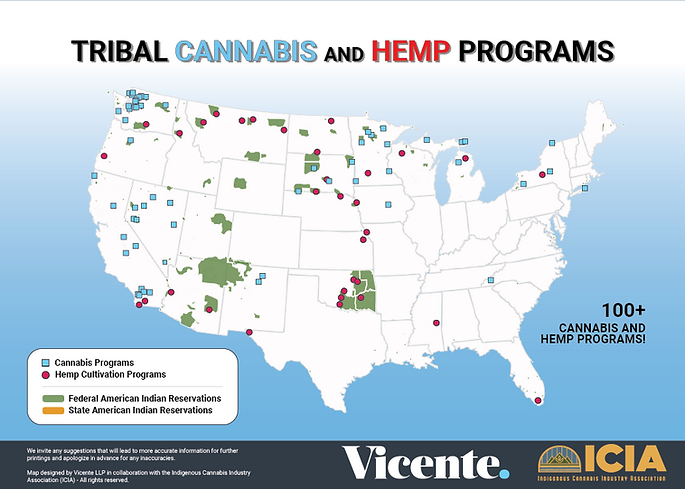
The Indigenous Cannabis Industry Association (ICIA) last week unveiled a map of tribal cannabis and hemp programs. In collaboration with cannabis law firm Vicente LLP, the map was developed through research and interviews with tribal leaders. The map shows the locations of Indigenous cannabis programs in blue and hemp programs in red. There are currently 52 tribal communities that operate federally approved hemp programs, and dozens have created custom systems to regulate cannabis for both medical and adult use.
About 26% of Indigenous communities in the continental U.S. are involved with cannabis or hemp programs, according to ICIA data.
In a statement, ICIA Founder Rob Pero said the project “will highlight the thoughtful work that has gone into these sovereign regulatory programs as well as how these businesses affect local employment and revenue for community service.”
“Together, we hope to inform, inspire and empower other Indigenous communities considering cannabis as well as policy makers around the world.” — Pero in a press release
Andrew Livingston, director of economics and market analysis at Vicente LLP, added that “Indigenous cannabis programs are a vital piece of America’s cannabis movement.”
“And these businesses deserve recognition,” he said in a statement. “The goal of our study is to provide information on how different Indigenous communities have established their regulated cannabis programs, the size of the economic opportunity, and the ways that regulating cannabis can be structured in the future to further the goals of each community.”
Information for the ICIA map powered is taken from all accessible data, including the U.S. Department of Agriculture directory, in-market research, and relationship data, and is current as of April 2024.
Get daily cannabis business news updates.Subscribe
Have an additional perspective to share? Send us a message to let us know, and if your comment is chosen by our editors it could be featured here.
Perspective to add? Suggest a revision or submit commentary for review using the form below.
Amid legislative roadblocks, Nebraska Gov. Jim Pillen (R) announced last week his administration’s intentions to provide support and resources to the newly-created Medical Cannabis Commission (MCC) through the Policy Research Office (PRO) and Department of Administrative Services (DAS), consistent with the support those agencies provide to other agencies during the regulatory process.
The MCC was created through voter approval of two initiatives, but launching the medical cannabis program has so far been blocked by lawmakers who cannot agree on legislation to enact the reforms. Earlier this month, state Attorney General Hilgers urged lawmakers to reject proposals to create the program, alleging that regulating the medical cannabis industry would “supercharge the black market,” fuel adult-use cannabis reforms, and “make Nebraska less safe, more dangerous.”
“I have appointed two experienced, well-qualified individuals to the Medical Cannabis Commission, who will ensure this new industry is strongly regulated to the letter of the law the people of Nebraska enacted. I urge the Legislature to promptly confirm them so they can take up the urgent work of writing strong and effective ‘rules of the road’ for the medical cannabis industry.” — Pillen in a press release
Pillen added that with support from the PRO, DAS, and other agencies, as necessary, the MCC is fully enabled to meet and carry out its responsibilities under the Patient Protection Act and the Regulation Act to meet its milestone dates of July 1 and October 1. He noted that operational funding has already been appropriated to the MCC and that due to the statutory financial authority of DAS, the commission will have all the financial resources it needs to effectively function under current law.
Get daily cannabis business news updates.Subscribe
Have an additional perspective to share? Send us a message to let us know, and if your comment is chosen by our editors it could be featured here.
Perspective to add? Suggest a revision or submit commentary for review using the form below.
Suspended sentences for U.S. service members and Defense Department civilian employees for importing drugs onto Okinawa via mail are not uncommon. (Pixabay)
NAHA, Okinawa — A Japanese court on Tuesday handed a U.S. Marine Corps spouse a suspended sentence for sending liquid cannabis to Okinawa through the Military Postal Service.
Naha District Court Judge Masataka Tanabe sentenced Ashley Griewahn, 38, to two years in prison with hard labor. Her case was tried April 30. Tanabe suspended Griewahn’s sentence for three years, meaning she will not serve time in Japanese prison provided she commits no further offenses.
She is married to Capt. Kenneth Griewahn, who works at Marine Corps Air Station Futenma, according to evidence read during the trial by the prosecutor, who identified himself in court only by his last name, Ikeda.
Capt. Griewahn, of Michigan, is an avionics officer with Marine Aviation Logistics Squadron 36, Marine Aircraft Group 36, according to an email Tuesday from 1st Marine Aircraft Wing spokesman Maj. Joseph Butterfield.
The Marine Corps cooperated with Japanese authorities during the investigation, which found no evidence of misconduct by Capt. Griewahn, he added.
“We are committed to being good neighbors in our host communities, and we expect the same standard of conduct from all family members accompanying service members on orders,” he said.
Ashley Griewahn was indicted March 10 for attempting to smuggle 10.73 grams of liquid cannabis, or 0.4 ounces, to Okinawa in October.
She hid 11 cartridges of the drug in two boxes of toys that her husband shipped from Michigan on Oct. 12 and were intercepted Oct. 17 by the Camp Foster customs office, according to the indictment.
She bought the drugs from a website, Amazing Budz, while in Michigan, Ikeda said in court on April 30. Recreational cannabis is legal in Michigan.
During the investigation, Griewahn told prosecutors she secured four cartridges in one box and seven in the other with tape, and that her husband sent the packages without knowing they contained drugs.
Tanabe suspended the sentence because Griewahn admitted to smuggling the cannabis, showed remorse and has no criminal record in Japan, he said Tuesday.
“I’m truly sorry for what I’ve done,” Griewahn said April 30. “I regret it deeply. I’m sorry to Japan, to the people related and to my family.”
Suspended sentences for U.S. service members and Defense Department civilian employees for importing drugs onto Okinawa via mail are not uncommon.
An illegal immigrant has been jailed for three years after an “industrial” cannabis growing operation was found in an extension attached to a Brighouse hotel and wedding venue.
The sophisticated set-up, uncovered in 2024, could have produced cannabis worth almost £500,000 on the wholesale market and up to £1.4m at street value, Bradford Crown Court heard.
Le Thanh Long, 23, worked in other parts of the Casa Hotel and Restaurant on Elland Road while hotel guests enjoyed fine dining, prosecutor Nadim Bashir said.
Long, of Withington Road in Manchester, was found guilty of being concerned in the production of cannabis, and was jailed on Monday for three years.
Long and four other Vietnamese men were cleared of their involvement in another large cannabis grow uncovered during a police raid on the former Ritz Ballroom on Bradford Road in Brighouse, when 1,800 plants were found inside the former dance venue.
The defendants said they were victims of modern slavery and had been forced to work there in January 2024.
Electricity workers at the Casa Hotel eventually discovered in August that the supply to the premises had been bypassed, Mr Bashir said.
Police set up a “scene guard” overnight following the discovery of the cannabis operation, and more than 1,700 cannabis plants were found in 13 “grow rooms”, Mr Bashir said.
Long was found to be hiding in the premises before making a bid to escape in the early hours, but was spotted running from the scene by an officer and detained at a nearby bus stop.
Barrister Jeremy Barton, defending Long, said his client had worked as a “gardener” for about four months.
During sentencing, Judge Kirstie Watson said the cannabis found at the Casa Hotel was being produced on an “industrial basis” and that Long must have been aware of the scale of the operation if he had been involved for four months.
“I accept that having entered this country illegally, looking for work, that vulnerability was no doubt exploited by others,” she told Long via an interpreter.
Two individuals were arrested on Monday in northern Greece for allegedly being part of a drug trafficking operation that used postal services to deliver packages.
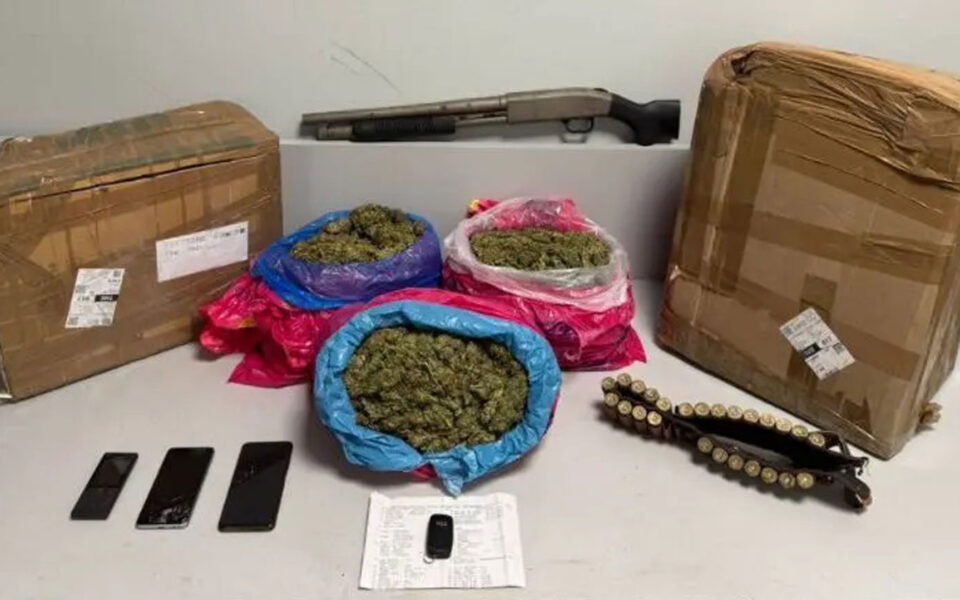
The arrests, made in the Imathia and Pella regions, followed a recipient’s collection of a 3.2-kilogram cannabis package from a courier locker in the town of Alexandreia, in the Imathia region.
A subsequent search led to the discovery of a shotgun, 25 cartridges, three mobile phones, and a vehicle. All items were seized.
The suspects face charges of membership in a criminal organization and violations of drug and weapons laws. They are set to appear before the competent prosecutorial authority as part of the ongoing judicial process.