
Target’s Hemp-Derived THC Beverage Launch in Minnesota—A Missed Opportunity in a Legal State

Target’s Hemp-Derived THC Beverage Launch in Minnesota—A Missed Opportunity in a Legal State


Target’s Hemp-Derived THC Beverage Launch in Minnesota—A Missed Opportunity in a Legal State

When Target announced its pilot program to sell hemp-derived THC beverages in select Minnesota stores, the news made waves in both the cannabis and retail industries. Major headlines touted it as a “monumental” shift, a sign of mainstream acceptance, and a potential bellwether for national change. But as we look closer, it’s clear that Target’s entry into the THC beverage market is far from revolutionary—especially in Minnesota, a state that has already embraced full cannabis legalization.

Instead of charting a bold new course, Target’s approach feels like a calculated compromise: safe, limited, and designed to minimize risk rather than genuinely embrace the cannabis revolution already underway. Here’s why that matters—and why consumers and brands invested in true cannabis innovation should view this move with a healthy dose of skepticism.


Playing It (Too) Safe: Why Hemp-Derived Only?

Minnesota legalized adult-use cannabis in 2023, joining a growing list of states where consumers over 21 can legally purchase and enjoy a wide variety of cannabis products. Licensed dispensaries offer flower, edibles, concentrates, and yes—THC-infused beverages, often crafted with high-quality cannabis extracts. These products are often more transparent, rigorously tested, and tailored for a sophisticated consumer base that knows the difference between hemp- and cannabis-derived THC.

Yet Target chose to offer only hemp-derived THC beverages, capped at 5mg THC per serving and 50mg per package, as allowed under Minnesota’s earlier 2022 “low-potency” hemp law. Brands like Cann, Hi Seltzer, Stigma, and Trail Magic are featured in the pilot, but all conform to the more restrictive framework designed for a pre-legalization market.

For a retailer of Target’s size and influence—headquartered in Minneapolis, no less—the decision to stick to hemp-derived products feels behind the curve. With adult-use cannabis now legal statewide, this “soft launch” looks less like innovation and more like corporate hedging.


Hemp vs. Cannabis: The Critical Distinction

It’s crucial to understand the difference between hemp-derived and cannabis-derived THC products. Hemp-derived THC beverages are made using cannabinoids extracted from federally legal hemp, defined as cannabis plants containing less than 0.3% THC by dry weight. These products exist in a regulatory gray area—legal at the federal level, but often facing patchwork state restrictions and less consumer trust.

Cannabis-derived products, by contrast, come directly from marijuana plants bred for higher THC content. In legal states like Minnesota, these products are subject to stringent state oversight, lab testing, and transparent supply chains. They’re what most consumers are looking for when they want a premium, reliable, and enjoyable cannabis experience.

By limiting its offering to hemp-derived beverages, Target is not only restricting consumer choice, but also sending a message: mainstream corporate America is still wary of fully embracing legal cannabis, even in states where voters and lawmakers have already paved the way.


Consumer Savvy in a Mature Market

Minnesota’s cannabis consumers are more sophisticated than ever. They know the difference between a hemp beverage and a full-spectrum cannabis drink from a licensed dispensary. They understand dosage, entourage effect, and brand reputation. Many have already sampled high-quality cannabis beverages from local craft producers or specialized dispensaries—products that often deliver richer flavors and more consistent effects, thanks to robust state regulation.

So, when Target stocks hemp-derived THC beverages on its shelves, the move feels less like a game-changer and more like a half-step, especially when better options are available just down the street.


Missed Brand Value (and Consumer Trust)

For brands and consumers who stand for authentic cannabis experiences, Target’s pilot is a missed opportunity. Rather than elevating the conversation around cannabis and bringing new consumers into the fold, this approach risks confusing or even alienating them.

Imagine a new customer, curious about cannabis, who picks up a hemp-derived drink at Target, only to find it underwhelming compared to products from licensed dispensaries. Or a more experienced enthusiast, who sees the move as evidence that big-box retailers just don’t “get it.” In both cases, the result is the same: a diluted brand experience and a missed chance to foster real loyalty.


Regulatory Reality or Convenient Excuse?

It’s worth acknowledging that federal law still prohibits the sale of cannabis-derived THC outside of licensed dispensaries, even in legal states. But Minnesota’s regulatory framework is evolving rapidly, with new dispensaries opening regularly and consumer demand on the rise. Target, with its resources and local footprint, could have played a leadership role—perhaps by partnering with licensed cannabis retailers, advocating for expanded access, or supporting education around safe and responsible cannabis use.

Instead, the company chose the path of least resistance, sticking to hemp-derived beverages that avoid federal scrutiny but fall short of meeting the market’s true potential.


Industry Reaction: Not All Cheers

While some in the beverage and cannabis sectors have hailed Target’s move as “monumental,” others see it as a clear sign of how mainstream retail is still skittish about full cannabis integration. Local dispensaries, craft beverage makers, and advocacy groups have all pointed out the limitations of hemp-only offerings—especially in a state that is supposed to be leading the way on legalization.


The Bottom Line

Target’s decision to sell hemp-derived THC beverages in Minnesota is, at best, a cautious toe-dip into the cannabis space. In a market where consumers already have access to legal, tested, and regulated cannabis products, this approach feels less like innovation and more like a corporate cop out.

If Target and other major retailers truly want to be leaders in the cannabis beverage revolution, they’ll need to move beyond the safety of hemp-derived products and embrace the full spectrum of what legalization has to offer. Until then, savvy consumers—and authentic cannabis brands—will continue to look elsewhere.


Author’s Note:
We believe that the future of cannabis—not just beverages—lies in transparency and authenticity. The industry should prioritize naturally derived cannabinoids and resist the growing trend toward synthetics. Only by upholding these standards can we ensure safe, genuine products that truly serve and respect consumers.

Source link

The High-THC Revolution: Why Growers Are Pushing Limits

The High-THC Revolution: Why Growers Are Pushing Limits


Why Growers Are Pushing Limits There was a time when anything above 20 percent THC was considered strong. Now, that is the warm-up round. American growers are chasing a new standard for power, flavor, and fame. The numbers keep rising, and so does the pride of the person who grows the strongest flower in the […]

The post The High-THC Revolution: Why Growers Are Pushing Limits appeared first on Stoner | Pictures | Stoners Clothing | Blog | StonerDays.


Source link

A Christmas Carol by Truman Capote, as told to Andy Warhol

A Christmas Carol by Truman Capote, as told to Andy Warhol

A Christmas Carol by Truman Capote, as told to Andy Warhol

In the “Opinion” section of the December, 1978 edition of High Times, famed writer Truman Capote (1924 – 1984) chats with art-world legend Andy Warhol (1928 – 1987) about what they want for Christmas.

Merry Christmas…

AW: So do you know what you want for Xmas?

TC: Well, first of all, I don’t want anything for myself at Xmas, I think that’s very selfish and what not. I know what I want for other people.

  • For Jackie Kennedy I want a sex-change operation. The reason is that since the American people must have a Kennedy, I’d rather have a Jackie than a Teddy.
  • I want for Timothy Leary justice at last, a ten-year full professorship at Harvard.
  • For Richard Avedon, I hope his portrait of Kate Graham finally makes the cover of Newsweek. You know, they took a picture of him for the cover of Newsweek and then discarded it because I don’t know…the Pope died or something.
  • For Gore Vidal, because of his great politics, I wish him an ambassadorship to Paraguay…and hope he stays there forever.
  • For Larry Flynt, the newborn Christian, I want him to be made first ambassador to the Vatican.
  • For Norman Mailer, I want a five-million-dollar contract to rewrite the old Tenth Amendment.
  • For Mick Jagger, in his old age, the directorship of the Metropolitan Opera.
  • For Andy Warhol, at all times, the directorship of the Metropolitan Museum and all its branches.
  • For Anita Bryant, I want her to be appointed editor of the Advocate.
  • For Steve Rubell [owner of Studio 54], I want him to be appointed ambassador to the court of St. James.
  • For Muhammad Ali, I want him to be our first black president.
  • For Ralph Nader, a wife at last, none other than little Anne Ford.

Joy to the World…

AW: Is high society really high?

TC: I wouldn’t know, I never met anyone from high society. I think high society is a complete myth, made up from the movies. When Joan Crawford died, so did high society.

Amen…

AW. Do you think everything in the world should be legal?

TC: Yes, I do, except murder.

High Times Greats: A Christmas Carol By Truman Capote As Told To Andy Warhol
Photo by Mick Rock

<p>The post A Christmas Carol by Truman Capote, as told to Andy Warhol first appeared on High Times.</p>

Source link

High Times Greats: A Christmas Story - Which Real Meaning?

High Times Greats: A Christmas Story – Which Real Meaning?

High Times Greats: A Christmas Story – Which Real Meaning?

High Times Greats: A Christmas Story - Which Real Meaning?

For an article in the December, 1979 edition of High Times, late, great counterculture correspondent Glenn O’Brien examined the connections between Santa Claus and a specific kind of psychedelic mushroom known as the fly agaric, aka the toadstool that conquered the universe. In fact, the existence of Santa could be related to a shaman in Lapland who ate Amanita muscaria. Even the government supports the compelling association between Santa and the fly agaric. Was Santa a mushroom eater?


This year, as usual, you’re going to get a lot of reminders on the subject of the Real Meaning of Christmas. And, as usual, these reminders will just be reminders. They will say, “And don’t forget the Real Meaning of Christmas.” They won’t remind you what the Real Meaning is, they’ll just remind you to remember it. They will assume that you know what it is. And you do, don’t you?

The Real Meaning of Christmas goes something like this: Christmas is not just a time for spending vast sums on lavish gifts, eating and drinking heavily and observing a complex of celebration scenarios derived more from the Druids and Vikings than from the apostles. No, it’s not just that. First and foremost Christmas commemorates the birth of Jesus Christ. For Christians it is the holiest of holy days, marking the birth of a Divine Man. The first Christmas was the day God was made Flesh.

Now that is certainly something to bear in mind as you make your Christmas rounds this year. But don’t let it put a damper on your shenanigans. For unlike most of those who would like to remind you of the Real Meaning of Christmas, we are not suggesting that you have a solemn, meditative or restrained little Xmas. No, not at all. Maybe all of the wild partying and gift giving and the artificially good manners that have sprung up around the day and all of those funky old neopagan trappings like the mistletoe and the Yule log and that old elf Santa are not really so far removed from the most holy Real Meaning of Christmas after all.

High Times wants you to remember to do both things this Christmas—get wild and high and ponder the significance of this highest holiday. There may be more of a connection here than meets the first two eyes. Maybe there’s a Real Meaning of Christmas that’s even more real.

Let’s start with the basic Real Meaning: All of a sudden God is a man. That’s the first Christmas. And a first-class mystery. How did man become God? A tough question. The traditional religious answer is that God became man. But supposing it was the other way around. How did man do it?

That’s a very tough question—especially because there is very little agreement as to how man became man. But maybe the answers to both questions are similar, if not one and the same.

Most docs think that man got to be man by evolution. From apes. Then again the apes are still around. The mystery hasn’t been totally solved by science. Some researchers seek the key to the evolution of intelligence in the DNA molecule, some suggest it drifted here in virus form from other worlds. One evolutionary theory that gets better every day suggests that man became man through his apprehension of God through the ingestion of psychoactive plants—a phenomenon still popularly known as seeing God. And who knows, maybe man got to be God, or vice versa, in a similar fashion.

The first Christmas was two millennia ago, give or take a bit. Stories can change a lot in a week. So our search for the secret, inside story of the Real Meaning of Christmas won’t be easy. We’ll have to look at the facts. We’ll even have to keep thinking, What’s a fact? Above all, we’ll have to keep our inspiration level high and hope for a perfect coincidence of the scientific method and shamanism or pharmacological Gnosticism. So keep your eye on the interstice at all times. If this works, it might disappear.

The Secret Funk Gospels

To rehash, the basic premise: If a man takes drugs, he may see God. If an ape takes drugs, may he see man?

The case for psychoactive plants as prime catalysts in the evolution of human consciousness (“creation”) has advanced remarkably over the last 30 years, and what not long ago was lunatic-fringe thinking in academia is now a heavyweight contender of a theory. Its first great proponent was R. Gordon Wasson, who rediscovered in the ’50s the Mexican psilocybe-mushroom culture. He later published a landmark of scholarship called Soma: Divine Mushroom of Immortality (Harcourt Brace Jovanovich, 1971), in which he sought to prove that another psychoactive mushroom, the fly agaric (Amanita muscaria), was the lost drug of the gods mentioned in the Vedic scriptures.

Another significant contribution to the idea was made by Andrija Puharich, whose Sacred Mushroom: Key to the Door of Eternity (Doubleday, 1959) made an impressive case for a similar usage of the fly agaric in ancient Egypt—although Puharich, unlike Wasson, did not limit himself to traditional research methods, and most of his data came through a medium.

Although the questions raised by Wasson and Puharich may have been hot questions in certain academic circles, they didn’t bring about a full-scale furor, nor did they instantly revolutionize modem thought. But in 1970 John M. Allegro, a distinguished philologist and the world’s foremost authority on the Dead Sea Scrolls, exquisitely blew the finely tuned minds of his academic colleagues—philologists and theologians alike—with the publication of The Sacred Mushroom and the Cross (Doubleday).

R. Gordon Wasson, in Soma: Divine Mushroom of Immortality, had already presented a distinguished scientific case for the fly agaric’s being Soma, the God-Plant of the Rig-Veda. And the research of Wasson and others had already established the widespread role of mushrooms in other shamanistic religions. But Allegro’s serious, scholarly case for Christianity’s being the decadent and totally misunderstood remnant of a tremendously powerful magical fertility cult that used a mushroom called Christ-Crucified was quite simply too much for almost everybody. It was bad enough that Allegro smoothly traced the origin of Yahweh to “juice of fecundity,” but to interpret the life of Jesus Christ as an allegory concealing a drug cult was simply preposterous. But, as Jesus said, “the last shall be first.” Right? Maybe that’s true for theories, too.

Anyway, even if it’s preposterous, it’s great Christmas reading and it certainly sheds a whole new light on the whole Christmas story. Allegro’s key to the Gospels is built into the fact that Semitic writing before and after the Gospel writers is uniquely rooted in puns as conveyors of multiple levels of information.

Jesus and his followers are not walking mushrooms but priests who used the various divine plants to heal, anointing the sick with them and casting out demons or various illnesses in their names.

According to Allegro, the sacred mushroom is the manna that fell from heaven and fed the Israelites in the desert. It is also the sacrament, the body and blood of Christ, that Jesus fed his apostles. It is the unleavened bread.

The body of Christ was born in a stable—traditional birthplace of mushrooms. At night. Of a virgin. The virgin birth is of particular interest since it explains the peculiar form of reproduction in fungi.

And no less an authority than Pliny is quoted as characterizing the Magi as “the great drug peddlers of the ancient world.” (Their gifts to Jesus were medicines and drugs.)

Whether or not there was a historical Jesus remotely resembling the object of Christianity is besides the point this Christmas, as the stars glide by Bethlehem.

You can’t write everything down. You have to use your imagination. Keep your eyes on the crèche.

According to Allegro, the real Christians wrote the Gospels when their cult was imperiled by Roman repression of the Jewish revolt of A.D. 66. He wrote:

“Instigated probably by members of the cult, swayed by their drug-induced madness to believe God had called them to master the world in his name, they provoked the mighty power of Rome to swift and terrible action….The secrets, if they were not to be lost forever, had to be committed to writing, and yet, if found, the documents must give nothing away or betray those who still dared defy the Roman authorities and continue the religious practices.”

The Gospels were the secret handbooks of the cult, and Allegro describes their intent:

“To tell the story of a rabbi called Jesus, and invest him with the power and the names of the magic drug. To have him live before the terrible events that disrupted their lives, to preach a love between men, extending even to hated Romans. Thus, reading such a tale, should it fall into Roman hands, even their mortal enemies might be deceived and not probe farther into the activities of the cells of the mystery cults within their territories.”

Of course this literary plot failed miserably and the cultists were persecuted like nobody else in history. Until the secret had to be covered, until the whole thing was forgotten. Almost. The greatest cover-up in history. And the cover organization, the copy of the original cult, became the greatest religion in the history of the world and invented Christmas, the greatest religious holiday in history.

Sound farfetched? Of course it is. And so are you. Look at all the things you did this year. All the stupid, selfish, dumb things. Jesus, of course, will forgive you. But what about Santa?

The Santa Connection

When it comes to Christmas, Santa is the one cat who can give Jesus a run for his money. Christmas might be intended to commemorate the birth of Jesus, but for the kids it’s mainly the arrival of Santa.

Now who is this Santa Claus character, and what does he want?

Actually, Santa Claus, like most success stories of today, is a conglomerate personality. He is, of course, Saint Nick, the patron saint of Greek sailors. But his real popularity began in Holland, where, known as Santa Klaas, he was associated with Christmas because of his alleged generosity, and thereby inspired the custom of gift giving. But obviously the Santa of today bears virtually no resemblance to Saint Nicholas (bishop of Myra, persecuted by Diocletian), who remains one of the more obscure martyrs on the heavenly roster. But even the Saint Nicholas of today, the patron saint of Russia, bears little resemblance to the “jolly old elf” who runs Christmas.

Most of Santa Claus’s characteristics, in fact, seem to be derived from Thor, the thundering hearth god of ancient blonds, who also celebrates his birthday on December 25th. Santa Claus is a sort of Thor emeritus, who held the old pagan rituals together in Europe under Christianity. He rides through the sky on a sleigh drawn by flying reindeer. And, of course, he can levitate, after placing a finger to the side of his nose.

Santa’s workshop is located at the North Pole. And what would he be without his red and white Santa suit? And for that matter, where would the Salvation Army be?

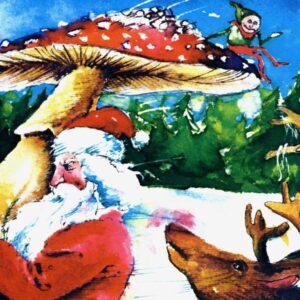
The truth of the matter is that the Santa suit depicts the Amanita muscaria (fly agaric) mushroom mentioned earlier. For one thing, his suit looks more like this mushroom than it does the suit of any other person, actual or fictional. If that isn’t enough, consider that Santa is the world’s largest employer of “little people.” It is well known that elves, gnomes, leprechauns and other diminutive types are often seen in the vicinity of these mushrooms, in the field and in children’s literature and interior design. And if that isn’t enough, what about the flying reindeer?

Well, anybody who knows anything at all about reindeer knows that there are two things in the world that reindeer crave: human urine and mushrooms, particularly the fly agaric mushrooms of the sort resembling Santa’s suit. It would seem that reindeer like to get off on amanitas as much as their Mongol owners do. No sane reindeer owner would consider whipping it out in front of one reindeer, much less ten, because the urine of the amanita user has the same potency as the mushroom.

Anyhow, this constellation of amanita clues could be laid to coincidence if it were not for the flying and the levitation, both symptoms of amanita eating in reindeers and humans.

It is also likely that Rudolph’s red nose comes from amanita consumption. And his ability to guide Santa’s sleigh through the densest fog in Christmas history is perhaps not from the actual illumination of his nose but from a sort of psychic radar. This same ability is perhaps what enables Santa to know when you are sleeping, to know when you’re awake, and to know when you’ve been bad or good.

And let’s not forget that you never see Santa without his cap.

As for living at the North Pole: Santa denies any connection with Hollow Earthers, Theosophists, the Nazi Party and UFOs. His only human contacts are a few neighboring Eskimo who trade in amanita and reindeer. Every once in a while they all get high and eat golden snow cones.

<p>The post High Times Greats: A Christmas Story – Which Real Meaning? first appeared on High Times.</p>

Source link

DIY Genetics: Why Growing  Your Own Strain Feels Like Reclaiming Cannabis Culture

DIY Genetics: Why Growing Your Own Strain Feels Like Reclaiming Cannabis Culture


Walk into any dispensary today and it is easy to forget that cannabis once belonged to the people who grew it. Shelves are stacked with branded jars, shiny labels, and celebrity strains with their own merch lines. The weed is fine, but something feels missing. The personal part. The ritual. The bragging rights. That is […]

The post DIY Genetics: Why Growing Your Own Strain Feels Like Reclaiming Cannabis Culture appeared first on Stoner | Pictures | Stoners Clothing | Blog | StonerDays.


Source link

Even the Feds Say Teen Marijuana Use Is Declining

Even the Feds Say Teen Marijuana Use Is Declining

Even the Feds Say Teen Marijuana Use Is Declining

For years, critics of cannabis reform have leaned on the same warning: legal weed will lead to more teens using marijuana.

The data keeps telling a different story.

According to newly released, federally funded survey data compiled by researchers at the University of Michigan, teen marijuana use has continued its long-term decline and now sits at or near historic lows, even as more states regulate legal cannabis for adults.

What the latest numbers show

The findings come from the Monitoring the Future survey, one of the longest-running and most widely cited federal drug-use studies in the country, funded by the National Institutes of Health and conducted annually among 8th, 10th and 12th graders.

Between 2012 and 2025, the period that coincides with the rise of state-regulated adult-use cannabis markets, reported marijuana use among teens fell sharply across every age group.

  • Among 12th graders, lifetime cannabis use dropped 23%.
  • Among 10th graders, it fell 35%.
  • Among 8th graders, it declined 17%.

Past-year use fell even more steeply, while past-month use dropped between 25% and 45%, depending on grade level.

These aren’t marginal changes. They’re sustained, multi-year declines.

The federal government isn’t disputing this

In a press release accompanying the data, Nora D. Volkow, director of the National Institute on Drug Abuse, acknowledged the trend plainly.

“We are encouraged that adolescent drug use remains relatively low and that so many teens choose not to use drugs at all,” Volkow said, adding that continued monitoring remains essential.

Importantly, the data shows that from 2024 to 2025, cannabis use among teens did not increase in any grade level across lifetime, past-year or past-month measures. Among 8th graders, use actually declined further year over year.

Legalization didn’t reverse the trend

The timing matters.

Teen marijuana use has been falling steadily since 2012, the same year voters in Colorado and Washington approved the first adult-use cannabis laws. Since then, 24 states and Washington, D.C. have legalized marijuana for adults 21 and older.

If legalization were driving teen use upward, the signal would show up here.

It doesn’t.

Instead, today’s levels are far below the historic highs of the late 1970s, when more than half of U.S. high school seniors reported using cannabis in the previous year.

What about daily use?

Daily or near-daily cannabis use among teens remains rare.

Among 8th graders, daily use has hovered between 0.2% and 2% for decades. Among older students, daily use rose slightly during the pandemic years but has not returned to pre-2020 levels and remains statistically stable.

In fact, the percentage of 12th graders reporting daily cannabis use for a month or more over their lifetime declined significantly in 2025 compared to the year prior.

NORML’s takeaway

Commenting on the findings, NORML Deputy Director Paul Armentano was blunt.

“Sensational claims that adult-use legalization laws are linked with greater marijuana use by teens are simply not backed by government data,” Armentano said. “These findings ought to reassure lawmakers that cannabis access can be legally regulated in a manner that is safe, effective, and that does not inadvertently impact young people’s habits.”

That conclusion aligns with a growing body of peer-reviewed research from journals including JAMA Psychiatry, JAMA Pediatrics and The American Journal of Preventive Medicine, all of which have found no causal link between legalization and increased youth marijuana use.

The bigger picture

The Monitoring the Future survey also shows something broader at work: teens today are using fewer substances overall.

Rates of alcohol use, nicotine use and illicit drug use remain at or near historic lows, while abstention rates remain high. Researchers largely attribute the sharp drop that began in 2020 to pandemic-era changes in social behavior — but those lower levels have persisted.

In other words, legalization didn’t interrupt the decline. It happened alongside it.

What the numbers keep telling us

Teen marijuana use isn’t rising. It’s falling.

It has been for more than a decade, through multiple waves of legalization, retail expansion and cultural normalization. That doesn’t mean youth prevention efforts stop mattering. It means policy debates should start from reality, not fear.

The data is clear. The trend is steady. And the argument that legal cannabis inevitably leads to more teens using marijuana keeps losing its footing.

Photo: Shutterstock

<p>The post Even the Feds Say Teen Marijuana Use Is Declining first appeared on High Times.</p>

Source link

การเมืองที่แท้จริง : Thailand’s new PM vows to end the ‘free use’ of cannabis

The Journey to the WIPO Treaty on Genetic Resources and Associated Traditional Knowledge

The Journey to the WIPO Treaty on Genetic Resources and Associated Traditional Knowledge

The Journey to the WIPO Treaty on Genetic Resources and Associated Traditional Knowledge Policy, Process and People Wend Wendland, Adjunct Professor, Faculty of Law, University of Cape Town, South Africa, former Director, WIPO Publication Date: 2025 ISBN: 978 1 03532 513 9 Extent: 288 pp This book recounts the colourful and eventful journey to the landmark WIPO Treaty on Intellectual […]

Source link