Trump Reschedules Marijuana. But, Wait… There’s A Catch
Cannabis is now in the middle of a rare federal pivot. President Trump has signed an executive order directing the federal government to move marijuana toward reclassification under federal law. Some see the shift as long overdue recognition of medical reality. Others worry it could deepen federal control over a plant that remains illegal nationwide.
President Trump announced during a press conference today that he has directed marijuana to be removed from the most restrictive category of the Controlled Substances Act and placed into Schedule III, a class reserved for substances deemed to have accepted medical use but subject to regulation.
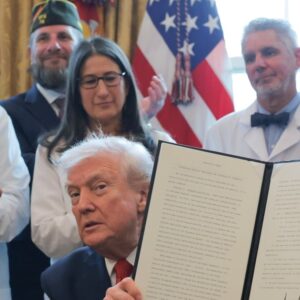
Gathering in the Oval Office, the President directed Attorney General Pam Bondi to move what federal law still calls “marijuana” from Schedule I to Schedule III, marking the first time since 1970 that cannabis would no longer be listed alongside drugs considered to have no medical value.
“We have people begging for me to do this. People in great pain,” the President said. He was flanked by health officials. “I want to emphasize [that] the order I’m about to sign is not the legalization. It does not legalize marijuana in any shape or form and in no way sanctions its use as a recreational drug.”
“Some people are literally dying with tremendous pain and this can literally stop it in many cases and they have their sense about them.”
“I promised to be the president of common sense and that is exactly what we’re doing.”
“I’ve never been inundated by so many people as I have about this particular reclassification.”
“When you see polls show 82% of people want this.”
Placed in Schedule I during the Nixon administration, cannabis was legally defined as having a high potential for abuse and no accepted medical use. Other Schedule I drugs include heroin, LSD, and ecstasy.
Schedule III drugs, by contrast, are recognized as having medical applications. They include ketamine, anabolic steroids, and products like Tylenol with codeine. Fentanyl, notably, remains a Schedule II drug, despite being linked to 48,422 overdose deaths in 2024 alone. Cannabis has no known lethal overdose threshold.
Public opinion has long diverged from federal policy. Roughly 64% of Americans support full legalization, and more than 90% support medical use. 24 states have legalized adult use, most recently Ohio and Delaware, while 42 states allow medical cannabis, including Mississippi.
What Schedule III could change
The practical effects of rescheduling remain uncertain. Federal arrests for marijuana are rare. Enforcement largely happens at the state level.
The most immediate impact could be financial. Moving cannabis out of Schedule I would remove the tax penalties imposed by IRS code 280E, which currently prevents cannabis businesses from deducting ordinary expenses. The tax artificially inflates their costs of doing business. These higher costs are then passed on to the consumer in the form of higher prices for retail cannabis products.
“This change will also likely benefit cannabis consumers by resulting in lower overall prices for retail products, further incentivizing them to abandon the underground market,” said NORML Executive Director Paul Armentano.
Numerous federal statutes are tied specifically to cannabis’ Schedule I status, touching tax law, housing access, employment protections, gun ownership, and more.
Rescheduling could improve a person’s ability to secure federal housing, maintain employment protections, or access medical cannabis through veterans’ programs. It could also strengthen certain workers’ compensation claims.
But those potential gains come with significant caveats.
Critics warn that placing cannabis in Schedule III may expose THC to greater federal oversight, particularly from agencies like the FDA, without ending prohibition or protecting existing state markets.
Marijuana Policy Project Executive Director Adam Smith said the organization supports descheduling rather than rescheduling, paired with basic consumer safety rules.
“Schedule 3 is a compromise position that was initially from the previous administration that wanted to appear as if they were backing reform without actually addressing the problem,” Smith said. “Certainly, any progress is progress.”
Fear of a pharmaceutical takeover
Some in the cannabis industry worry that Schedule III could open the door to pharmaceutical dominance. Federal law, however, still places limits on that scenario.
Research may become easier under Schedule III, but companies would still need FDA approval for specific drugs derived from federally approved cannabis sources. Pharmaceutical companies cannot simply sell plant-based cannabis products through pharmacies.
“That plant material itself is not going to be a pharmaceutical product,” Smith said.
Several cannabis-related drugs already hold FDA approval, including Marinol (synthetic THC), nabilone, and Epidiolex. Despite their existence, the state-legal cannabis market has grown into a $45 billion industry.
Can Trump reschedule cannabis?
The president cannot directly reschedule a drug. But he can order the Attorney General to do so.
Under the Controlled Substances Act, the Attorney General has the authority to reclassify substances. Historically, that power has been delegated to the Drug Enforcement Administration, which rejected five previous rescheduling petitions.
If Attorney General Bondi proceeds, the change would be published in the Federal Register and likely face legal challenges.
Anti-cannabis group Project SAM has already urged opposition. In an August 28 letter to Bondi, nine members of Congress argued that rescheduling would “send a message to kids that marijuana is not harmful.”
“I think this will be tied up in litigation for quite some time,” Armentano said.
Symbolism and limits
The Executive Order is likely to energize Trump’s supporters who favor cannabis reform. Politically, the move is largely symbolic. It reflects a reality that the public reached long ago.
“It’s a recognition from the federal government that marijuana has medical value,” Armentano said. “Claims that cannabis poses unique harms to health, or that it’s not useful for treating chronic pain and other ailments, have now been rejected by the very federal agencies that formerly perpetuated them.”
That acknowledgment follows decades of advocacy and research, including testimony from cancer patients, epilepsy patients, and others who have relied on cannabis therapeutically.
Rescheduling could also influence state policy debates. Lawmakers opposing reform will no longer be able to cite Schedule I as justification.
NORML Political Director Morgan Fox said Republican backing could shift the landscape.
“Having a Republican administration backing this effort will likely embolden more Republican lawmakers, many of whom have privately endorsed marijuana policy reform, to now do so publicly,” Fox said.
The weight of Schedule I
Placing cannabis in Schedule I was one of the foundational acts of the modern drug war. The designation carried cascading consequences.
Parents who used marijuana were treated like heroin users by child welfare systems. Banks servicing cannabis businesses were viewed as criminal enterprises. Millions lost access to housing, education, employment, or financial services.
For some, the consequences were fatal. Prohibition fueled violence, robberies, and long-term criminal records that continue to shape lives.
Activists have long argued the designation was political, not scientific. Former Nixon administration officials later acknowledged it was designed to suppress youth and minority voters during the Vietnam War and Civil Rights era.
How the road led here
In 2022, President Biden ordered a review of cannabis’ Schedule I status. The Department of Health and Human Services concluded that modern science supported rescheduling. The process ultimately stalled at the DEA.
The Trump administration has taken a different approach, relying on executive authority rather than prolonged review. The move reflects an expansive view of presidential power and a shift away from DOJ independence.
Trump publicly endorsed Florida’s legalization initiative during last year’s campaign and accepted donations from cannabis companies, including Curaleaf and Trulieve. He has previously floated rescheduling as a trial balloon.
Hemp already changed the game
Today’s rescheduling order may carry legal and symbolic weight, but hemp legalization has already reshaped the marketplace.
THC-A flower ships nationwide. Delta-8 drinks line shelves in prohibition states. In that context, rescheduling arrives late, after federal hemp policy quietly opened the floodgates.
For longtime advocates, however, even partial movement matters.
“No matter what happens, the battle for nationwide cannabis law reform is far from over,” Armentano said.
High Times note: Rescheduling acknowledges medical reality. It does not end prohibition. The fight for decriminalization and full legalization continues.
Shealeah Craighead, Public domain, via Wikimedia Commons
<p>The post Trump Reschedules Marijuana. But, Wait… There’s A Catch first appeared on High Times.</p>
Source link