
Newsletters are great way to receive information. They’ve become more popular in general, and many specifically cater to the cannabis crowd. Here’s our Top 25.
Source link
Cannabis info and related links and post from around the web

Newsletters are great way to receive information. They’ve become more popular in general, and many specifically cater to the cannabis crowd. Here’s our Top 25.
Source link


LOUISVILLE, Ky. – Two former Lagunitas Brewing Company executives joined Cornbread Hemp’s advisory board. Ron Lindenbusch and Greg Merideth were part of the team that lead craft brewer Lagunitas from startup in 1995 to its billion-dollar acquisition by Heineken N.V. in 2015.
Lindenbusch was Lagunitas’ second employee, leading sales and marketing in the early years and eventually serving as chief marketing officer during his 23 years with the company. He played a crucial role in building relationships with distributors and retailers and understanding how to effectively price and position the brand, helping transform Lagunitas from a local brewery into the fifth-largest craft brewery in the United States.
Merideth served for ten years as senior vice president of sales, where he built and managed the company’s 200-person sales team and established a worldwide distribution network for the one-million-barrel brand.
Cornbread distributes a line of hemp-infused CBD and THC products, including beverages, across twelve states


This year, 2024, marks a significant milestone for Cannabiz Media – we’re proudly celebrating our 10th anniversary! Over the past decade, Cannabiz Media has evolved from a vision into a powerhouse in the cannabis industry, and as we reflect on the journey, it’s inspiring to see the impact of our growth, innovation, and leadership in such a young industry. © CNB Media LLC dba Cannabiz Media
Source link


In 2017, when we launched Prohibition Partners, we set out with the goal to change the conversation around cannabis. Regulators needed data, policymakers needed evidence, and stakeholders needed a credible platform to engage with an industry emerging from decades of prohibition.
Over the next few years, we built the infrastructure to make that happen. Market reports that brought institutional rigour to sector analysis. Events that convened ministers, investors, and operators in the same room. Media platforms that covered cannabis as a serious commercial and medical category, not a cultural phenomenon.
The work succeeded. Markets opened. Regulations evolved. Capital flowed in. Cannabis moved from advocacy to industry.
As it did, a new challenge emerged. The question was no longer how do we make this legal? It became how do we compete and grow in newly legal markets?
Early-stage cannabis businesses required communications that educated regulators and shifted policy. Today, they need brands that cut through crowded markets, comply with complex frameworks, and position them for institutional capital or strategic acquisition.
The operators, investors, and founders we work with aren’t asking for advocacy anymore, they’re asking for growth. They need brand strategies that work across multiple jurisdictions, are compliant, creative, and drive commercial outcomes.
Today’s businesses need market entry plans informed by regulatory intelligence, PR that opens doors to partnerships, not just press coverage, and meaningful access to the investors and operators who control distribution and capital.
Traditional agencies can’t deliver this. They lack sector expertise, they don’t have real-time regulatory insight, they can’t make introductions that matter, and they don’t understand how compliance and creativity intersect in markets where a single misstep can derail funding or trigger enforcement.
Cannabis companies were asking us for execution. We had the platform, the network, and the intelligence. What we needed was the operational capability to turn that into tangible commercial outcomes.
Before Prohibition Partners, I spent years in creative and digital advertising. I understand what disciplined execution looks like. I know how strategy translates into campaigns, how creative drives performance, and how modern production infrastructure, including AI-enhanced workflows, can compress timelines without compromising quality.
Prohibition Partners offered something most traditional agencies will never have: deep sector expertise, proprietary market intelligence, and an institutional network built over years of convening the people who actually make decisions in this industry.
PPX combines both. Innovative, creative and digital discipline, applied with the industry knowledge and connections that come from operating at the centre of global cannabis for nearly a decade. We’re not a traditional agency trying to understand cannabis. We’re a cannabis intelligence and events platform that has built the creative and growth marketing capability the market was demanding.
PPX will provide full-service growth marketing, including everything from brand strategy to creative, demand generation, PR, events, and market entry.
But the differentiation isn’t the service list. It’s how we deliver it.
When we develop brand positioning, it’s informed by proprietary market data and competitive analysis that most agencies can’t access. When we plan market entry, we’re not researching from the outside; we already know the regulatory landscape, the key operators, and the investors active in that geography. When we execute PR, we’re leveraging direct relationships with the journalists and publications that matter, including our own platforms: Business of Cannabis and Cannabis Health News.
Our creative teams understand compliance. Our strategists operate from real intelligence, not assumptions. And our network opens doors that media spend and cold outreach cannot.
We also deploy AI across content production, campaign optimisation, and market analysis. This isn’t experimental; it’s operational infrastructure that lets us move fast, maintain consistency, and deliver enterprise-grade work at the cost structure growth-stage companies require.

One of the hardest challenges in cannabis marketing is standing out while staying compliant. Brands need impact. But they operate under platform restrictions, regulatory scrutiny, and the reality that reputational missteps can kill partnerships or financing.
Most agencies either play it too safe, producing work that’s invisible, or push boundaries in ways that create risk clients didn’t sign up for.
PPX operates differently because we understand that compliance isn’t a creative constraint, it’s a competitive filter. Companies that communicate effectively within the rules have an edge over those that can’t. When you know how to work confidently within regulatory frameworks, compliance becomes a moat, not a limitation.
Our teams include regulatory advisors who review messaging before it goes live. We know which claims are defensible and which invite problems. We understand the nuances of medical versus consumer positioning, platform policies across jurisdictions, and how to build brands that earn trust with regulators, investors, and consumers simultaneously.
The result is creative that works, commercially and legally. Campaigns that survive scrutiny and still drive measurable growth.
Cannabis has moved beyond the early days of market creation. The companies succeeding now aren’t the loudest or most provocative. They’re the ones with strategic clarity, regulatory discipline, institutional credibility, and access to the networks that accelerate growth.
That’s a different skill set than traditional advertising. It requires sector fluency, compliance rigour, and the ability to operate at the intersection of creative, strategy, and institutional access.
Our clients don’t need another agency. They need a partner who understands what serious growth looks like in regulated markets. Who can deliver intelligence-informed strategy, compliant execution, and the introductions that compress timelines and open opportunities?
We built PPX because the market demanded it. Because the industry matured past advocacy and into competition. And because we had the platform, expertise, and creative discipline to deliver what cannabis companies actually need right now.
If you’re scaling a cannabis brand, entering new markets, or positioning for corporate growth, this is what we do.
The post Why We Built PPX: From Advocacy to Growth appeared first on Business of Cannabis.

Abdullah Saeed’s “Deli Boys” is Harold & Kumar on coke. In this Hulu comedy series, two Pakistani-American novices take over their father’s drug business.
Source link

Connecticut lawmakers are among the latest in the U.S. to take up legislation to allow medical marijuana use by certain qualifying patients at health facilities such as hospitals, nursing homes and hospices.
Members of the legislature’s Joint Committee on Public Health convened to discuss the cannabis bill at a hearing on Monday, taking testimony from state agencies, medical institutions and more as they consider implementing a policy known as “Ryan’s law,” named after a young California medical cannabis patient who passed away.
Under the proposal, terminally ill patients could access cannabis products that could not be smoked or vaporized at health facilities such as hospitals. That would not extend to patients receiving emergency care, however.
The bill, HB 5242, also stipulates that health facilities could suspend the medical cannabis allowance if a federal agency such as the Justice Department or Centers for Medicare & Medicaid Services (CMS) initiates an enforcement action or issues guidance specifically prohibiting medical marijuana access on their premises.
Erin Gorman Kirk, Connecticut’s Cannabis Ombudsman, advised the joint committee that current policy means “a registered patient facing a terminal prognosis may be forced to abandon their legally authorized regimen the moment they are admitted to a hospital or nursing home.”
“Patients who cannot or will not tolerate opioids, or who have found in medical cannabis the only effective relief for their pain, nausea, or anxiety, are left without options simply because of where they receive care,” she said. “HB 5242 corrects this by requiring covered facilities to allow those with a terminal prognosis of one year or less, to use non-smokable cannabis forms including tinctures, edibles, and topicals.”
“HB 5242 is important, impactful, and morally necessary. It is a n ethical, commonsense bill that protects vulnerable patients who do not want opioids, who cannot tolerate them, or who have simply found in cannabis the relief and clarity that allows them to die with dignity. Medical cannabis is backed by clinical evidence, endorsed by nurses and policy analysts who work with these patients every day, and modeled on laws that are working right now in states across the country. Connecticut should not be a state that tells a dying patient: your medicine is legal, your doctor approved it, but you cannot have it here.”
The Connecticut Hospital Association (CHA), meanwhile, voiced opposition to the proposal, telling lawmakers that the bill “misapprehends several issues about the laws and regulations governing hospitals.”
“HB 5242 requires Connecticut hospitals to break the law—a law that [the Department of Public Health, or DPH] itself will need to enforce as part of the [Centers for Medicare and Medicaid Services, or CMS] oversight system and the Department of Consumer Protection (DCP) would need to enforce as part of its role overseeing controlled substances laws,” it said.
The Connecticut Association of Health Care Facilities and Connecticut Center for Assisted Living (CAHCF/CCAL) also submitted testimony in opposition to the reform, advising that “compliance would place providers in a very difficult and untenable situation of trying to navigate conflicting federal and state laws.”
—
Marijuana Moment is tracking hundreds of cannabis, psychedelics and drug policy bills in state legislatures and Congress this year. Patreon supporters pledging at least $25/month get access to our interactive maps, charts and hearing calendar so they don’t miss any developments.
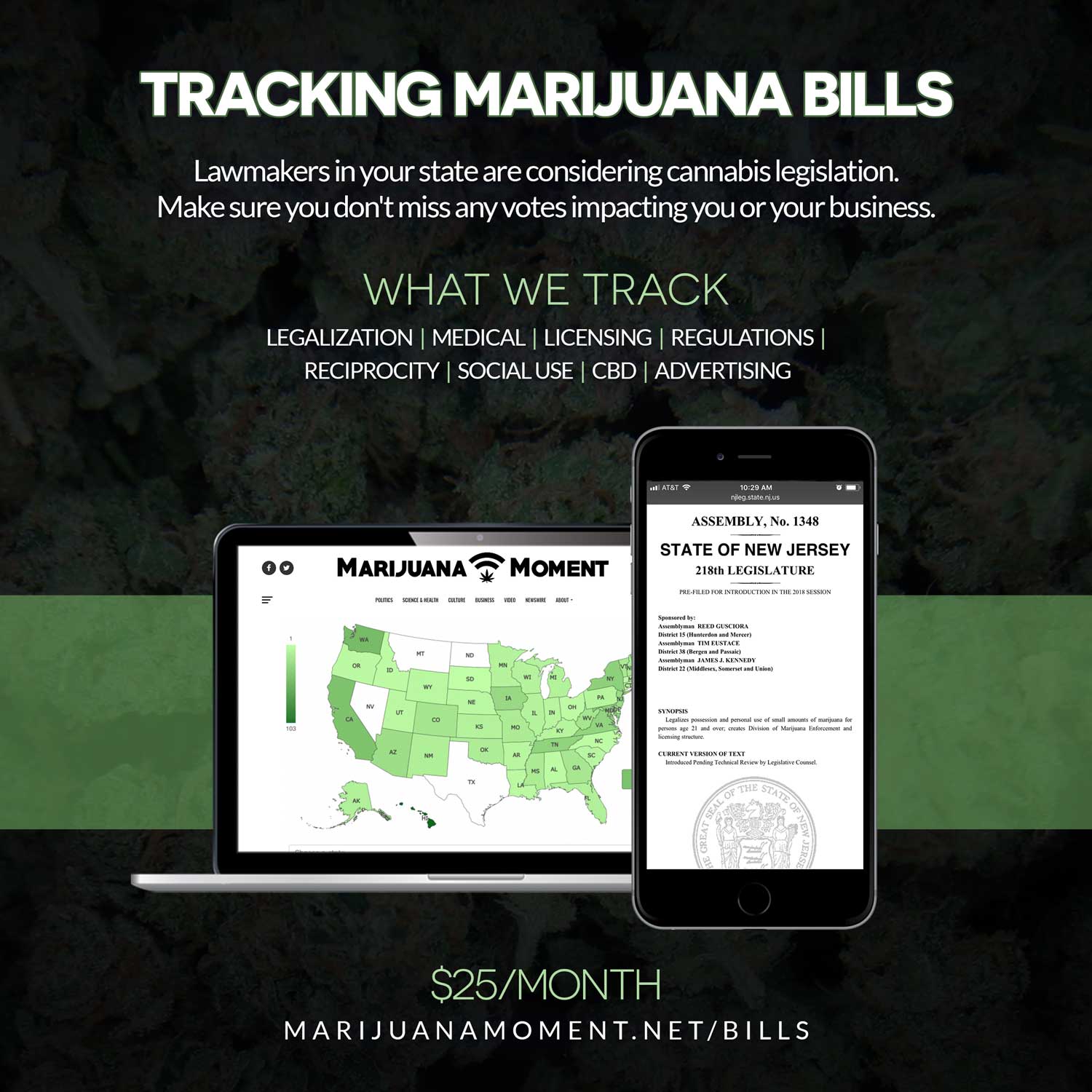
Learn more about our marijuana bill tracker and become a supporter on Patreon to get access.
—
Lawmakers in multiple states are advancing similar bills meant to provide patients with access to medical marijuana in health care facilities, with legislators across the U.S. making the case this week for a policy change they say is necessary to ensure patients have a full range of treatment options at their disposal.
Last week alone, Ryan’s law proposals saw action in at least four states: Colorado, Hawaii, Virginia and Washington State.
Photo courtesy of Philip Steffan.
The post Connecticut Lawmakers Take Up Bill To Allow Medical Marijuana Access In Hospitals appeared first on Marijuana Moment.