
Super Boof
November 14, 2025
(updated December 3, 2025)
Published by toker

New York marijuana regulators are celebrating the opening of the state’s 500th legal cannabis dispensary—touting the fact that there have been $2.3 billion in adult-use sales since the market launched, supporting an estimated 25,000 jobs across the industry.
At a ribbon-cutting ceremony on Friday, Green Comfort Dispensary became the 500th licensed adult-use marijuana retailer to open its doors in the state since the market launch in late 2022.
Felicia A.B. Reid, acting executive director of the Office of Cannabis Management (OCM), said in a press release that the “growing number of licensed dispensaries reflect a market that’s maturing with purpose.”
“Each new business represents economic growth, community investment, and safer access for consumers,” she said. “Together, they signal that New York’s legal cannabis market, industry innovation, and consumer demand are showing no signs of slowing down.”
Beyond the 500-shop milestone, OCM also highlighted other statistics about the industry’s growth—including the approval of 1,949 adult-use cannabis businesses across license types. Dispensaries are now present in 51 counties and 161 municipalities statewide.
“Every licensed storefront represents a vetted operator, tested products, and a community choosing safer cannabis,” Jessica Garcia, chair of the Cannabis Control Board (CCB), said. “Reaching 500 shows the industry’s momentum and our continued focus on equity, compliance, and consumer protection.”
Of the nearly 2,000 adult-use licenses that have issued to date, OCM said that 56 percent have gone to social equity businesses that have been disproportionately impacted by prohibition.
With tax revenue from marijuana sales and licensing fees, $5 million has been invested in community reinvestment initiatives, another $5 million has gone to a grant program for conditional business licenses for eligible applicants and $2.6 million has supported technical assistance for those seeking to enter the marketplace.
“Equity has been the foundation of this market from the start,” Simone Washington, chief equity officer at OCM, said. “Reaching this milestone reinforces that progress is possible when fairness is built and embedded into the system. Our focus remains ensuring that equity is not just a principle on paper—but a measurable outcome across every level of the industry.”
Tim Tanavung, CEO of Green Comfort Dispensary, said it’s “truly an honor to be recognized as NYS’s historic 500th licensed dispensary.”
“It is really a labor of love and passion from myself, David and all the staff here at Green Comfort,” he said. “We are excited to foster a vessel in which we can give back to the community, the city of Rochester and the state. We’re optimistic for the future of Green Comfort and the future of NYS cannabis.”
With respect to marijuana sales in the Empire State, regulators in September announced that the state had officially surpassed $2 billion in adult-use cannabis purchases.
Meanwhile, given confusion within the marketplace about timelines for provisional licenses, CCB said it will be extending the renewal deadline for conditional adult-use until December 31, 2026.
“This extension provides licensees additional time to secure viable locations and move toward full licensure,” OCM said. “It will also apply to any provisional licenses issued between September 9, 2025, and December 30, 2025, ensuring clarity and consistency for all provisional license holders.”
Part of the uncertainty surrounding provisional licensees concerns a recently identified zoning issue impacting more than 100 cannabis businesses that are apparently located too close to public schools or places of worship than is allowed under current statute. Gov. Kathy Hochul (D) has said that she will be pushing the legislature to amend the state’s marijuana law to address the issue.
—
Marijuana Moment is tracking hundreds of cannabis, psychedelics and drug policy bills in state legislatures and Congress this year. Patreon supporters pledging at least $25/month get access to our interactive maps, charts and hearing calendar so they don’t miss any developments.
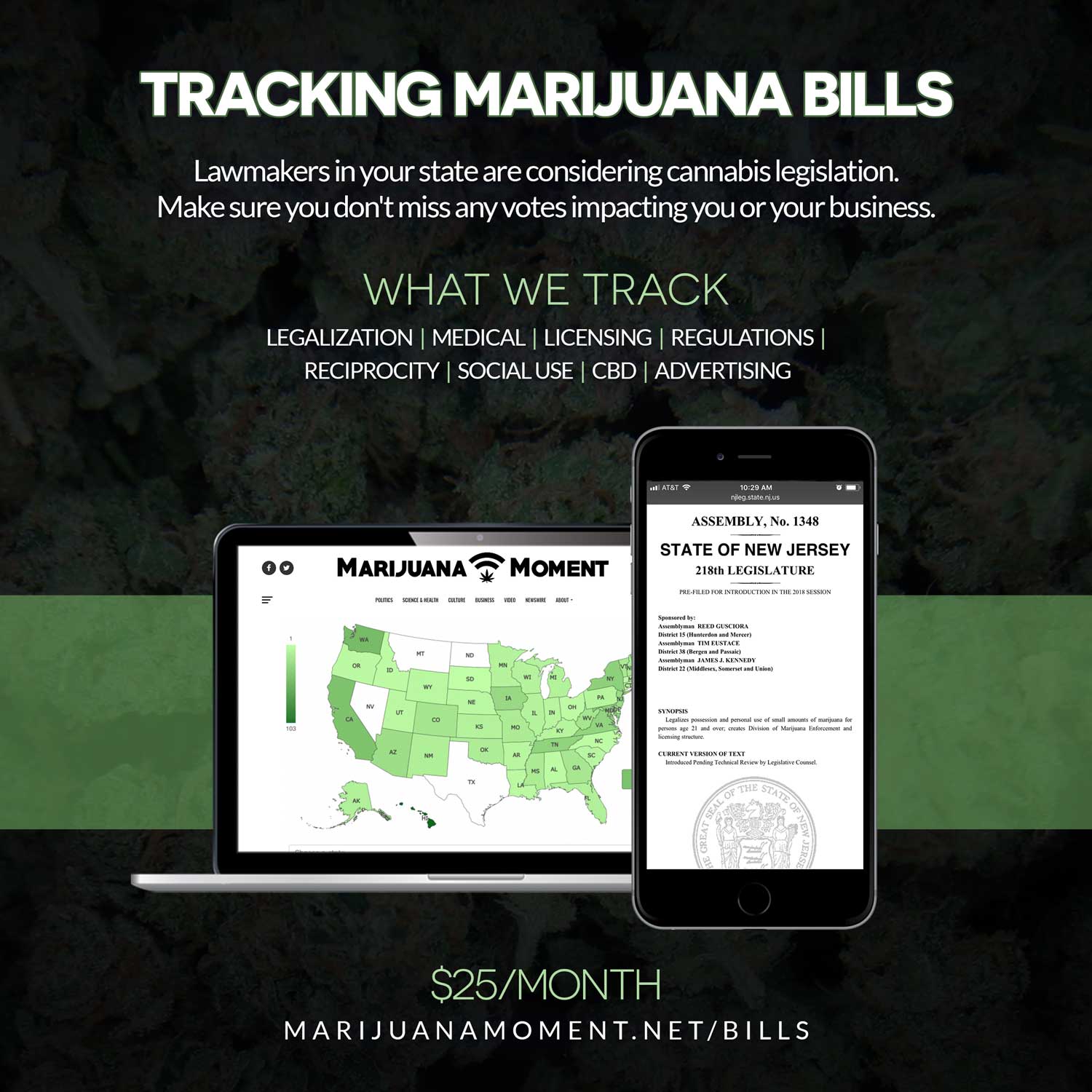
Learn more about our marijuana bill tracker and become a supporter on Patreon to get access.
—
Meanwhile, both chambers of the New York legislature earlier this year passed legislation that would extend the deadline for some marijuana businesses to file electronic tax returns, sending the proposal next to the governor’s desk.
If signed into law, the measure would give cannabis manufacturers and distributors 30 extra days to submit their tax returns following the end of each quarterly tax period. Currently the companies have a 20-day window to file the documents, which the legislation would extended to 50 days.
Sponsors of the bill have noted that Hochul vetoed an earlier cannabis business tax reform proposal late last year, claiming it would “pose significant operational challenges for the State and confusion for taxpayers,” but that they’ve worked to address those concerns in the current version.
The earlier, vetoed measure would have allowed marijuana growers and processors to pay excise taxes on an annual basis rather than quarterly—a change that would have extended the same treatment to cannabis as the state already offers the alcohol industry.
In July, meanwhile, New York officials announced the first round of grants under a $5 million program to help retail marijuana businesses owned by justice-involved people cover startup costs.
About three months after opening up applications for the Conditional Adult-Use Retail Dispensary (CAURD) Grant Program, OCM and Empire State Development (ESD) announced on Wednesday that they have awarded 52 licensed dispensaries up to $30,000 each in funds meant for startup and operational costs such as rent, renovations, inventory tracking and security systems.
To qualify for the program, applicants need to have been “justice involved”—in other words, impacted by a marijuana-related conviction—and have some experience running a profitable business.
Meanwhile, OCM recently launched a new online map that’s meant to help adults locate licensed marijuana retailers—one of their latest efforts to encourage consumers to buy their cannabis from the regulated market.
After a rocky rollout of the state’s legalization law opened the door to a proliferation of illicit marijuana shops, the governor and regulators have prioritized educating the public about the need to purchase their products from licensed dispensaries as a health and safety imperative.
The broader New York campaign has also involved digital ads and educational resources, including a guide on safe consumption practices, as well as graphics and videos featuring licensed cannabis business owners and messaging about the benefits of participating in the regulated market.
OCM also advises that “continued enforcement against the illicit market is critical to building a health regulated market,” pointing to what it describes as successful enforcement efforts in 2024. Last spring, for example, officials in New York City launched Operation Padlock, an enforcement initiative meant to shutter illegal storefronts. Within months, licensed shops that were open before the operation began saw sales climb 105 percent, according to an OCM survey.
Regulators are also moving forward with new proposed regulations around the state’s so-called “cannabis showcase” program, which allows licensed businesses to sell to consumers at pop-up, farmers market-like events.
As originally authorized, the showcase events were largely in response to the slow rollout of New York’s adult-use marijuana program, which faced multiple delays in implementation amid litigation and other matters.
Separately Hochul signed state budget legislation that did not include a controversial earlier provision that would have allowed police to use the smell of marijuana as probable cause that a driver is impaired and then force them to take a drug test.
Amendments made in the legislature removed the provision, which a coalition of 60 reform groups had argued in a letter to Hochul and top lawmakers would “repeat some of the worst harms of the War on Drugs” and allow law enforcement to “restart unconstitutional racial profiling of drivers.”
In April, New York cannabis regulators and labor officials announced the launch of a workforce training program aimed at “providing comprehensive safety education to workers” in the state’s legal marijuana industry.
Separately, OCM’s press secretary indicated the office is working on plans to expand permitting and licensing rules that could allow adults to buy and consume marijuana at movie theaters. Authorizing sales of cannabis products at theaters would set New York apart as it continues to build upon the state’s legalization law.
Earlier this year, a collective of businesses licensed under the CAURD program called on Hochul to forgive tens of millions of dollars in high-cost loans issued under a governor-created social equity loan fund.
A state lawmaker said in December that there’s a need to extend financial aid to CAURD license holders, many of whom are struggling under the high-cost loans.
Critics—including the NAACP New York State Conference, Black Cannabis Industry Association, Minority Cannabis Business Association, Service Disabled Veterans in Cannabis Association, Drug Policy Alliance, NYC NORML and VOCAL-NY—wrote to the governor earlier that month to express dismay at what they described as marijuana regulators’ “efforts in service of big corporations at the expense of small business and equity outcomes.”
Photo courtesy of Mike Latimer.
The post New York Officials Celebrate 500th Marijuana Dispensary Opening, With $2.3 Billion In Sales Since Market Launch appeared first on Marijuana Moment.


We caught up with Elbo in Colorado to talk about his expansive career, current projects and where he sees the craft going.
SUBSCRIBE ► https://www.youtube.com/@jollyrogerhq?sub_confirmation=1
Reddit ► https://www.reddit.com/r/jollyrogerHQ/
Instagram ► https://instagram.com/jollyroger
———————————————————————
#puffco #jollyroger
source

Germany’s medical cannabis imports continued their historic run in Q3 of 2025, seeing the country bring in just under 57 tonnes, though growth levels dipped slightly from Q2.
Cannabis importers appear entirely undeterred by looming market challenges, both structural and political, as imports grew a further 19.3% compared to the previous quarter, seeing the total for the year to date top 140,000kg, nearly double the entire imports of 2024.
These latest figures from BfArM come just days before proposals to restrict the booming medical market will be considered during the Bundesrat’s 21 November 2025 plenary session, and just weeks after the regulator was forced to expand the upper limit of import quotas by a further 70 tonnes after the 122 tonne limit was exceeded by September.
As seen in Poland when it introduced its restrictions on cannabis telemedicine, analysts suggest fears of a crackdown could actually be driving up demand.
Germany’s medical cannabis imports hit a new all-time high between July and September 2025, rising nearly 20% quarter on quarter to 56.9 tonnes, bringing total imports for the first nine months of the year to 142 tonnes, up from 72 in all of 2024.
While the growth of +9,209 kg in Q3 fell from an increase of 10,018 kg (26%) in the previous quarter, even with a further reduction in growth, Germany is on track to top 200 tonnes by year’s end, once again exceeding its import quota (now 192 tonnes).
The gains were once again heavily concentrated in Canada and Portugal, which together supplied around 80% of the total.
Canada remained the dominant exporter of medical cannabis worldwide, increasing shipments by 49 per cent from 20.1 tonnes in Q2 to 30.1 tonnes in Q3.
Portugal also continued to consolidate its position as Europe’s key export hub, with volumes rising 23 per cent to 16.6 tonnes over the same period.
Further growth was recorded across a range of emerging European and African markets. North Macedonia posted a 56 per cent rise to 2.7 tonnes, while Spain more than doubled its exports to 2 tonnes.
Malta, a smaller but fast-maturing player, saw a three-and-a-half-fold increase to 1.9 tonnes, marking its largest quarter on record.
Shipments from South Africa and Lesotho rose 54 per cent and 34 per cent respectively, highlighting Africa’s continued role as a growth frontier. Colombia also re-emerged as a meaningful contributor, expanding exports from just 0.1 tonnes in Q2 to 1.2 tonnes in Q3.
By contrast, a number of established markets saw declines. The Netherlands fell a further 6 per cent to 0.46 tonnes, continuing a gradual downward trend. The Czech Republic dropped 37 per cent, while Argentina contracted by 45 per cent.
The post Germany Medical Cannabis Imports Surge a Further 19%, but Are Looming Curbs Actually Boosting Demand? appeared first on Business of Cannabis.

Learn how to maintain the perfect moisture levels for your plants. Discover the impact of relative humidity on plant health and how to avoid common issues like disease and water stress. Find out how to choose the right humidification or dehumidification system and monitor humidity levels with a hygrometer. Keep your plants thriving with these expert tips! #PlantCare #GardeningTips #HealthyPlants #HumidityControl #Hygrometer #PlantHealth #MoistureManagement #IndoorGardening #GreenThumbs #GardeningHacks
source