ICE raids cannabis farms: Man dies in Camarillo; Carbajal slams ‘disproportionate level of force’ in Carpinteria | News

ICE raids cannabis farms: Man dies in Camarillo; Carbajal slams ‘disproportionate level of force’ in Carpinteria | News


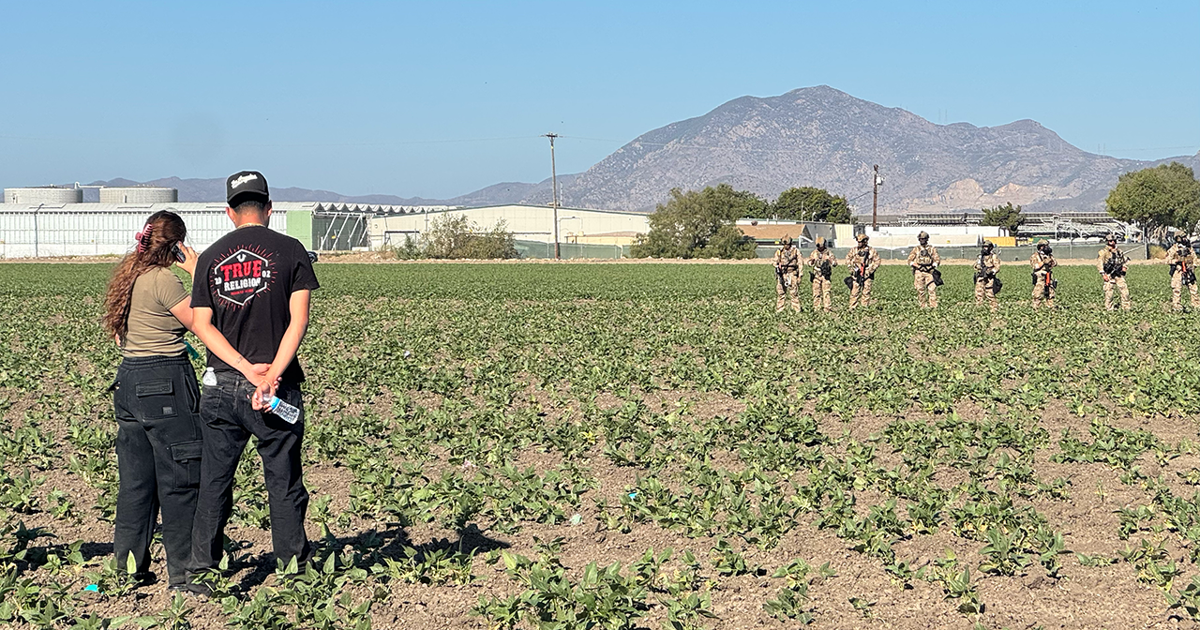
Judith Ramos stood in the middle of an agricultural field gazing at an enormous, high-tech greenhouse originally built for growing tomatoes hydroponically, but now also used for cannabis.

Between her and the massive complex owned by Glass House Farms, a California state-licensed cannabis company with stock traded publicly on a Canadian stock exchange, stood a row of federal law enforcement officers.

“My dad is in there,” Ramos told the Ventura County Reporter, as she awaited word on her father, Elias, who worked on the tomato side of the operation, at 5:29 p.m. July 10. “He gave me a call around 11:45 that they (U.S. Immigration and Customs Enforcement) were already inside. So, what I last heard was that he was still in there.”

Ramos said her dad is undocumented and she was worried about what would happen to him if he were taken into federal custody.

“I feel like it’s not right because these people are just working here,” the Oxnard resident with two younger sisters said. “They’re not criminals, they’re not doing anything wrong. They’re just working for their families.”

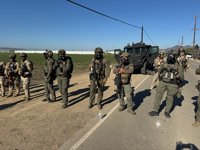
About 200 feet away from where Ramos was standing, about two dozen protestors faced off against a line of federal law enforcement officers with black armored vehicles on Laguna Road. At one point a long row of identical white vans drove along the perimeter of the greenhouse complex down a dirt road, and people on both sides of the protest line stopped for a moment to watch as the caravan of official government vehicles kicked up a big cloud of dust.

Melissa Aguayo of Oxnard sat cross-legged just a few feet in front of federal officers wearing gas masks and carrying a wide assortment of equipment and weapons. She later told the VCReporter what compelled her to sit on the hard asphalt, blasting traditional Mexican and rap music from a large speaker.

“I’m pissed off,” she said. “We’re not bad people. We’re here peacefully…They’re coming where our parents work. Siblings, uncles, aunts, and they’re taking them without letting them even say goodbye to their families.”

Protestor Aileen Alejandre looked each individual officer straight in the eye and asked them direct questions such as, “You guys genuinely don’t feel anything knowing that there’s going to be little kids with parents who aren’t coming home tonight?”

The Oxnard resident later told the VCReporter she’s worried about where people might be taken by ICE.




Aileen Alejandre  (3).png

Aileen Alejandre of Oxnard faced off against federal law enforcement officers, asking them difficult and emotional questions about people impacted by the raid. 


“They’re taking kids and they’re leaving them in detention centers where they don’t know anything,” she said. “The parents that don’t even speak English, they’re getting put in places where they’re not getting help, they’re not getting food, they’re not getting water, they’re sleeping on the ground, and it’s just not okay.”  

ICE response to inquiries about Glass House raids

Public affairs officials with U.S. Immigration and Customs Enforcement (ICE) provided the VCReporter with a statement regarding Glass House Farms on July 11, misstating the day the raid happened, which was actually on Thursday, July 10, and misspelling the name of the city of Carpinteria.

“On July 11, 2025, HSI (Homeland Security Investigations) Ventura executed search warrants (8 USC 1324) pursuant to an investigation into the harboring if [sic] illegal aliens at two marijuana farms in Carpenteria and Camarillo, CA,” the statement read. “Approximately 200 illegal aliens (pending processing and verification) were reported as apprehended from both targeted sites. The search warrants also resulted in the recovery of one firearm and the seizure of employment records.”

ICE officials also gave an account of clashes near Glass House Farms’ 5.5 million-square-foot greenhouse south of Camarillo at 645 Laguna Road, purchased for around $100 million in 2021 and considered the largest greenhouse for growing cannabis anywhere.

“During this operation approximately 500 protestors gathered at the targeted site and violently confronted law enforcement forcing HSI and Border Patrol agents to use less-than-lethal rounds on the crowd,” ICE officials said in the news release. Some government vehicles were damaged, but no law enforcement officers suffered significant injuries during the protests or search warrant execution, officials said.

“One protester discharged a firearm during the protest and his identity is currently being investigated. A shell casing was recovered at the scene in the vicinity where the firearm was discharged,” ICE officials said, adding that a “wanted poster” with a photo of the suspect and a $50,000 reward offer was issued. At least four U.S. citizens were arrested for allegedly assaulting and resisting federal officers, ICE officials said.

U.S. Customs and Border Enforcement (CBP) also reported finding juveniles at Glass House Farms.

“HSI is attempting to identify the juveniles, verify their status and determine if they are unaccompanied minors. If verified, HSI will pursue human trafficking and forced labor charges against the owners of the farms,” ICE officials said.

Glass House corporate officials denied employing minors in a July 11 post on the Glass House Brands Inc. X page, adding that the company verified the federal warrants and complied with them.

“Workers were detained and we are assisting to provide them legal representation. Glass House has never knowingly violated applicable hiring practices and does not and has never employed minors. We do not expect this to affect operations moving forward. We will provide additional details when applicable,” the Glass House social media post said. 


IMG_1633.png

Federal law enforcement officers block Laguna Road to keep people away from Glass House Farms on July 10


Worker dies from injuries

A Glass House Farms worker died at a hospital after suffering injuries from a fall during the raid in Camarillo, according to family members.

His niece, Yesenia Duran, set up a GoFundMe titled RIP Jaime Alanís (farm worker @GlassHouseFarms). By July 15 the drive had far surpassed its $50,000 goal to top $165,000. The GoFundMe asks people to allow the family time to lay his body to rest and said he will be taken to his hometown of Huajumbaro, Michoacán where “his wife and daughter are waiting for him.”

Duran said her family is “still looking for justice” as he died due to the “reckless ICE raid.” “My uncle Jaime was just a hard-working, innocent farmer. He has his wife and daughter waiting for him. He was chased by ICE agents, and we were told he fell 30ft,” she stated on the GoFundMe page.

ICE public affairs officials issued a statement to the VCReporter attributable to ICE Assistant Secretary Tricia McLaughlin regarding the Glass House Farms worker who died.

“This man was not in and has not been in CBP or ICE custody. Although he was not being pursued by law enforcement, this individual climbed up to the roof of a green house and fell 30 feet. CBP immediately called a medivac to the scene to get him care as quickly as possible,” McLaughlin said.

Congressional clashes

Rep. Salud Carbajal, D-Santa Barbara, a former U.S. Marine representing part of Ventura County and all of Santa Barbara County, was observed by members of the media and others walking down a public road toward Glass House Farms property in Carpinteria the morning of July 10. Video shared on social media shows federal agents grabbing and stopping Carbajal from getting any closer. Carbajal issued a July 10 statement about what happened.

“Today, I was at Casitas Pass Road in Carpinteria where ICE was conducting a raid using disproportionate displays of force against local farm workers and our agricultural community,” Carbajal said. 

“As a member of Congress and representative of the Central Coast, I have the right to conduct oversight and see first-hand what ICE was doing here,” Carbajal continued, adding that as soon as he walked up, he was denied entry and was not allowed to pass, “which was completely unacceptable.”

“There’s been a troubling lack of transparency from ICE since the Trump Administration started, and I won’t stop asking questions on behalf of my constituents. I will be demanding answers from the Department of Homeland Security to find out who they detained and where the detainees are being taken. And let me be clear: These militarized ICE raids are not how you keep our communities safe. This kind of chaos only traumatizes families and tears communities apart. They are also a gross misuse of limited resources and a betrayal of the values that define us as Americans,” the congressmember said.




Glass House photo by Graham Farrar.jpg

Glass House Farms owns a 5.5 million-square-foot greenhouse complex south of Camarillo originally designed for growing tomatoes hydroponically. 


DHS accuses Carbajal

On Monday, July 14, the U.S. Department of Homeland Security issued an official news release regarding Carbajal.

“U.S. Representative Salud Carbajal (D-Calif.) was among the mob of rioters who attacked federal immigration authorities as they executed a criminal search warrant at a marijuana facility,” according to the DHS news release, which claims Carbajal “doxed” an ICE employee. Doxxing is the act of making sensitive personal information about an individual public without their consent or knowledge, generally for malicious reasons. Federal officials claimed the employee was injured as a result of Carbajal’s actions.

“Who was subsequently attacked by rioters and sent to the emergency room. During the enforcement operation in Carpinteria, California, Rep. Carbajal spoke to an ICE Public Affairs Specialist, who gave the congressman his business card. The congressman then showed the ICE employee’s business card to the mob, making a target out of him,” ICE officials said.

“The employee was subsequently attacked, with lacerations to his left hand due to a rock being thrown at him. The employee had to go to the emergency room and get stitches for his injury. When ICE announced his actions led to an ICE employee’s injuries, the congressman deflected from his own actions by claiming oversight and falsely labeled the crowd as ‘peaceful protesters.’ Unfortunately, this is just another case of Democratic lawmakers labeling political stunts as oversight while they endanger the safety of ICE personnel,” the news release said, before quoting McLaughlin directly. 

“The actions by Representative Carbajal are downright un-American. He dares to claim that his actions were simply congressional oversight, but doxing ICE personnel and inciting a mob of rioters to attack law enforcement is NOT oversight — it’s abominable,” McLaughlin said. “His actions sent an ICE employee to the emergency room. It’s no wonder that ICE agents are facing a 700% increase in assaults when radical members of Congress like Salud Carbajal and LaMonica McIver [D-New Jersey] are openly encouraging and leading their supporters in assaulting law enforcement.”

ICE officials updated the number of people detained during the Glass House raids to “361 illegal aliens” and said 14 migrant children were “rescued” who were “victims of potential exploitation, forced labor, and human trafficking.”

Carbajal responded to the DHS news release with another statement later in the afternoon of July 14, calling it, “A blatant attempt to distort what occurred in Carpinteria.”

“DHS and ICE conducted their raid using a disturbing and disproportionate level of force, both on the farm workers they were targeting and the peaceful protesters who gathered to defend their neighbors. I witnessed agents, in full military gear, fire smoke canisters and other projectiles into a crowd of peaceful civilians. Just before I arrived at the scene, witnesses told me the agents threw a stun grenade into the crowd. Several civilians were injured, including a child.” 

“This aggressive behavior in a normally quiet part of the Central Coast sparked alarm across our community, prompting a flood of calls and messages to my office from concerned citizens,” Carbajal explained in his news release. “I went to the scene to seek answers and represent my constituents. In response to my questions, an ICE Public Affairs Specialist voluntarily gave me his card in full public view of the dozens of TV cameras, reporters, and livestreaming smartphones that were around us to film the interaction.”

“ICE’s claims of ‘doxxing’ and ‘violent mobs’ are attempts to deflect attention from their unjust tactics, distort the facts to support misleading narratives, and avoid accountability for their aggressive actions that caused injuries and left our community traumatized,” Carbajal said. 


Source link

Bipartisan bill proposes to legalize recreational cannabis in PA

Bipartisan bill proposes to legalize recreational cannabis in PA


There is a renewed effort in Harrisburg to legalize recreational marijuana use for adults in Pennsylvania. “This bill is really comprehensive and includes a lot of the input from stakeholders of every background to make sure that we’re crafting what we’re really hoping stands out as a gold standard of legalization in the U.S.,” said Pennsylvania State Rep. Emily Kinkead (D) of District 20. Kinkead and Rep. Abby Major (R) introduced House Bill 20 this week to make recreational cannabis legal for people 21 and over in the commonwealth. Kinkead explained that the idea is to allow for recreational marijuana to be sold through private industry, similar to its medical counterpart. “It would allow current dispensaries that sell medical marijuana to convert over and also to sell recreational marijuana,” Kinkead told Pittsburgh’s Action News 4. Doug Whaley, the owner of the Glass Whale in Lawrenceville, said he believes it’s a great idea if done properly. For him, that means making sure small businesses benefit too. “Versus just allowing big business to come in and monopolize. Then you just kind of get, you know, batched product,” Whaley said. Black Bear Hemp Dispensary is operational under the federal Farm Bill and sells third-party tested hemp in western PA. Founder Jesse Worsk expressed appreciation for leaders’ efforts to keep cannabis conversations going. However, he noted a lack of regulation when it comes to the hemp industry. “If HB20 really comes into place, the current operations that we have go into real jeopardy, I’ll be honest with you,” Worsk said. “It has been more of a placeholder for Black Bear Hemp Dispensary to serve our community and then hopefully transition into adult-use cannabis, but the hemp market is vast, I’ll be honest.”Worsk said that not all hemp operators take the necessary steps to ensure the safety of products.He added, “Both of the bills introduced lately included a merit-based application system, so I do feel like operators who have decided to go into the hemp space like Black Bear has, do hold a great opportunity if they’ve been doing things the right way too.” According to Kinkead, if PA becomes the 25th state to legalize marijuana, there is potential for 30,000 new jobs and a steady revenue stream. The state representative said the bill also focuses on social equity and justice reform by proposing a “clean slate” policy for people with cannabis convictions. “By legalizing, we are allowing these folks to kind of restart, you know, their lives and not have these kind of weighing over their head,” Kinkead said. The legislation features a “Community Opportunity Fund,” which provides grant opportunities to social equity applicants and aims to invest in communities. The bill has been referred to the Health Committee.

There is a renewed effort in Harrisburg to legalize recreational marijuana use for adults in Pennsylvania.

“This bill is really comprehensive and includes a lot of the input from stakeholders of every background to make sure that we’re crafting what we’re really hoping stands out as a gold standard of legalization in the U.S.,” said Pennsylvania State Rep. Emily Kinkead (D) of District 20.

Kinkead and Rep. Abby Major (R) introduced House Bill 20 this week to make recreational cannabis legal for people 21 and over in the commonwealth.

Kinkead explained that the idea is to allow for recreational marijuana to be sold through private industry, similar to its medical counterpart.

“It would allow current dispensaries that sell medical marijuana to convert over and also to sell recreational marijuana,” Kinkead told Pittsburgh’s Action News 4.

Doug Whaley, the owner of the Glass Whale in Lawrenceville, said he believes it’s a great idea if done properly. For him, that means making sure small businesses benefit too.

“Versus just allowing big business to come in and monopolize. Then you just kind of get, you know, batched product,” Whaley said.

Black Bear Hemp Dispensary is operational under the federal Farm Bill and sells third-party tested hemp in western PA. Founder Jesse Worsk expressed appreciation for leaders’ efforts to keep cannabis conversations going.

However, he noted a lack of regulation when it comes to the hemp industry.

“If HB20 really comes into place, the current operations that we have go into real jeopardy, I’ll be honest with you,” Worsk said. “It has been more of a placeholder for Black Bear Hemp Dispensary to serve our community and then hopefully transition into adult-use cannabis, but the hemp market is vast, I’ll be honest.”

Worsk said that not all hemp operators take the necessary steps to ensure the safety of products.

He added, “Both of the bills introduced lately included a merit-based application system, so I do feel like operators who have decided to go into the hemp space like Black Bear has, do hold a great opportunity if they’ve been doing things the right way too.”

According to Kinkead, if PA becomes the 25th state to legalize marijuana, there is potential for 30,000 new jobs and a steady revenue stream. The state representative said the bill also focuses on social equity and justice reform by proposing a “clean slate” policy for people with cannabis convictions.

“By legalizing, we are allowing these folks to kind of restart, you know, their lives and not have these kind of weighing over their head,” Kinkead said.

The legislation features a “Community Opportunity Fund,” which provides grant opportunities to social equity applicants and aims to invest in communities.

The bill has been referred to the Health Committee.


Source link

21 detained in Royal Oaks suspected illegal cannabis warehouse raid, no ICE involvement

21 detained in Royal Oaks suspected illegal cannabis warehouse raid, no ICE involvement


Este artículo ha sido traducido al español. Puedes encontrarlo al final.An early morning raid at a pot farm on San Juan Road near Pajaro was conducted by the San Bernardino County Sheriff’s Office as part of a criminal investigation into an illegal grow operation.The activity was first reported around 7:43 a.m. near 1400 San Juan Road in Royal Oaks.”Every plant has to be tracked. All the processed plant has to be tracked if it’s outside of that. There’s really only two reasons to do that, either because you got it from outside the licensed market and you’re inverting it in, or you’re intending to divert product outside of the licensed market and into the illicit market generally for exportation,” Kevin McInerney, a commander with the California Department of Cannabis Control Law Enforcement Division stated. Approximately 70 local, state, and federal agents raided the farm, emptying large containers of marijuana. Although 21 people were detained, they were later released, and no arrests were made. The warrant, issued by San Bernardino County, involved a suspected illegal grow warehouse. They say the search warrant in Monterey County is tied to a case from their area.Agents clarified upon arrival that the raid was not part of any immigration enforcement.”When we got here, we made announcements. Hey, this is not immigration enforcement. We are not ICE. We are the Department of Cannabis Control conducting a state criminal search warrant. Please come out with your hands up. We’ve had to change our tactics. Things have been challenging lately,” McInerney said.Observers attended the raid to ensure it was not an immigration sweep, following a recent ICE raid on two pot farms near Oxnard that resulted in 300 arrests and turned violent.”What we see in Camarillo, Oxnard, you know, I was terrible. You know, one person passed away, you know, die because of this situation. So we don’t want that. We don’t want to see it. We don’t want to see things like that. Violence, you know, from one side or another. We don’t want that,” Manuel Abrigo, a local pastor, said.The same observer interviewed several employees as they exited the facility, indicating they were treated well and no one was injured.EspañolUn operativo matutino en una granja de marihuana en San Juan Road, cerca de Pajaro, fue llevado a cabo por la Oficina del Sheriff del Condado de San Bernardino como parte de una investigación criminal sobre una operación de cultivo ilegal.La actividad se reportó inicialmente alrededor de las 7:43 a.m. cerca del número 1400 de San Juan Road en Royal Oaks.”Cada planta debe ser rastreada. Toda la planta procesada debe ser rastreada; si esto no ocurre, realmente solo hay dos razones para ello: o porque se obtuvo fuera del mercado con licencia y se está introduciendo, o se tiene la intención de desviar el producto fuera del mercado con licencia hacia el mercado ilícito, generalmente para exportación”, dijo un oficial.Aproximadamente 70 agentes locales, estatales y federales allanaron la granja, vaciando grandes contenedores de marihuana.Aunque 21 personas fueron detenidas, posteriormente fueron liberadas y no se realizaron arrestos.La orden de allanamiento, emitida por el Condado de San Bernardino, involucraba un almacén de cultivo ilegal sospechoso. Dicen que la orden de registro en el Condado de Monterey está relacionada con un caso de su área.Los agentes aclararon al llegar que el operativo no era parte de una acción de control migratorio.”Cuando llegamos aquí, hicimos anuncios. Oigan, esto no es un operativo migratorio. No somos ICE. Somos el Departamento de Control de Cannabis ejecutando una orden de registro penal estatal. Por favor, salgan con las manos en alto. Hemos tenido que cambiar nuestras tácticas. Las cosas han sido desafiantes últimamente”, dijo un oficial.Observadores asistieron al operativo para garantizar que no se trataba de una redada migratoria, tras un reciente operativo de ICE en dos granjas de marihuana cerca de Oxnard que resultó en 300 arrestos y se tornó violento.”Lo que vimos en Camarillo, Oxnard, fue terrible. Una persona falleció, murió debido a esta situación. No queremos eso. No queremos verlo. No queremos ver cosas así. Violencia, ya sea de un lado o del otro. No queremos eso”, dijo un observador.El mismo observador entrevistó a varios empleados cuando salían de la instalación, indicando que fueron tratados bien y que nadie resultó herido.

Este artículo ha sido traducido al español. Puedes encontrarlo al final.

An early morning raid at a pot farm on San Juan Road near Pajaro was conducted by the San Bernardino County Sheriff’s Office as part of a criminal investigation into an illegal grow operation.

The activity was first reported around 7:43 a.m. near 1400 San Juan Road in Royal Oaks.

“Every plant has to be tracked. All the processed plant has to be tracked if it’s outside of that. There’s really only two reasons to do that, either because you got it from outside the licensed market and you’re inverting it in, or you’re intending to divert product outside of the licensed market and into the illicit market generally for exportation,” Kevin McInerney, a commander with the California Department of Cannabis Control Law Enforcement Division stated.

Approximately 70 local, state, and federal agents raided the farm, emptying large containers of marijuana.

Although 21 people were detained, they were later released, and no arrests were made.

The warrant, issued by San Bernardino County, involved a suspected illegal grow warehouse. They say the search warrant in Monterey County is tied to a case from their area.

Agents clarified upon arrival that the raid was not part of any immigration enforcement.

“When we got here, we made announcements. Hey, this is not immigration enforcement. We are not ICE. We are the Department of Cannabis Control conducting a state criminal search warrant. Please come out with your hands up. We’ve had to change our tactics. Things have been challenging lately,” McInerney said.

Observers attended the raid to ensure it was not an immigration sweep, following a recent ICE raid on two pot farms near Oxnard that resulted in 300 arrests and turned violent.

“What we see in Camarillo, Oxnard, you know, I was terrible. You know, one person passed away, you know, die because of this situation. So we don’t want that. We don’t want to see it. We don’t want to see things like that. Violence, you know, from one side or another. We don’t want that,” Manuel Abrigo, a local pastor, said.

The same observer interviewed several employees as they exited the facility, indicating they were treated well and no one was injured.

Español

Un operativo matutino en una granja de marihuana en San Juan Road, cerca de Pajaro, fue llevado a cabo por la Oficina del Sheriff del Condado de San Bernardino como parte de una investigación criminal sobre una operación de cultivo ilegal.

La actividad se reportó inicialmente alrededor de las 7:43 a.m. cerca del número 1400 de San Juan Road en Royal Oaks.

“Cada planta debe ser rastreada. Toda la planta procesada debe ser rastreada; si esto no ocurre, realmente solo hay dos razones para ello: o porque se obtuvo fuera del mercado con licencia y se está introduciendo, o se tiene la intención de desviar el producto fuera del mercado con licencia hacia el mercado ilícito, generalmente para exportación”, dijo un oficial.

Aproximadamente 70 agentes locales, estatales y federales allanaron la granja, vaciando grandes contenedores de marihuana.

Aunque 21 personas fueron detenidas, posteriormente fueron liberadas y no se realizaron arrestos.

La orden de allanamiento, emitida por el Condado de San Bernardino, involucraba un almacén de cultivo ilegal sospechoso. Dicen que la orden de registro en el Condado de Monterey está relacionada con un caso de su área.

Los agentes aclararon al llegar que el operativo no era parte de una acción de control migratorio.

“Cuando llegamos aquí, hicimos anuncios. Oigan, esto no es un operativo migratorio. No somos ICE. Somos el Departamento de Control de Cannabis ejecutando una orden de registro penal estatal. Por favor, salgan con las manos en alto. Hemos tenido que cambiar nuestras tácticas. Las cosas han sido desafiantes últimamente”, dijo un oficial.

Observadores asistieron al operativo para garantizar que no se trataba de una redada migratoria, tras un reciente operativo de ICE en dos granjas de marihuana cerca de Oxnard que resultó en 300 arrestos y se tornó violento.

“Lo que vimos en Camarillo, Oxnard, fue terrible. Una persona falleció, murió debido a esta situación. No queremos eso. No queremos verlo. No queremos ver cosas así. Violencia, ya sea de un lado o del otro. No queremos eso”, dijo un observador.

El mismo observador entrevistó a varios empleados cuando salían de la instalación, indicando que fueron tratados bien y que nadie resultó herido.


Source link

Adult-Use and Medical Cannabis Legalized by Omaha Tribe of Nebraska

Adult-Use and Medical Cannabis Legalized by Omaha Tribe of Nebraska


Image | adobe.stock/johnalexandr

Recreational and medical cannabis have both been legalized by the Omaha Tribe of Nebraska (1-3), becoming the first “fully legal and regulated medical and adult-use cannabis system in Nebraska,” (3). Tribal Council members voted unanimously and adopted Title 51 – Cannabis Regulatory Code. Once passed, the code was implemented immediately. The Omaha Tribe of Nebraska contains around 6,000 members that live on the Omaha reservation.

With the law adopted, adults are now able to “possess up to one ounce of marijuana on tribal lands,” (1). A part of the regulation is that a Cannabis Regulatory Commission be created, and they will be providing rules in relation to the sale of cannabis products to Tribal members and visitors, retail production, and testing. These new rules are expected to be formed and made final later in 2025. An additional measure in the law is that a pathway be formed for prior Tribal cannabis offenses to be expunged. Adults 21 years old and up will be able to utilize the adult-use program, which includes “non-Tribal visitors, on Reservation land,” (3).

“We are asserting our sovereign right to govern, protect our community, and build a sustainable economy that reflects our values,” Tribal Attorney General John Cartier said in a statement (1-3). “Title 51 [the Cannabis Regulatory Code] is the most comprehensive and forward-looking cannabis code in the region, that is rooted in our traditions and designed for our future.”

NORML reported that (1), “Under Nebraska law, marijuana possession is classified as either an infraction or a misdemeanor, depending on whether the violation is one’s first or second offense. Growing or selling cannabis is classified as a felony offense, punishable by up to 20 years in prison and a $25,000 fine.”

In Fall 2024, Nebraska voters approved cannabis-related ballot initiatives which would have legalized the dispensing of medical cannabis and its use (1). The initiatives were not found to be in support of the Nebraska Attorney General and other regulators. Officials selected by Nebraska Governor Jim Pillen (1), “adopted emergency rules gutting much of the initiative, including repealing patients’ access to botanical cannabis.”

“More and more, we see citizens and communities taking marijuana-related matters into their own hands when their elected officials are either unwilling to do so or are unresponsive to what their constituents demand,” NORML’s Deputy Director Paul Armentano expressed (1). “Legalizing and regulating cannabis access is a policy issue that is supported by most of the public. Lawmakers who continue to either ignore or undermine this issue can expect to be met with pushback from the public, particularly at the ballot box.”

References

  1. Norml. Nebraska: Omaha tribe approves marijuana legalization on Reservation Lands Nebraska: Omaha tribe approves marijuana legalization on reservation lands https://norml.org/blog/2025/07/16/nebraska-omaha-tribe-approves-marijuana-legalization-on-reservation-lands/ (accessed Jul 16, 2025).
  2. Abbott, G. Pennsylvania House passes cannabis legalization bill https://www.ganjapreneur.com/pennsylvania-house-passes-cannabis-legalization-bill/ (accessed May 12, 2025).
  3. Omaha tribe of Nebraska becomes first in state to fully legalize and regulate cannabis https://www.omahatribe.com/omaha-tribe-of-nebraska-becomes-first-in-state-to-fully-legalize-and-regulate-cannabis/ (accessed Jul 16, 2025).


Source link

Cloquet sets cannabis business regulations - Cloquet Pine Journal

Cloquet sets cannabis business regulations – Cloquet Pine Journal


CLOQUET — Following Minnesota’s legalization of cannabis, the city will now regulate how cannabis retailers can operate within city limits.

On Tuesday, July 15, the Cloquet City Council passed an ordinance that, drawing from the city’s existing liquor licensing process and state statute, will regulate how cannabis is cultivated and sold, as well as products using lower-potency hemp, like beverages and gummies. The ordinance passed 6-1, with Councilor Kerry Kolodge voting against it.

The ordinance takes effect as the Office of Cannabis Management is starting to grant licenses to cannabis businesses via a lottery system. Once licensure is granted, dispensaries are required to register with the local government and receive a certification of zoning compliance.

The ordinance does not limit the number of dispensaries that can operate within city limits. Municipalities are allowed to set a limit, determined by population, but Cloquet councilors opted not to do so. Because Cloquet’s population exceeds 12,500, the city is required to permit a minimum of two cannabis dispensaries.

Zoning restrictions passed by the City Council last month

limit dispensaries to operating in the city’s business district along Highway 33. The new ordinance further prohibits dispensaries from operating within 1,200 feet of a school and 600 feet of churches, day care facilities, residential treatment facilities, other cannabis retail businesses and certain park amenities.

Nick Montanari, owner of Salute Dispensary in Cloquet, asked for an exemption. He said his business, which has been in operation since 2022 and currently sells lower-potency hemp products, is within 600 feet of a church.

“Without this protection, we’re effectively being kind of regulated out of existence when we’ve never had any issues the last two years with anything like that,” Montanari said.

City Administrator Tim Peterson agreed with Montanari, stating existing businesses should be exempted, while new dispensaries would be subject to the location prohibitions in the ordinance. The zoning ordinance does allow lower-potency hemp to be sold citywide.

The ordinance allows 30 businesses to register and sell lower-potency hemp products. Peterson said he imagines products will largely be sold by gas stations, restaurants and liquor stores. Peterson said the cap was determined by the number of existing area businesses that would likely sell the products, while leaving the room for a few future operations to sell it as well.

The ordinance limits hours cannabis retailers can operate from 10 a.m. to 9 p.m. daily. Low-potency hemp products can be sold from 8 a.m. to 2 a.m. Monday through Saturday and 10 a.m. to 2 a.m. Sunday.

“We would want to follow that time frame for all bars so they don’t have to change out any inventory at different times of the evening,” Peterson said.

The ordinance requires the city to complete one unannounced inspection annually. Businesses selling cannabis and low-potency hemp products without proper registration could incur a fee of up to $2,000. The city can suspend and revoke licenses for violating the ordinance.

The city plans to follow Carlton County’s

cannabis consumption ordinance,

which largely prohibits public consumption of cannabis.

The Office of Cannabis Management held its first round of lotteries in June. However, it was limited to social equity applicants and general applicants seeking cannabis business licenses, such as cultivators and manufacturers. A second lottery for general applicants seeking a cannabis retailer license will be held on July 22.

The ordinance will not apply to areas of Cloquet within the Fond du Lac Reservation without the consent of the band’s government.

Macklin Caruso is a reporter for the Cloquet Pine Journal. You can reach him at mcaruso@pinejournal.com or 218-461-8278.


Source link

Mostly Sunny

4 N.J. dispensaries get the green light to open cannabis consumption lounges


The state’s Cannabis Regulatory Commission approved four stores Tuesday that will allow customers to smoke weed in a cafe-like format.

The additions to the stores are known as consumption lounges, where consumers who are 21 years or older can buy weed and also find a place to smoke. The retailers still have to pass a final inspection from state regulators before the lounges open for business.

“This is a major milestone in New Jersey’s cannabis industry. These designated spaces provide consumers with safe and legal options for cannabis consumption,” said commission chair Dianna Houenou. “Whether individuals cannot consume cannabis inside their homes or simply wish to consume cannabis legally and responsibly, these areas provide a practical solution. We are proud to support this next phase of safe-use infrastructure in our state.”

The stores approved included High Rollers Dispensary and SunnyTien Dispensary in Atlantic City, Gynsyng in Merchantville, and URB’N Dispensary located in Newark.

All are consider diversely owned Businesses, which means each business is either minority-owned, woman-owned, or disabled veteran-owned, as certified by the state Department of Treasury.

Some businesses are looking forward to using the lounges as something that can further engage customers.

“It can set us apart and we can add that extra service,” said Ramez Maxemous, manager at URB’N dispensary. “Education, actually opening the weed and smelling it, talking about it. We’re going to do events when we drop new strains.”

Consumption lounges can partner with rideshare services to make sure patrons get back home safely. The lounges can also serve as a place where consumers can be given demonstrations on how to use or roll their own weed.

The dispensaries have to show good faith efforts to make sure legal weed is being consumed and also have to seek the permission of their local town to create one.

The state is taking applications on a rolling basis.

Maxemous said he didn’t know the store had been approved until the commission had said their names at the meeting.

“We were screaming, we were all going nuts,” he said. “It was a long time coming.”

Jelani Gibson may be reached at jgibson@njadvancemedia.com.

If you purchase a product or register for an account through a link on our site, we may receive compensation. By using this site, you consent to our User Agreement and agree that your clicks, interactions, and personal information may be collected, recorded, and/or stored by us and social media and other third-party partners in accordance with our Privacy Policy.


Source link

THC Is Not Alcohol: Why Cannabis Needs Its Own Rules, Not Liquor Laws | stupidDOPE

Islip Delays Cannabis Retail Vote Again—Here’s Why Residents Shouldn’t Let It Slide | stupidDOPE


The Town of Islip, located in Suffolk County, Long Island, once again chose delay over progress by punting a pivotal vote that would have reversed its outdated stance on retail cannabis sales. What was expected to be a decisive moment in aligning Islip with New York’s growing adult-use cannabis industry turned out to be another frustrating example of municipal foot-dragging. Instead of moving forward, the town board tabled the measure—without even setting a date for reconsideration.

This move leaves local entrepreneurs, tax-hungry budgets, and cannabis consumers in limbo, and it raises a serious question: What exactly is Islip waiting for?

Background: New York’s Cannabis Law and the Opt-Out Loophole

In March 2021, New York State legalized adult-use cannabis under the Marijuana Regulation and Taxation Act (MRTA), giving municipalities until December 31, 2021 to “opt-out” of retail dispensaries and on-site consumption lounges. Islip, like many towns across Long Island, chose to opt out before the deadline. The decision drew criticism from advocates and potential business owners who saw cannabis as a much-needed economic and cultural opportunity for the town.

The law allows these municipalities to later reverse their decision and opt back in—something numerous towns across the state have already done as they’ve witnessed surrounding areas benefit from legal cannabis commerce. Tuesday’s scheduled vote was supposed to bring Islip one step closer to joining the list of towns that understand the long-term benefits of regulated weed sales. Instead, the proposal was shelved without a timeline for action.

The Stakes for Islip: Economic Growth and Social Equity

Tabling this vote isn’t just a bureaucratic delay—it’s a missed opportunity. Islip, home to over 300,000 residents, is forfeiting potential revenue, job creation, and the ability to shape how cannabis is introduced into the community on its own terms.

1. Lost Revenue

Municipalities that opt in to cannabis sales are entitled to 3% of gross sales tax revenue from dispensaries. These funds can be used for community services, infrastructure improvements, public safety, and local programs. Given the strong consumer demand for legal cannabis in New York, that’s real money being left on the table.

2. Jobs and Small Business Opportunities

Retail cannabis generates licensed job opportunities and opens the door for locally owned businesses to thrive. For a town like Islip, which includes several working-class and historically underserved neighborhoods, cannabis presents a unique chance to stimulate local entrepreneurship and employment in a highly regulated and professional industry.

3. Public Health and Safety

Ironically, by blocking legal dispensaries, Islip continues to push residents to the unregulated market—one that lacks lab-tested products, age verification, and accountability. Legal shops, on the other hand, are subject to strict state oversight, security protocols, and product safety standards. Opting in would help bring clarity, safety, and transparency to what is already a widely-used product.

No Vote, No Progress: What This Delay Really Means

The decision to table the vote sends a clear signal: Islip’s leadership isn’t treating this issue with the urgency it deserves. Whether it’s due to outdated stigma, political maneuvering, or a lack of public pressure, the result is the same—Islip remains stuck in 2021 while surrounding towns move forward.

Brookhaven, Babylon, and Riverhead have already opted in. Suffolk County is rapidly becoming a patchwork of green zones and dead zones. By failing to act, Islip is giving away its competitive edge to neighboring municipalities that welcome the jobs, commerce, and cultural energy that come with a smartly regulated cannabis industry.

And let’s not ignore the most infuriating part: no future date has been set for another vote. That’s not strategy—that’s stalling.

Residents Deserve Better—Here’s What They Can Do

If you live in the Town of Islip and are frustrated with how local government is handling cannabis reform, there are a few things you can do to help push the issue forward:

1. Show Up and Speak Out

Attend town hall meetings. Get your name on the list of speakers and demand clarity on when the next vote will happen. Don’t let this quietly disappear into committee limbo.

2. Contact Your Local Officials

Call, email, or write your town representatives. Ask them to explain why the vote was delayed and what their plan is to revisit the issue. Public pressure works.

3. Vote Accordingly

If your elected officials continue to ignore the cannabis issue, make it a voting issue. Local elections often have low turnout, meaning even a small group of passionate residents can drive real change.

Whenever possible, support New York-based licensed cannabis brands and dispensaries in towns that are doing it right. The more success stories there are across the state, the harder it becomes for holdout towns to justify their resistance.

What’s at Risk if Islip Doesn’t Act?

The longer Islip waits, the more it cements itself as a place where progress takes a backseat to politics. By choosing not to participate in the adult-use cannabis industry, Islip is actively limiting its own growth and denying its residents access to regulated, safe, and legal weed.

And let’s be clear—people in Islip are already consuming cannabis. The only question is whether the town will help ensure that cannabis is taxed, regulated, and sold by trained professionals… or continue to let the unregulated market do the job.

Inaction is a decision. And this delay—this silence—is costing Islip real money, real jobs, and real control over its future.

Final Thoughts: The Clock Is Ticking

Islip doesn’t need more “discussions” or “reviews.” The state law has been in place for over three years. Other towns have shown how to implement retail cannabis safely and profitably. The model is clear. The public support is strong. The only thing missing is political courage.

The next time Islip’s town board meets, they need to put this measure back on the agenda and move it forward. No more tabling. No more dodging. It’s time to get it done.

Because if they don’t, voters should remember this moment—and act accordingly at the ballot box.

For more information about how legal cannabis works in New York, visit
https://cannabis.ny.gov


Source link

Mexico considering legal action over migrant's death during ICE raid at cannabis farm in Camarillo

Mexico considering legal action over migrant’s death during ICE raid at cannabis farm in Camarillo


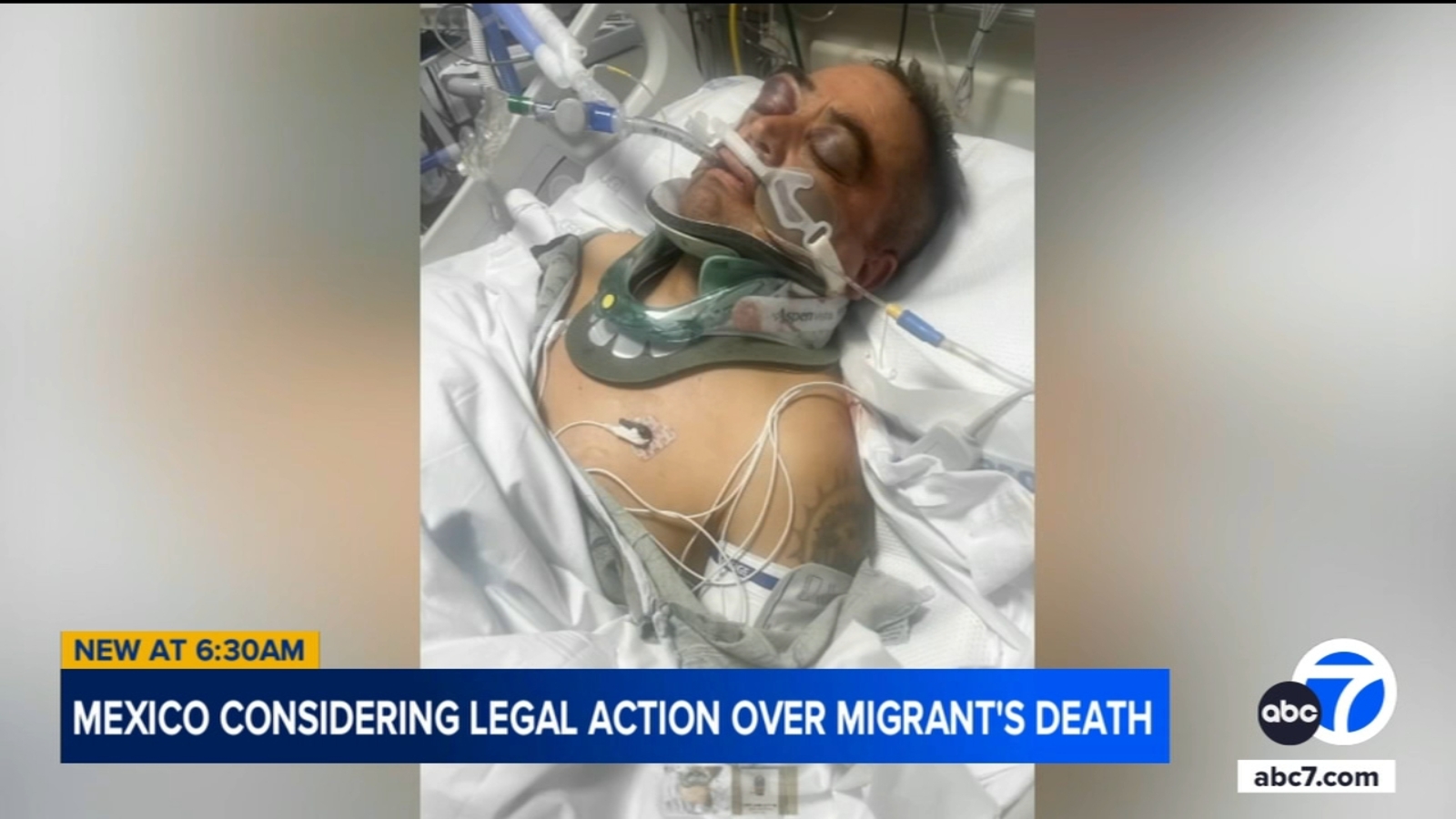
MEXICO CITY — Mexico’s President Claudia Sheinbaum on Tuesday said her administration was considering the possibility of filing a legal complaint over the death of a migrant who fell to his death during an immigration raid at a cannabis farm in Camarillo.

Jaime Alanís Garcia was hospitalized and later died after falling off a roof during an Immigration and Customs Enforcement raid in Camarillo.

“Jaime was not just a farmworker, he was a provider, and a human being who deserved dignity. His death is not an isolated tragedy. It is the result of a targeted raid at Glass House Farms. Workers were met not with protection, but with chaos and fear. Some were detained. Others were traumatized. Jaime lost his life,” the family posted on social media.

Federal agents clashed with protesters during the immigration raid at the farm in Ventura County, one of at least two large-scale raids in Southern California on July 10.

Garcia’s family said he fell about 30 feet off a building while he was possibly trying to run from federal agents. Garcia suffered a broken neck and skull.

“We are supporting the family, we are in contact with them, and we’re also exploring the possibility of filing a complaint (in the U.S.) because this is unacceptable,” Sheinbaum said at a Tuesday press conference. “The Ministry of Foreign Affairs is currently reviewing the matter. It is very unfortunate that this happened. All our solidarity and support go to the family, and there must not be another case like this one. That’s why the complaint must be filed in the courts over there.”

The Department of Homeland Security said he was not being pursued by law enforcement when he fell.

“This man was not in and has not been in CBP or ICE custody. Although he was not being pursued by law enforcement, this individual climbed up to the roof of a green house and fell 30 feet,” said DHS Public Affairs Assistant Secretary Tricia McLaughlin. “CBP immediately called a medivac to the scene to get him care as quickly as possible.”

Since June 6, 435 people have been repatriated from the U.S. to Mexico. Between Jan. 20 and July 14, 1,427 people have been deported to Mexico “specifically due to raids,” Sheinbaum said.

Including all repatriations to Mexico during that period, the total is 75,341 people: 68,790 Mexican nationals and 6,551 foreigners.

A worker is recalling how he escaped arrest during a chaotic immigration raid at a cannabis farm in Camarillo.


Source link

NY's Weed Scene Is Buzzing About Diamond Powder—Find Out Why

Long Island Cannabis Club in Deer Park Restocks Silly Nice’s Premium Weed Drops | stupidDOPE


As Suffolk County continues to cement itself as a rising hotbed for high-quality cannabis, Long Island Cannabis Club in Deer Park has quietly built a reputation for carrying some of the most potent and in-demand products available in New York. Now, the dispensary at 94 E Industry Ct, Deer Park, NY 11729 has just restocked its shelves with three of Silly Nice’s best-selling, high-performance weed offerings. For anyone serious about flavor, strength, and full-spectrum effects—this is the drop worth tracking down.

Whether you’re a seasoned smoker or a flavor-focused flower aficionado, the re-up includes some of Silly Nice’s most coveted products: Frosted Hash Balls, Diamond-Frosted & Live Resin Infused Flower, and 1G Bubble Hash.

Cannabis delivery is available throughout Suffolk County, but if you’re local, the best move is to call (631) 868-8488 or pre-order online for pickup. With Silly Nice drops, waiting until the weekend is a gamble—they don’t tend to stick around.

Silly Nice Diamond-Frosted & Live Resin Infused Flower: Papaya Wine Power

If you’re craving a true top-shelf flower experience, Silly Nice’s Diamond-Frosted & Live Resin Infused Flower (Papaya Wine) delivers a knockout combo of flavor, terpenes, and sky-high potency. This 3.5g jar is anything but ordinary. The flower is infused with terpene-rich live resin and encrusted with THC-A diamonds for an astonishing 47.75% THC and 55.47% total cannabinoids.

The Papaya Wine strain brings a lush tropical fruit flavor with earthy, floral undertones. But it’s not just about taste—the cannabinoid profile includes THCv, CBD, CBN, CBC, CBG, CBDa, and CBGa, offering a comprehensive entourage effect. Whether you roll it, bowl it, or vape it, this flower burns slow and hits hard with clarity, euphoria, and full-body calm.

Terpenes:

  • Beta-Caryophyllene – stress support

  • Farnesene – calming, floral aroma

  • Limonene – citrusy mood booster

  • Alpha-Humulene, Alpha-Bisabolol, Valenene – balancing and soothing

This one’s for seasoned smokers who want all gas and no filler. It’s lab-tested, consistent, and small-batch—exactly what you’d expect from a brand that prides itself on making Weed Done Better.

Frosted Hash Ball: Full-Spectrum Hash With Heavyweight Credentials

The Frosted Hash Ball is an underground legend for a reason. Each 1G handcrafted sphere is packed with 67.34% THCand 78.34% total cannabinoids, including rare gems like THCv, CBN, CBDa, CBGa, and CBC. It’s not just strong—it’s built to satisfy both recreational and wellness-focused users alike.

Crafted using old-school hash-making techniques and refined for today’s connoisseur, this product offers a smooth, terpene-rich experience whether smoked solo, crumbled into a blunt, or paired with flower. The terpene load clocks in at 5.7%, delivering a complex aroma that’s citrusy, spicy, and sweet all at once.

Full Terpene Breakdown:

  • Beta-Caryophyllene, Limonene, Myrcene – mood, flavor, relaxation

  • Pinene, Farnesene, Terpinolene – clarity and alertness

  • Linalool, Bisabolol – soothing and aromatic

Each ball is lab-tested for purity, potency, and consistency. It’s strong, clean, and potent without losing sight of flavor or smoothness. Ask for it at the counter—it often disappears fast.

1G Bubble Hash: Solventless and Seriously Flavorful

For hash heads and flavor chasers, the 1G Bubble Hash from Silly Nice is a top-tier choice. Made through a traditional ice-water extraction process, this solventless hash retains all the plant’s natural goodness—zero chemicals, just pure trichomes. With 52.10% THC and 61.93% total cannabinoids, the high is deep, euphoric, and long-lasting.

Unlike commercial BHO or CO2 extracts, Bubble Hash focuses on maintaining terpene and cannabinoid integrity. That means you’re not just getting high—you’re tasting the plant in all its earthy, citrus-forward glory.

Terpene Profile (5.2%):

  • Beta-Caryophyllene – spicy and grounding

  • Limonene – bright citrus lift

  • Beta-Myrcene – herbal, relaxing

  • Farnesene – subtle sweetness and calm

Perfect for dabs, topping a bowl, or rolling into joints, this hash is full-spectrum and full-flavored. It’s also lab-tested and clean, so you can enjoy it with peace of mind.

Where to Get It

Long Island Cannabis Club
Address: 94 E Industry Ct, Deer Park, NY 11729
Phone: (631) 868-8488
Website: longislandcannabisclub.com

You can search “Silly Nice” right on their site to check availability or place a pre-order. Delivery is available across Suffolk County, making it easy to stock up even if you’re not nearby.

For a full list of New York dispensaries that carry Silly Nice products, visit: sillynice.com/locations

Pro Tip: Call Ahead or Pre-Order

Silly Nice drops don’t linger. Products like the Frosted Hash Ball or the Diamond-Frosted Flower are often sold out within days of restocks. That’s why it’s always best to call ahead or pre-order online to ensure you don’t miss out.

With the demand consistently high and stock limited, a little planning goes a long way. And if you want to try something that consistently gets called “the strongest, cleanest, and best-tasting weed on the shelf,” this is your chance.

Final Word

From slow-burning infused flower to full-spectrum hash, Silly Nice is redefining what craft weed can be. Their products are small-batch, terpene-rich, and lab-tested—built for people who actually care about what they smoke.

If you’re in or near Deer Park, swing by Long Island Cannabis Club and treat yourself to one (or all) of Silly Nice’s high-potency options. Whether you’re dabbing, rolling, or loading a bowl, there’s something here that’s built to impress.

And remember: tip your budtender, always.


Source link