

Lack of access to cannabis in casinos hurts Las Vegas and Nevada tourism, study finds – CDC Gaming
May 2, 2026
Published by toker

Wellness brand positioning starts with one question: what makes your brand unique.
Ask most wellness founders who they are and they’ll answer with their product instead. “We make a high-bioavailability magnesium supplement.” “We sell full-spectrum CBD oil, third-party tested.” “Our pet health line uses only organic, human-grade ingredients.”
All true. None of it is wellness brand positioning. In-fact, there are only a few companies that understand how important wellness brand positioning is.
Positioning isn’t what you make, it’s who you are or what is your solution to a specific problem. It’s the reason that makes the client choose you over other. And the brands that define themselves by their product almost always end up in the same place: competing on price, fighting for attention in a crowded category, wondering why growth has stalled.
In a category where everyone offer dreams and focus on high-quality, organic and natural ingredients your brand must stand out. The natural way is to drive attention to your products, but that’s what everyone does…
It feels natural to lead with the product. You’ve spent months or years developing it. You know every ingredient, every formulation decision, every quality control step. The product is real and specific in a way that “positioning” feels abstract.
But your buyer doesn’t start with your product. They start with a problem.
They’re not waking up thinking “I need a high-bioavailability magnesium supplement.” They’re waking up thinking “I can’t sleep” or “my stress levels are unsustainable” or “my dog’s joints are getting worse.” The product is a potential solution to a problem they already have. Whether they choose your product over the thirty others at the same shelf depends entirely on whether your brand speaks to that problem more clearly and credibly than the alternatives and whether they can trust YOU.
When you lead with the product, you’re answering a question your buyer hasn’t asked yet. When you lead with the problem, you’re meeting them where they already are. True, when you lead with a solution you might end up with claim you are not allowed to say, that’s why this step is so important: knowing how to support your claims in a way that won’t put you in risk. That is why smart brands are winning by turning regulations Into a competitive advantage, while others are trying to avoid it and fail.
That’s the difference between positioning that works and positioning that doesn’t.
In an unregulated market, you can close the gap between product and problem with direct claims. “This will help you sleep.” “This reduces anxiety.” “This relieves joint pain.”, etc.
In regulated wellness, you can’t make those claims, or you can only make them within strict limits that make them feel vague and unconvincing. So the gap between product and problem stays open, and most brands fill it with the same generic language: “natural,” “effective,” “trusted,” “premium.”
The buyer reads those words and feels nothing. Because everyone says them. Because they can’t be proven. Because they address no specific problem the buyer actually has.
True, this constraint is frustrating. But it’s also, as I’ve written before, an opportunity. The brands that figure out how to speak to their buyer’s problem within their regulatory constraints, specifically, credibly, without overclaiming and focus on the truth.
The constraint forces creativity. Most brands fail because they don’t know how to solve this problem.
If you’re not sure whether your positioning is working, try answering these three questions as specifically as possible.
Who is your buyer, exactly?
Not “health-conscious consumers.” Not “people interested in wellness.” The specific person, their age, their situation, their prior experience with products in your category, their level of skepticism, their information sources, what they’ve already tried and why it didn’t work.
The more precisely you can describe your audience, the more precisely your messaging can speak to it. Vague positioning attracts vague buyers. Specific positioning attracts the right buyers, the ones who stay, who repeat purchase, who tell others.
What problem are you solving, specifically?
Not the general category problem. The specific, particular, this-is-what-keeps-them-up-at-night problem. The one your product should be uniquely positioned to address. The one that, when you name it precisely, makes your buyer feel genuinely understood rather than marketed to.
In regulated wellness, you often can’t name the problem directly in your advertising. But many times you have ways to point to it in your content, your email, your community, your brand story. The channels that actually work in this market are the ones where you have the freedom to be specific, the brains to do it right and the balls to do it at all.
Why should they believe you over the alternatives?
This is the hardest question and the one most brands skip. “Because our product is better” isn’t an answer as every other brand says that. The real answer is specific and provable: your sourcing, your testing, your formulation rationale, your track record, your transparency about what you can and can’t claim and why.
Don’t offer 100 fraudulent reviews, that will only put you in trouble. Try to do the hard work, with real science and treat your brand like a pharmaceutical one, with that level of seriousness.
If you can’t be specific and verifiable about your brand and about your solutions, your buyer doesn’t have any real reason to choose you. Practice on your elevator pitch – that 30-to-60-second, concise professional summary designed to introduce who you are, what you do, and your unique value is. Until you do it right, your path to success is blocked.
Good wellness brand positioning has three qualities.
It’s specific enough to exclude people. If your positioning speaks to everyone in your category, it speaks to no one… The best-positioned brands in this market have a clear sense of who they’re for and who they’re not for, and they’re comfortable with that.
It’s built around a specific buyer’s problem, not the product’s features. Features are the proof (and make sure your deliver the truth in every statement of your brand, or you will lose trust). The problem is the hook, always. Lead with what keeps your buyer awake, and use your method, research, tests and features to explain why you’re the solution.
It works within your regulatory constraints rather than despite them. The positioning doesn’t depend on claims you can’t make. It’s built on what you can prove, what you can demonstrate, what your buyer can verify independently. That kind of positioning is durable in a way that claim-dependent positioning never is.
Sadly, repositioning an existing brand is harder than positioning a new one. But the starting point for a successful wellness brand positioning is the same: get out of your own product and into your buyer’s specific problems.
Talk to your customers. Not a survey, not reviews, not AI, but a real conversation and do it often! Ask them what they were trying to solve when they found you. Ask them what they’d say to a friend who had the same problem. Ask them what made them choose you over the alternatives. The language they use to answer those questions is almost always better positioning material than anything your marketing team has written.
Then look at that language and ask: does our current messaging reflect this? Does someone who arrives at our website with the problems our customers had would feel immediately understood.
If the answer is no, and for most regulated wellness brands, it is, that’s where the work starts.
Not in marketing. Not in advertising. Not in a new marketing channel. In the positioning that everything else is built on. This is where you should focus your attention, as nothing else will help, if your brand uniqueness is the color of your packaging…
The post The Positioning Trap: Why Most Wellness Brands Get It Wrong first appeared on Cannadelics.

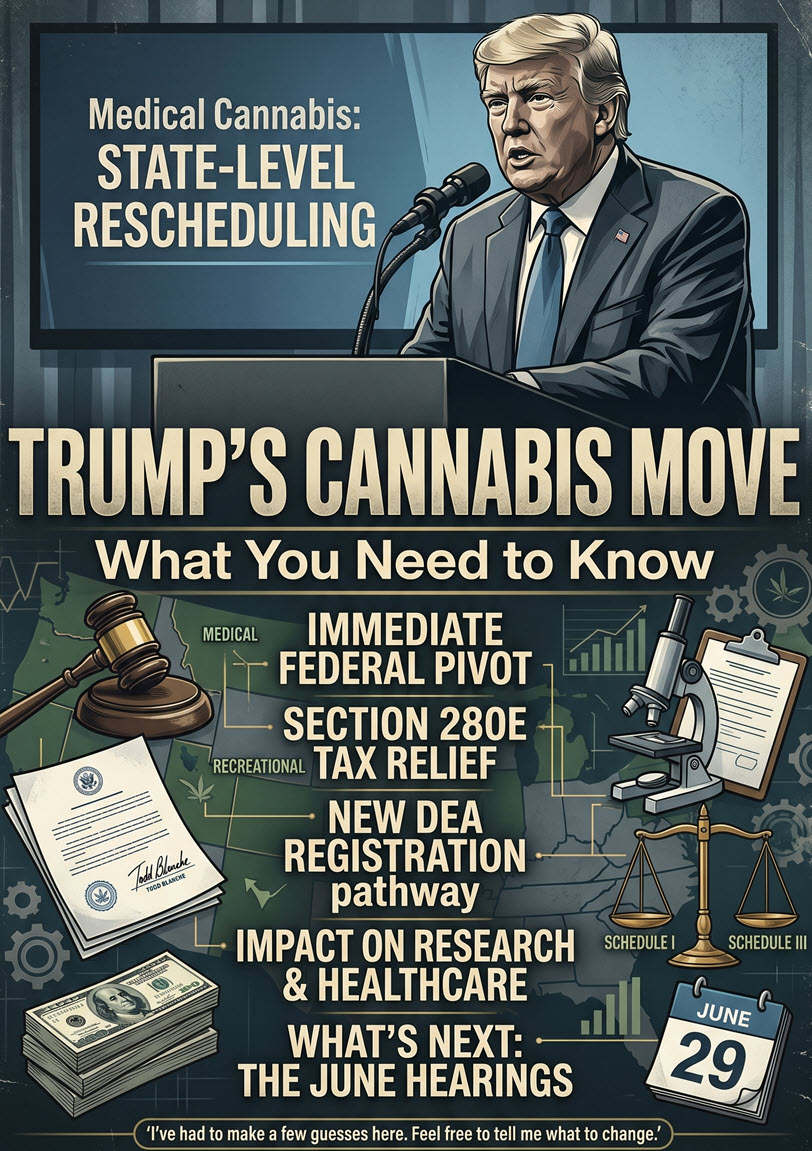

Rescheduling cannabis to Schedule III isn’t the goal, and our work isn’t done yet. Yet, it finally cracks open a nearly ancient framework and makes way for potentially revolutionary healthcare science grounded in research while also legitimizing cannabis as medicine. We no longer have to wonder when cannabis policy will evolve; it’s now a question of when society and institutions around us will finally catch on.
A Texas judge has issued a temporary injunction that continues to prevent state officials from enforcing new rules restricting access to hemp-derived products such as smokable THCA flower. Meanwhile, the state Supreme Court in a separate case is allowing regulators to ban delta-8 THC.
Judge Daniella DeSeta Lyttle’s ruling on Friday follows one from another judge last month who issued a temporary restraining order on the hemp product ban. Under the latest order, broad hemp product sales can continue until at least July 27.
The decisions come amid a lawsuit brought by a coalition of hemp industry leaders and advocacy organizations that claim the Department of State Health Services (DSHS) and the Health and Human Services Commission (HHSC) illegally bypassed lawmakers to effectively ban the sale and manufacture of certain consumable hemp products.
Under state law as approved by the legislature and governor in 2019, the suit says, cannabis products are legal if they contain a delta-9 THC concentration of not more than 0.3 percent. But regulators at DSHS and HHSC recently adopted a “total delta-9 THC” limit using a post-decarboxylation formula that includes tetrahydrocannabinolic acid (THCA) in the calculation.
Texas lawmakers did pass legislation to severely restrict hemp products in
The post Texas Judge Allows Smokable Hemp And Other Products To Be Sold, Blocking State Ban From Being Enforced appeared first on GrowCola.com.

Whitney Economics says U.S. cannabis operators carried more than $3.8 billion in delinquent receivables at the end of 2023, projected to top $4.2 billion in 2024. California’s legislature has tried twice to mandate timely vendor payments. Both bills died. A public credit-scoring platform is now filling the gap.
The cannabis industry has a payment problem. According to Whitney Economics, U.S. cannabis operators carried more than $3.8 billion in delinquent receivables at the end of 2023, with projections topping $4.2 billion in 2024. That figure equals roughly 1.6 months of total legal U.S. cannabis retail revenue, sitting on the books across the supply chain.
A public credit-scoring platform now tracks which California operators have the lowest ratings.
Whitney Economics, the leading economic research firm in the cannabis sector, published its 2023 U.S. Cannabis Delinquent Payments Report in early 2024 under a blunt title: “Cannabis Delinquencies: An Existential Threat to the U.S. Cannabis Industry.”
The survey findings landed hard. 57.3% of respondents said delinquent receivables have a greater impact on their business than 280E, the federal tax code provision that has long been the industry’s signature complaint. 44% said unpaid receivables are impacting their ability to service debt. 34% said it was impacting their ability to pay state or federal taxes. More than half of all delinquencies (56.3%) are over 45 days past due.
“The pressures created by current macroeconomic factors and regulatory policies have incentivized operators to stop paying their suppliers. Unless there is some form of federal and state regulatory intervention, the issues associated with the lack of payments will only get worse.”
Beau Whitney, founder and chief economist, Whitney Economics
One survey respondent put it more bluntly: “I would love to pay my bills, if others would simply pay me first so I could do so.”
Whitney’s data shows the crisis is concentrated upstream. Cultivators take the worst hit on accounts receivable. Retailers carry the lowest amount of delinquent A/R, because they collect from consumers in cash at the point of sale. They sit on what they owe upstream.
The result is a supply chain where operators at the top of the chain (growers, manufacturers, distributors, ancillary service providers) effectively finance the operations of those below them. Whitney’s report notes the impact is “disproportionately impacting smaller and minority owned businesses and in many cases is resulting in forced market consolidation and individual wealth destruction.”
California has the largest legal cannabis market in the country and one of the worst payment cultures. State lawmakers have tried twice to do something about it.
AB 766, introduced in 2023 by Assemblymember Phil Ting, would have required licensees to pay invoices of $5,000 or more within 15 days of the date set on the invoice. Unpaid invoices would have been reported to the Department of Cannabis Control, which could have issued warnings, citations or full disciplinary action. Licensees who failed to pay would have been prohibited from purchasing on credit until the invoice was settled.
AB 766 died in committee in early 2024.
A second attempt followed. AB 2888, introduced in 2024 by Assemblymember Phillip Chen, contained nearly identical language. It also did not advance.
So the state with the largest cannabis market in the country also has no enforceable framework requiring timely vendor payment. The 15-day rule, which would arguably have changed payment culture overnight, simply does not exist.
That regulatory vacuum is where Cannabis Credit Scores has positioned itself. The platform aggregates feedback from cannabis vendors and assigns operators a credit score based on payment behavior, dispute history and supplier reports. Operators with scores below 20 land on what CCS calls its “Shit List.”
CCS scores reflect aggregated vendor feedback. Low scores can stem from a range of underlying causes, including disputed invoices, financial distress, operational issues or alleged non-payment. The platform compiles and publishes the reports rather than adjudicating the underlying reasons.
More than 100 California operators currently appear on the list, per CCS data. Patterns worth noting:
CCS does not publish dollar amounts owed. It tracks the pattern and frequency of vendor reports. The list is updated continuously based on new submissions.
For cultivators, distributors and ancillary service providers, the platform functions as a vendor’s version of a credit bureau. Suppliers can check a buyer’s track record before extending net-30 or net-60 terms. For operators, a low score is a public signal that vendors should require cash up front.
The CCS list is, in effect, a private-sector workaround for the regulation California’s legislature couldn’t pass. The platform isn’t enforcing payment. It’s making credit performance public, in real time, across the largest cannabis market in the country.
<p>The post The Cannabis ‘Shit List’: Where Vendors Are Naming California’s Lowest-Rated Operators first appeared on High Times.</p>
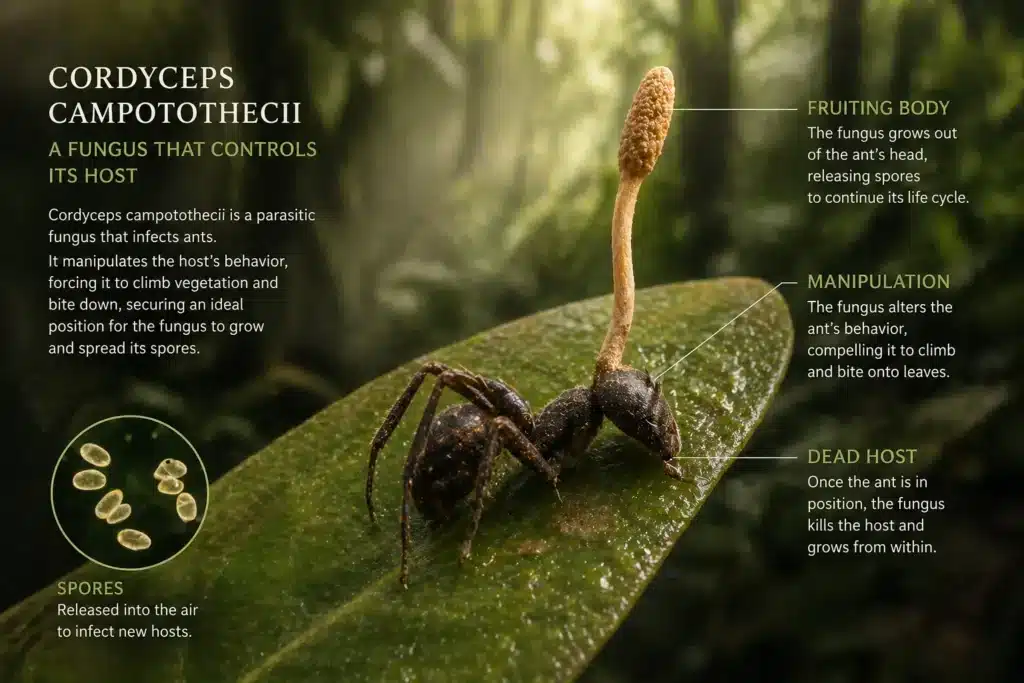
Cordyceps is a popular functional mushroom, usually discussed in the context of energy, immunity, and wellness products. Most people encounter it through capsules, powders, or blends marketed for daily performance. But the origin story of cordyceps is very different. It involves ants, behavioral control, and something that resembles a scene from a horror movie. Let’s take a closer look at the origin of the so-called “zombie-ant fungus.”
In nature, certain species of cordyceps infect insects, alter their behavior, and use their bodies to reproduce. This is where the term “zombie-ant fungus” comes from. It sounds extreme, and it is, but it is also well documented.
Understanding this process gives a clearer picture of what cordyceps actually is, how it evolved, and why it behaves the way it does.
The term refers to species within the Ophiocordyceps genus, closely related to cordyceps fungi. One of the most studied species is Ophiocordyceps unilateralis. These fungi are known to infect ants in tropical forests, particularly carpenter ants. Once inside the host, the fungus begins to grow and interact with the insect’s internal systems.
Over time, it alters the ant’s behavior in a very specific way.
The process follows a structured pattern:
First, fungal spores attach to the ant’s body and penetrate its exoskeleton. Once inside, the fungus spreads through the body, forming a network that interacts with the host’s tissues. It does not immediately kill the ant, but continues to grow while the ant remains active.
At a certain stage, behavior changes begin. The ant leaves its colony and moves to a location that favors fungal growth. This is usually a humid environment with a stable temperature, often on the underside of a leaf above the ground. The ant then bites down and locks its jaw in place. This is often referred to as the “death grip.”
Shortly after, the ant dies.
From that position, the fungus grows a stalk from the body and releases spores, continuing the cycle.
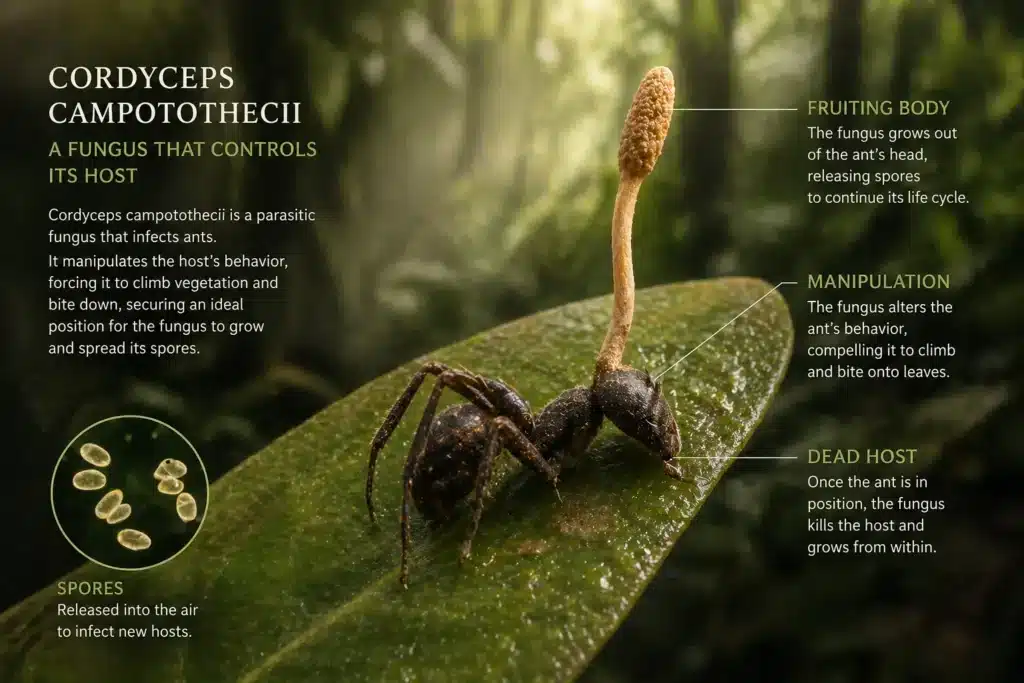
One of the most important questions is how the fungus alters behavior. Early assumptions suggested that the fungus directly controlled the ant’s brain. More recent research indicates a more complex mechanism.
Studies show that the fungus forms a network around muscle fibers rather than invading the brain extensively. It appears to influence behavior through chemical signaling and movement control, rather than direct neural takeover.
In simple terms, the fungus may not “control the mind” in the way people imagine. It interferes with the body in a way that produces predictable behavior. This distinction matters because it shows how targeted and specialized the interaction is.
From an evolutionary perspective, this behavior increases the fungus’s chances of survival and reproduction.
The elevated position of the ant allows spores to spread more effectively. The humidity and temperature of the chosen location support fungal growth.
Every step in the process improves the likelihood that the fungus will complete its lifecycle. This is not random. It is a refined biological strategy shaped over time.
The cordyceps used in supplements are not the same species involved in the zombie-ant phenomenon. Most commercial products use Cordyceps militaris, which can be cultivated in controlled environments.
The original Cordyceps sinensis also grows on insects in nature, but it is different from the Ophiocordyceps species that infect ants.
Still, the connection between these species matters.
It explains why cordyceps contains compounds designed to interact with biological systems. These fungi evolved to survive by influencing host organisms.
That does not mean they control human behavior, but it helps explain why they are biologically active.
The transition from a parasitic organism to a wellness product is unusual.
Cordyceps moved from traditional use into modern supplements largely because of its perceived effects on energy and vitality. Research has identified compounds such as cordycepin and various polysaccharides that may influence cellular processes.
However, the strength of evidence in humans is still limited, and as in many other areas, the market is moving faster than the research. This does not mean that consuming cordyceps leads to effects similar to those seen in insects, but it does suggest that these fungi are biologically active and still not fully understood.
The zombie-ant narrative plays a significant role in how people perceive cordyceps.
For some, it creates curiosity and interest. For others, it creates hesitation. From a content perspective, it is one of the most powerful entry points into the topic. This article is a good example. It does not focus on positioning, retention, or typical business topics. However, it is likely to attract attention because the topic is unusual and memorable.
It captures attention in a way that typical supplement descriptions do not.
At the same time, it needs to be handled carefully. Overemphasizing the “zombie” aspect without context can distort understanding. Used correctly, it provides a strong educational hook.
It is important to be clear: the zombie-ant phenomenon does not imply that cordyceps supplements can alter human behavior in a similar way. The biological interactions in insects are highly specialized. They involve specific species, environments, and evolutionary adaptations.
Human physiology is fundamentally different.
The “zombie-ant” fungus is not a marketing invention. It is a real and well-studied biological process. Understanding it provides context for what cordyceps is and how it developed.
It is not just a generic mushroom. It is part of a group of organisms that evolved complex ways to interact with living systems. This helps explain why researchers are increasingly interested in its compounds and potential effects.
Will we see pharmaceutical drugs developed from cordyceps in the future? Perhaps, but until then, for now, it is best understood as a functional ingredient with growing interest rather than a fully established clinical compound.
The post Cordyceps and the Zombie-Ant Fungus: a True-Life Horror Story first appeared on Cannadelics.









We use cookies to improve your experience on our site. By using our site, you consent to cookies.
Manage your cookie preferences below:
Essential cookies enable basic functions and are necessary for the proper function of the website.
Drag & drop or click to select
JPEG, PNG, GIF, WebP, MP4, WebM · Images max 30 MB · Videos max 100 MB