
Study: Cannabis-related hospital visits on the rise, linked to mental health disorders

Study: Cannabis-related hospital visits on the rise, linked to mental health disorders


The rate of cannabis-related hospital visits in Arizona rose by 20% between 2016 and 2021. In an increasing share of those visits, the patient was diagnosed with a mental health condition, Arizona State University Associate Professor of psychology Madeline Meier has found in a new study.

Cannabis-related visits were nearly eight times as likely as visits unrelated to cannabis to have a mental health condition as the primary diagnosis, Meier and co-authors reported in the Journal of Studies on Alcohol and Drugs

The association between cannabis-related visits and mental health diagnoses increased each year, most prominently among people age 65 or older.

ASU News talked with Meier about the research and its implications.

Question: Is it possible to explain why these visits are becoming more common? Is it related to legalization?

Answer: In Arizona, legalization of non-medical cannabis didn’t happen until late 2020, with sales starting in dispensaries in 2021. Our study covers a period earlier than that, so we can say without a doubt that the increase in these visits was not caused by recreational legalization. It’s possible that medical use contributed to the trends we observed, but we can’t say for sure.

Q: The link between the cannabis-related hospital visits and mental health diagnoses grew stronger over the five-year study period. Do you know what is driving this, or why the trends are more pronounced among older adults?

A: Our study doesn’t address mechanisms. It was observational; it documents the correlation and its increase but can’t address why. The increasing potency of cannabis might be a factor. The concentration of THC, the psychoactive constituent of cannabis, has increased a lot. In the 1990s, the THC concentration of cannabis products was about 4%, and today the average THC concentration of cannabis products in dispensaries across the country is about 20%, and you can find products called concentrates that contain upwards of 80% or 90% THC.

Another possibility is that an increasing number of people with mental health problems are turning to cannabis thinking it might be useful for treating anxiety or treating depression. It may be the case that more people are doing that. We know that depression and anxiety are among the top three reasons that people give for using medical marijuana.

Q: How pronounced is the problem among retirement-age people?

A: It’s important to point out that the rate of cannabis-related hospital visits remains much higher among younger adults than those age 65 and older. For 10- to 17-year-olds, the rate is more than 2,400 per 100,000 hospital visits, compared with 435 per 100,000 visits for those 65 and older. But older adults are showing the steepest increase in cannabis-related hospital visits and increase in the risk of a primary diagnosis of a mental health condition, given a cannabis-related hospital visit.

Q:  What are the implications for people who use cannabis? Any words of advice for them or for health care providers?

A: I think that health care providers have an opportunity, if they find out a person is using cannabis, to educate them that the THC content has increased a lot in recent years. I think that we have to warn people that this more potent cannabis could potentially be associated with more acute harms as well as potentially longer-term mental health risks. 

We have to educate people, also, that even though many states list mental health disorders among the qualifying conditions for medical cannabis, studies have not been done that show it’s beneficial for mental health. In fact, existing studies have found that if you quit using cannabis, your mental health will improve. Physicians should probably know that, and we need to do a better job getting that message out.



Source link

A.Y. Strauss Introduces New Cannabis Practice

A.Y. Strauss Introduces New Cannabis Practice


cannabis lawcannabis law

Law

A.Y. Strauss, a Livingston-based law firm, has launched its new cannabis practice. The firm has appointed cannabis attorney Jennifer Cabrera as partner to lead the expansion. Cabrera is joined by Kate Monroe, an project manager and cannabis licensing specialist.

Together, Cabrera and Monroe bring nearly two decades of experience in cannabis law to A.Y. Strauss. Previously, Cabrera led the New Jersey branch of one of the nation’s most prestigious cannabis law firms, where she and Monroe successfully won dozens – if not hundreds – of cannabis licenses for their clients across New York, New Jersey, and beyond. Cabrera’s focus is on providing expert, client-focused guidance across various aspects of cannabis law, including regulatory compliance, land use permitting, M&A, and fundraising.

“Our firm’s mission is to grow alongside the needs of our clients, and that includes building practices that reflect emerging areas of law. To do so, we recruit exceptional legal professionals who share our values and commitment, and we are very excited to welcome Jennifer as a Partner. Her expertise and advocacy work will be key as we expand this area of our practice and support our clients in navigating the complexities of cannabis law and policy,” said Aaron Strauss, managing partner of A.Y. Strauss.

Cabrera states, “My goal is to help cannabis business owners succeed in the regulated market. From working with the New Jersey CRC and New York OCM, to building bridges with their local community and labor union, to raising money or selling your business, success in the cannabis industry means being a sophisticated and reliable partner. Joining the team at A.Y. Strauss allows me to bring even more resources to my clients, with a deep bench of talent in areas like real estate, corporate transactions, litigation, labor and employment, and more. My mission since I represented my first client in the cannabis industry in 2014 remains the same: to support my clients, offer guidance, and help them move forward with clarity and confidence.”

The new Cannabis Practice at A.Y. Strauss will offer comprehensive services, including:

  • Commercial leasing and real estate transactions
  • Commercial transactions and contracts
  • Financial services and guidance
  • Government relations and policy advocacy
  • Labor and employment counsel
  • Licensing and permitting
  • Litigation and dispute resolution
  • Regulatory compliance

To access more business news, visit NJB News Now.

Related Articles:


Source link

Tory peer’s cannabis medicines firm goes under

Tory peer’s cannabis medicines firm goes under


A drugs company developing cannabis-based medicines and backed by Imperial Brands, the big tobacco group, has moved to appoint administrators just months after promoting a former chief executive of the Conservative Party to chairman in a “transformative” rebrand.

Oxford Cannabinoid Technologies (OCT), which is developing prescription medicines for pain, delisted from the London Stock Exchange last year, saying turbulent British markets had exerted “continuous, irrational and regressive pressure” on its share price.

The company, which was founded in 2017, had sought to rejuvenate itself as a private company. In February it rebranded as Octavian Therapeutics, promoted Lord Mott, 52, a non-executive director, to chairman and announced plans for a “major fundraising initiative”, targeting £10 million.

Portrait of Lord Mott, a member of the House of Lords.

Lord Mott had been promoted to chairman in February with plans for a £10 million fundraising initiative

ROGER HARRIS PHOTOGRAPHY

However, the company is understood to have struggled to raise funds and an application has now been filed with the High Court to appoint Rushtons Insolvency as administrator.

OCT, Rushtons and Imperial Brands, the London-listed maker of L&B cigarettes, declined to comment. Imperial held a 9.6 per cent stake, according to filings, and until March last year had a representative on the board.

A source blamed the wider difficulties biotech companies are facing in accessing sufficient capital and liquidity in the UK.

Medical cannabis has potential to fight cancer, largest study finds

OCT, which raised £16.5 million and was valued at £48 million when it floated in 2021, delisted last June blaming “turbulence” in the UK public markets for a “punitive effect on sentiment in biopharma as a sector, and on quoted biopharma businesses in particular”. It had said this had constrained it from sustaining a “sensible” valuation that reflected its “record of scientific and clinical achievements” and, in turn, had impeded it from raising money to develop its pipeline.

Snoop Dogg at the Time100 Gala.

The rapper Snoop Dogg is a partner in the cannabis-focused venture Casa Verde, which was a shareholder

TAYLOR HILL/GETTY IMAGES

Casa Verde, the cannabis-focused venture capital firm whose partners have included Snoop Dogg, the rapper, was also a shareholder. It is not clear whether Case Verde retains a stake. It was approached for comment.

When promoting Mott, who was chief executive of the Conservative Party between 2020 and 2022, and before that director of campaigning, the company had said he would provide “access to his extensive global network of investors and industry leaders, critical to Octavian’s continued growth”.

Mott had said: “My focus will be ensuring that investors fully appreciate the strength of Octavian’s drug discovery programmes and the commercial opportunities ahead.”

A number of small-cap biotech companies have delisted in the past year or so, including Destiny Pharma, which also subsequently entered administration.


Source link

Pennsylvania Democrats ‘Ram’ Partisan Cannabis Legalization Bill Through House

Pennsylvania Democrats ‘Ram’ Partisan Cannabis Legalization Bill Through House


Pennsylvania House Democrats expedited an adult-use cannabis legalization bill through their chamber via a 102-101 vote on May 6 without attracting a single vote from across the aisle.

House Bill 1200, sponsored by Reps. Rick Krajewski, D-Philadelphia, and Dan Frankel, D-Allegheny, would allow adults 21 and older to possess up to 42.5 ounces of flower, 5 grams of concentrate or 500 milligrams of THC. They could also cultivate up to two mature and two immature plants at home with a $100 annual permit fee.

The legislation would also establish a regulated commercial marketplace in which the Pennsylvania Liquor Control Board would oversee state-run cannabis dispensaries, guinea-pigging such a model in the federally illegal confines of the U.S. The board would determine which municipalities could have the dispensaries, but they could not be located within 1,000 feet of a school or day care.

Meanwhile, the state would license private entrepreneurs to operate cultivation, processing, transportation and laboratory businesses.

After Krajewski and Frankel introduced H.B. 1200 on May 4, the House Health Committee that Frankel chairs advanced the legislation on May 5, and the full House passed the legislation on a second reading entirely along party lines on May 6. The lower chamber must vote on a third reading of the bill before officially sending it to the Senate.

A divided government, Pennsylvania Republicans control a 27-23 majority in the upper chamber, meaning partisan bills such a H.B. 1200 have low probabilities of gaining floor consideration in an opposing body, much less passing.

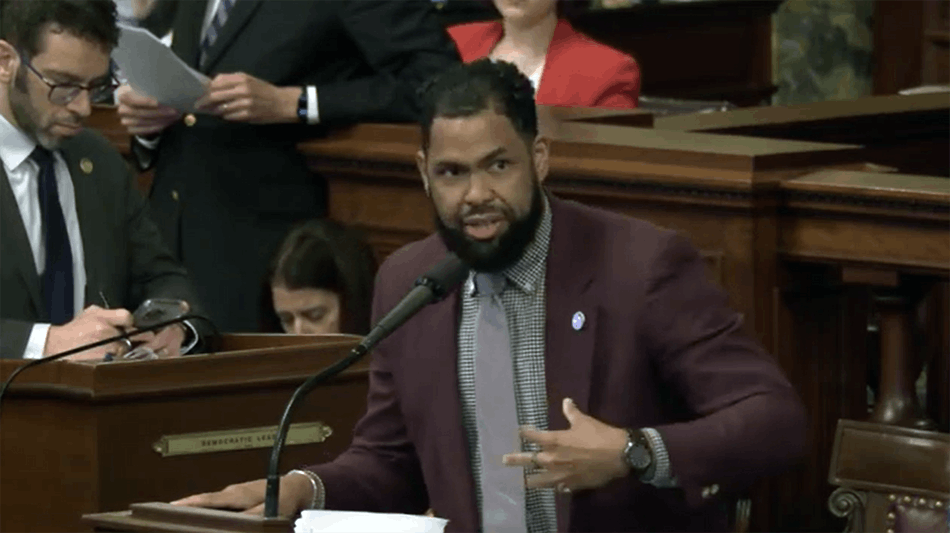
While there wasn’t floor debate on the underlying bill on Tuesday in the House, Rep. Charity Krupa, R-Fayette, said during the previous day’s committee hearing that she was appalled by how House Democrats “rammed” the legislation through.

“At this point, this vote isn’t just about marijuana; it’s about how we govern,” she said. “By scheduling a nonvoting session on a Sunday to introduce a sweeping 173-page bill and then racing it through committee and towards a floor vote with barely 48 hours’ notice, we are undermining the legislative process itself. … This scheme is a slap in the face.”

With their Sunday introduction, Krajewski and Frankel laid out five key priorities of the bill:

  • Automatically clearing criminal records and advancing restorative justice for those impacted by cannabis-related offenses;
  • Reinvesting tax revenue into communities disproportionately harmed by the war on drugs;
  • Implementing critical public health protections, including THC limits, marketing restrictions and child safety measures;
  • Creating pathways for diverse and local entrepreneurs to participate in the regulated cannabis market, with a priority on licensing and contracting; and
  • Maximizing state revenue and accountability with publicly owned and accountable retail stores.

More specifically, the legislation would cap cannabis flower at 25% total THC, concentrates at 200 milligrams of THC per package, and other products at 5 milligrams of THC per serving and 25 milligrams per package.

“We have listened carefully to public health experts, criminal justice reformers, small business advocates and community leaders,” Krajewski said. “Our bill reflects what we’ve learned—that we can and must legalize cannabis in a way that is safe, equitable and beneficial to all Pennsylvanians.”

The sponsors projected that a hybrid adult-use marketplace in the commonwealth would generate more than $500 million annually from taxes and state profits under the bill. In particular, the bill would impose a 12% excise tax on cannabis sales.

The legislation would establish a cannabis revenue fund, which, after paying for program costs, would designate 50% of the remaining money to a Communities Reimagined and Reinvestment fund, 10% to substance-use prevention and treatment, 5% to a cannabis business development fund, 2.5% to a minority business development fund and 2% to expungement processes. The remaining balance would go to the state’s general fund.

Karen O’Keefe, the director of state policies at advocacy organization Marijuana Policy Project, said there are pros and cons of the legislation.

“There are many provisions in this bill that we commend,” she said in a public statement. “It would stop criminalizing people for using cannabis and prevent families from being torn apart and lives being ruined because adults choose to relax with cannabis. However, we have serious concerns about the viability of a state-run stores model due to federal law. No other state operates cannabis businesses this way, and for good reason. State cannabis laws must be carefully crafted to ensure they are workable in the face of federal prohibition.”

Under current state law, possessing any amount of cannabis in Pennsylvania carries a misdemeanor penalty and the possibility of jail time, including up to 30 days with a $500 fine for 30 grams or less, and up to one year with a $5,000 fine for greater amounts. In 2023, Pennsylvania law enforcers arrested more than 11,000 people for cannabis possession, according to the National Incident-Based Reporting System.

Smoking cannabis in public would still carry a civil penalty under H.B. 1200, including a $100 fine on the first offense and up to a $200 fine on subsequent offenses.

The Liquor Control Board would be responsible for licensing 50 Category I cultivators for up to 125,000 square feet of canopy, 50 Category II micro-cultivators for up to 14,000 square feet of canopy, 50 Category I processors, 50 Category II micro-processors, up to 50 transporters, and additional permits for on-site consumption facilities and cannabis worker cooperatives.

Category I license applicants would be ranked and scored, with advantages awarded to certified social and economic equity applicants. Category II, transporter and consumption lounge applicants would enter lotteries designated for social equity and non-social equity applicants.

“By legalizing and regulating cannabis thoughtfully, we can avoid pitfalls that have marred rollouts in other states,” Frankel said. “Our plan will create clear rules that protect consumers, educate the public and ensure that Pennsylvania small businesses and taxpayers—not out-of-state corporations—benefit from the profits.”

While Pennsylvania Democratic Gov. Josh Shapiro has called for adult-use legalization in his last two budget addresses, he most recently proposed a 26% excise tax on sales, suggesting in February that the commonwealth is “losing out on revenue that’s going to other states instead of helping us right here.”

While the Krajewski-Frankel proposal remains partisan in the House, a bipartisan effort is unfolding in the Senate.

State Sens. Sharif Street, D-Philadelphia, and Dan Laughlin, R-Erie, introduced a bipartisan plan and circulated a sponsorship memo in February for their forthcoming adult-use legalization bill.

In Pennsylvania’s divided Legislature, Laughlin represents a pivotal peg in the legalization picture—a Republican champion for cannabis reform in the GOP-controlled chamber.


Source link

Up In Smoke (Cannabis Science with Staci Gruber)

Up In Smoke (Cannabis Science with Staci Gruber)


Taped Live in Los Angeles at Dynasty Typewriter with cultural icon and comedy legend, Tommy Chong alongside world-renowned cannabis researcher, Dr. Staci Gruber (McLean Hospital/Harvard Medical School).

Together, they do a deep dive on what science can tell us about cannabis use both recreational and clinical. Discover how cannabis is revolutionizing healthcare, its extraordinary biology, and its profound potential to treat disease. Don’t miss this enlightening and unforgettable episode! 


Source link

The Travel Agency Opens SoHo Flagship, Blending Cannabis, Culture, and Creativity | stupidDOPE

The Travel Agency Opens SoHo Flagship, Blending Cannabis, Culture, and Creativity | stupidDOPE


The Travel Agency, New York’s premier legal cannabis retailer, has opened its newest flagship in SoHo, marking a bold evolution in cannabis retail. Located at 598 Broadway, just below Houston Street, this new outpost delivers a full-spectrum sensory experience that merges sculpture, design, and function, all in service of destigmatizing cannabis while celebrating New York City’s deep cultural roots.

The SoHo location builds upon the brand’s success across Union Square, Downtown Brooklyn, and Fifth Avenue, bringing a design-forward, immersive approach to cannabis retail. This isn’t just a dispensary—it’s a contemporary space that feels more like a curated art gallery. Every element, from architecture to in-store installations, reinforces The Travel Agency’s commitment to reimagining what a cannabis experience can be.

Design Innovation That Pushes Boundaries

At the center of the SoHo store’s design is a collaboration with Leong Leong Architecture, whose vision for this space was inspired by downtown Manhattan’s history of experimental art spaces. Their concept introduces a glowing, arcing ceiling that bathes the entire store in a soft, ambient light, accentuating a constellation of illuminated vitrines. It’s a calming, futuristic environment that invites guests to linger, explore, and discover.

Big Heavy Studios adds a museum-quality presentation to the product displays, with custom-fabricated elements that frame cannabis products as cultural artifacts. This stylistic decision reframes cannabis from a commodity to a curated object of cultural relevance.

Andrew Zolty of Breakfast Studio contributes a kinetic art installation that pulses with data-driven motion, providing an ever-evolving heartbeat to the retail environment. The result is a dispensary that feels alive—responsive to both the people in it and the rhythms of the city around it.

A standout feature of the SoHo flagship is its Bong Gallery, where functional glass meets fine art. Here, Milan-based designer Serena Confalonieri presents vibrant, psychedelic bongs that nod to the joy and ritual of cannabis. Mexican sculptor Juan Manuel Carmona contributes with the OLMi Bong, a surreal piece that weaves cultural identity and political nuance into functional design. These pieces aren’t just for show—they challenge the viewer to rethink what cannabis culture can look like.

Cannabis Retail That Reflects the Neighborhood

SoHo has long been associated with avant-garde art movements and iconic figures like Jean-Michel Basquiat and Keith Haring. The Travel Agency taps into this creative legacy with a space that invites exploration and reflection. As Co-Founder Arana Hankin-Biggers explains, the store was designed to feel like a cultural landmark—a place worthy of sightseeing, not just shopping.

“The SoHo store is our most art-forward to date,” says Hankin-Biggers. “With custom installations and original artwork, we’re honoring the neighborhood’s rich artistic history while creating something entirely new for cannabis retail.”

Social Equity and Community-Centered Operations

The Travel Agency SoHo operates under New York’s SEE (Social and Economic Equity) program, a cornerstone of the state’s legal cannabis rollout aimed at ensuring access and opportunity for historically marginalized communities. Like all Travel Agency locations, this store is built on the principles of inclusivity, empowerment, and reinvestment into local economies.

This commitment is part of what makes the brand a leader in the cannabis space. Beyond innovative design, The Travel Agency is helping set a precedent for what a responsible, community-driven cannabis business looks like in New York.

National Recognition and Cultural Leadership

The Travel Agency’s commitment to excellence has not gone unnoticed. The brand has received three Clio Awards across retail design, branding, and PR. Its leadership team has been spotlighted in outlets like Green Market Report and Inc. Magazine for their role in shaping the industry.

The brand has also partnered with some of the world’s most iconic cultural institutions. From sponsoring the New York Film Festival to hosting cannabis-integrated events at NYFW and the PUBLIC Hotel’s Met Gala after-party, The Travel Agency has positioned itself as a lifestyle brand that intersects with fashion, film, and music.

Premium Product Selection and Expert Budtenders

Whether you’re new to cannabis or a seasoned enthusiast, The Travel Agency SoHo delivers a best-in-class product menu that includes both local and national brands. New Yorkers visiting the SoHo flagship can expect the same high-quality offerings and personalized attention that made the brand famous in Union Square and Brooklyn.

For those seeking potent and premium options, don’t miss out on Silly Nice’s Bubble Hash and Diamond Powder. Known for freshness and potency, Silly Nice products are only crafted once an order is placed by a dispensary, ensuring you get top-shelf quality every time. The Bubble Hash offers a full-spectrum experience with a terpene-rich flavor profile, while the Diamond Powder delivers concentrated THC crystals perfect for dabs, bowls, or infusions.

Upcoming Events and Grand Opening Celebration

The official ribbon-cutting for the SoHo flagship takes place on May 7, 2025, followed by a grand opening celebration on May 28, 2025. These events will showcase the store’s architectural details, highlight featured artists, and offer guests a first-hand experience of this redefined approach to cannabis retail.

Located in one of Manhattan’s most iconic neighborhoods, The Travel Agency SoHo invites locals and visitors alike to explore what happens when cannabis, design, and culture converge.

And remember, when visiting a dispensary—especially one as thoughtfully curated as this—ALWAYS TIP YOUR BUDTENDER.

Learn more at www.thetravelagency.co.


Source link

How to Take Your Cannabis Brand Multistate—Without Losing What Makes It Great 

How to Take Your Cannabis Brand Multistate—Without Losing What Makes It Great 


Every cannabis brand wants to grow. But growth isn’t just about entering new states. It’s about showing up the right way in each one. Without a strong brand identity and a tailored go-to-market plan, scaling can create more chaos than customers. 

Over the years, I’ve helped cannabis brands expand, and I’ve seen the same mistake play out repeatedly: companies treat growth as a logistics challenge – focusing on licenses, distribution, and operations. But the true challenge is strategic. 

Every new market brings new complexity. Consumers behave differently. Regulations shift. Retail dynamics vary. Without a clear blueprint from the start, things can fall apart fast. That’s why I use a core set of principles to help brands scale without losing what made them successful in the first place.

Define the Brand  

The first step is clarity. If a brand can’t articulate what makes it different, or why a consumer should choose it over the competition, there’s no foundation to scale from. 

At Sun Theory, one of the first things I did was launch a “reasons to buy” exercise. We surveyed the team anonymously, asking everyone to list the brand’s top three selling points. We surfaced assumptions, aligned on what actually mattered to the consumer, and built a core identity that the entire company could rally behind. 

Understand the Market  

Once you know who you are, you need to understand where you’re going. Every market is unique – in its regulations, consumer maturity, price sensitivity, and preferences. 

I always start with a full market assessment: how recently cannabis was introduced, how categories are trending differently, how fragmented the competitive set is, and how the retail environment operates. 

The structure of the retail landscape, in particular, plays a big role. In some markets, a concentrated group of operators controls the majority of shelf space. While that can pose a challenge, it also creates an opportunity: when you build strong relationships with a handful of key players, you can drive meaningful results quickly and efficiently. Depth wins over breadth in these situations, and the right partnership can accelerate awareness, trial, and long-term velocity. 

For example, Missouri was a strategic choice for Sun Theory. It’s an emerging market with healthy pricing, a relatively small competitive set, and white space for premium products like rosin gummies. 

Adjust Your Offerings 

A smart portfolio strategy aligns with both consumer demand and local regulation. Some markets skew value. Others support premium. 

In Arizona, a price-sensitive state, we’d lean on lower-funnel tactics to drive trial. In more mature markets, we can focus on storytelling and positioning. Pricing, pack size, cannabinoid content – all of it needs to reflect local dynamics. 

Define What Success Looks Like 

Before launching, I always ask: What does success mean here? Market share? Margin? Brand awareness? That clarity informs everything else, from sales structure to pricing to how we measure impact. 

Some markets require deep focus on a few high-volume doors. Others demand broader distribution from day one. Either way, your KPIs should shape your go-to-market plan, not the other way around. 

Build a Killer Team 

Your field structure should match the market. In states dominated by a few chains, you may need fewer traditional reps and more strategic account managers who can go deep with key partners. In more fragmented markets, a broader team with strong store-level coverage is essential. 

But before you can build the right structure, you need to embed yourself in the market. Every cannabis scene is its own ecosystem – tight-knit, often incestuous, and hard to crack from the outside. You’ve got to dig into LinkedIn and Reddit, get out and walk the doors, start conversations, and most importantly, really listen. The best hires aren’t always posting resumes, they’re already moving weight and influencing the floor. 

Engage in the scene and you’ll be rewarded. The right talent can supercharge your brand’s presence and pull at retail. Your structure shouldn’t just reflect what worked last time, it should be built around how things actually get done here. 

Match Your Marketing to the Market 

Marketing must evolve with market maturity. In new states, education is critical – especially for premium formats like rosin. In more saturated markets, it’s about differentiation and conversion. 

Execution is just as important as strategy. We equip our teams with playbooks, training decks, and merchandising guidelines tailored to each market. Even the platforms budtenders use vary, so we adapt our materials to match. 

Stay Adaptable 

Even the best plans need to flex. Pricing shifts. Competition ramps up. Consumer preferences evolve. What worked at launch might need to pivot six months later. 

We stay close to the data, to our retail partners, and to the consumer. Sometimes that means expanding a product line (like we did in Colorado with minor cannabinoids). Other times, it means narrowing focus. Either way, we act early. 

Scaling a cannabis brand isn’t about adding zip codes – it’s about consistency, adaptability, and clarity. The brands that get this right don’t just grow. They build loyalty. They earn repeat customers. And they last. 

  • Cannabis & Tech Today is the premier publication for inspiring business profiles, exclusive interviews with thought leaders in the field, science innovations, and insights on new legislation and growth in the cannabis market.


Source link

Cannabis retailer Trulieve reports Q1 2025 earnings results – BNN Bloomberg

Cannabis retailer Trulieve reports Q1 2025 earnings results – BNN Bloomberg


Source link

Former EMU football player turned marijuana entrepreneur banned from industry

Former EMU football player turned marijuana entrepreneur banned from industry


LANSING, MI — For the first time ever, Michigan marijuana regulators have banned a former business owner from the industry.

“The Cannabis Regulatory Agency (CRA) has permanently excluded Youssef Barakat from being employed by or being a supplemental applicant of any medical or adult-use marijuana business in Michigan,” the CRA said in a statement issued Tuesday, May 6.

The CRA served Barakat notice that he was being excluded from the marijuana industry on April 9, according to the CRA’s notice to exclude. By law, he had 21 days to contest the decision.

Bakarat held 50% ownership in two marijuana retail shops: Big Rapids Tree House Club, licensed in July 2022, and Bay City Tree House Club, licensed in March 2023.

The businesses were operated by Kzoo420, which Bakarat dissolved in August 2024, according to online business records.

CRA records indicate Bakarat’s Big Rapids store sold 1.5 ounces of marijuana in an unmarked sandwich bag to a 20-year-old state police trainee during a 2023, sting.

CRA inspectors were also present and during the investigation that followed identified multiple employees working without required approval of the CRA, doors that were unsecure and surveillance cameras obstructed by strategically placed pieces of toilet paper.

Bakarat told inspectors products were sold without required tracking labels because the store didn’t have a printer, the CRA said.

Big Rapids officials revoked the business license on March 10, 2023.

The Bay City Tree House Club received its marijuana retailer license 20 days later.

In June 2023, CRA staff met the landlord of the building at 215 S. Linn Street in Bay City and found the marijuana store was unlocked with no employees inside, according to CRA reports. CRA employees said there was no alarm system engaged and unsecured marijuana and unmarked marijuana was found inside.

State licensing records list the Bay City Tree House license as “void” with an expiration date of July 13, 2024.

MLive was unable to reach Bakarat for comment.

In a 2022 interview with the Big Rapids Pioneer, Bakarat said he learned about the medicinal benefits of marijuana use for pain while playing football at Eastern Michigan University.

The EMU Eastern Athletics website lists Bakarat, who graduated from Salem High School in Canton, as a defensive back and member of the team’s practice squad in 2013. No game stats are listed.

While Bakarat is the first to be placed on the CRA’s “involuntary exclusion list,” at least nine other marijuana entrepreneurs have agreed to no longer participate in the industry as a result of CRA investigations.

“Individuals may voluntarily exclude themselves from employment at, or participating in a marijuana business, by signing a consent order and stipulation to resolve disciplinary action the CRA has initiated against them,” the CRA said.

A full list of people banned from the marijuana industry is available on the CRA website.


Source link

Full-Spectrum CBD Drug for Autism Spectrum Disorder Poised for Phase 2 Clinical Trials in the US

Full-Spectrum CBD Drug for Autism Spectrum Disorder Poised for Phase 2 Clinical Trials in the US


DeFloria, a joint venture between Charlotte’s Web Holdings and Ajna BioSciences, is advancing toward the start of its Phase 2 clinical trial for AJA001, a cannabinoid-based (FDA) botanical drug developed to treat behavioural symptoms associated with autism spectrum disorder (ASD).

In February 2025, the company announced that its Investigational New Drug (IND) application for Phase 2 clinical trials had been cleared by the FDA, marking the first full-spectrum CBD-based drug in history to do so.

With approval granted, the company is now preparing to begin enrolling 60 participants, aged 13-29, for its 12-week study to establish a titration regimen and efficacy signals to inform dosing levels for eventual Phase 3 studies.

In a recently published interview in Clinical Leader Joel Stanley, CEO of Ajna BioSciences and Chairman of DeFloria, said that the trial is set to begin imminently.

“So, as soon as we close this round, we’ll move into those Phase 2 trials, and then it’ll probably be 14 to 16 months for results. We’ll start looking at future commercialization partners from that point and look at the appropriate ways to finance the larger Phase 3 trials.”

According to its specified timeline, DeFloria expects Phase 3 trials to begin next year, ahead of a final FDA approval in 2030.

It would become the first full-spectrum and only fifth botanical drug to be approved by the FDA, taking its place alongside Jazz Pharmaceutical’s $1bn Epidiolex, which was approved in 2018.

However, according to Stanley, being a US-based company has meant the process has been far harder than its UK-based pharmaceutical counterpart.

“Since 2018 (when the US legalized hemp), one CBD drug, Epidiolex, developed by GW Pharmaceuticals, has been approved for very rare epilepsy diagnoses,” he explained.

“A pure CBD drug — very different than our drug AJA001 — made by a UK company meant they didn’t need a Schedule 1 manufacturing license. Yet for American companies, the DEA considered CBD a Schedule 1 drug up until 2019. So, the UK company was able to race through the process.”

The market need is substantial. ASD affects approximately 1 in 36 children in the US, and currently only two FDA-approved drug treatments exist, both atypical antipsychotics known for serious side effects and poor long-term tolerability.


Source link