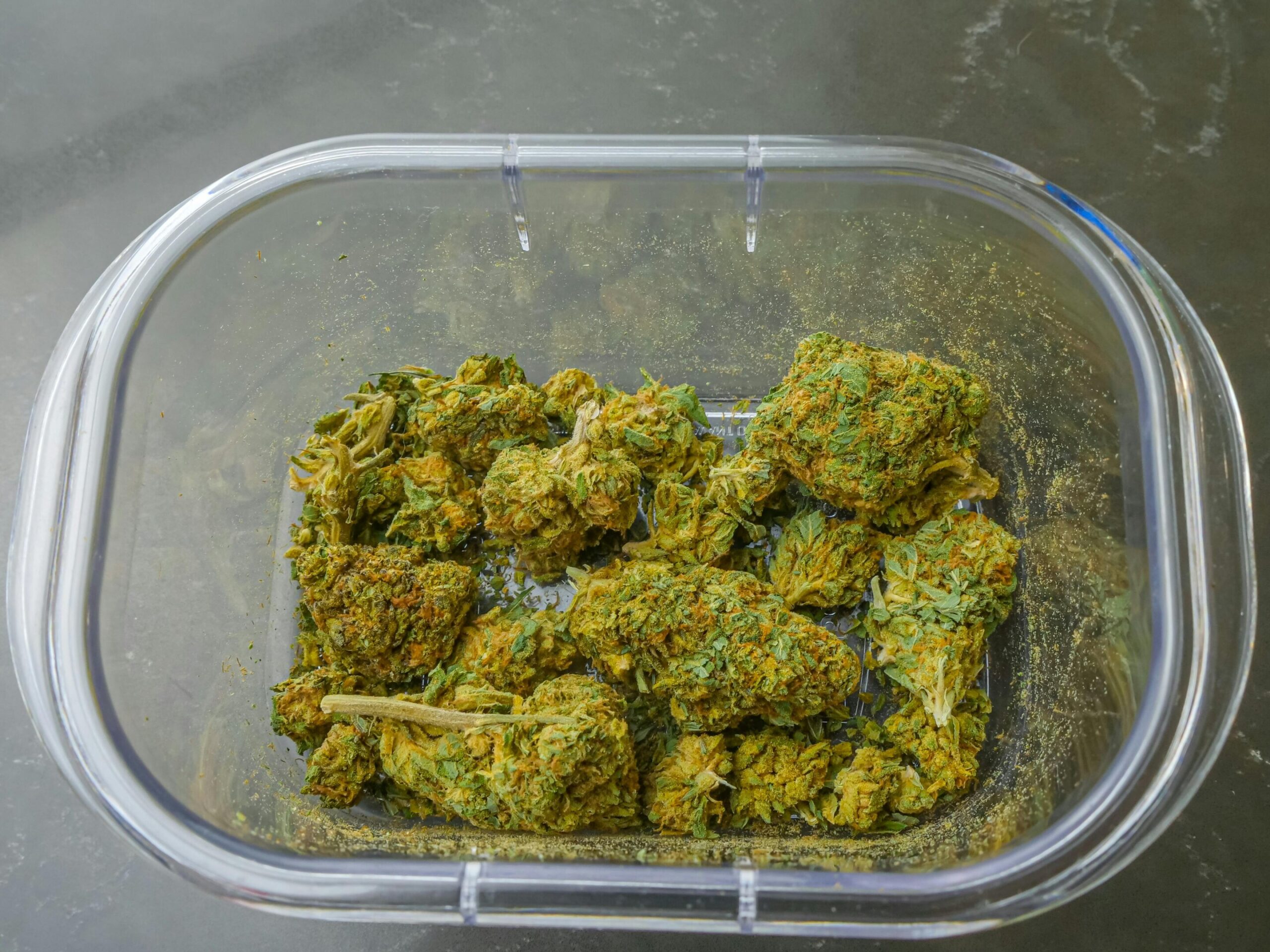
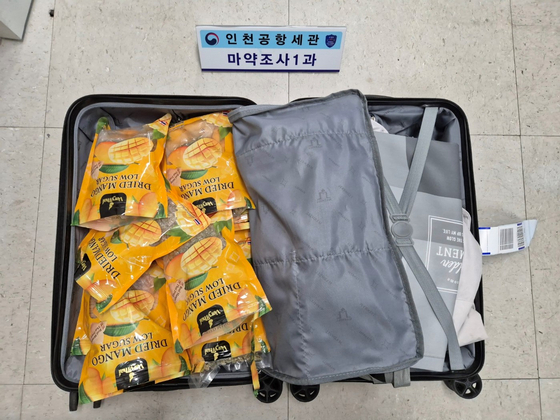
Packages of cannabis that two Thai nationals attempted to bring into the country in February [INCHEON AIRPORT REGIONAL CUSTOMS]
Two Thai nationals have been arrested for allegedly smuggling cannabis hidden in their luggage upon entering Korea through Incheon International Airport.
The Incheon Airport Regional Customs under the Korea Customs Service said Wednesday that it handed over the two suspects, aged 35 and 19, to prosecutors on charges of violating the Narcotics Control Act.
According to customs authorities, the suspects entered Korea from Thailand in February, carrying 3.1 kilograms (6.83 pounds) of cannabis. The drugs were concealed in vacuum-sealed packages disguised as dried mango products — a popular Thai export.
During the initial investigation, the pair claimed they had been asked by a third party to deliver packages of dried mango and dried banana. They also stated the cannabis was intended for personal use and that they were unaware possession was illegal in Korea. However, they eventually confessed after further questioning by airport customs officials.
In response to the case, the Incheon Airport Regional Customs plans to strengthen baggage inspections using advanced technology and big data analysis to identify high-risk travelers. The office also aims to establish stronger information-sharing channels with customs authorities in major drug-producing and -consuming countries, including those in Southeast Asia, the Americas and Europe.
“A surge in cannabis smuggling has been observed since Thailand legalized marijuana in 2022,” a customs official said Wednesday. “Cannabis possession and use are strictly prohibited in Korea. We urge travelers to be aware that violations will be punished and to report any suspected smuggling or drug-related activities to the Korea Customs Service hotline.”
Translated from the JoongAng Ilbo using generative AI and edited by Korea JoongAng Daily staff. BY PARK YOUNG-WOO [[email protected]]
More people are landing in the hospital with cannabis-related problems—and for many, a mental health condition is the primary issue, according to a new study published in the Journal of Studies on Alcohol and Drugs.
The study, conducted in Arizona, found that between 2016 and 2021, cannabis-related hospital visits across the state rose by 20%. Among those visits, one quarter ended up with a primary diagnosis of a mental health condition, including bipolar disorder, depression, and psychotic disorder. That compared with only about 3% of visits unrelated to cannabis.
Overall, people with a cannabis-related hospital visit were nearly eight times as likely to have a primary diagnosis of a mental health disorder. And the link between the two grew stronger over the five-year study period.
The reasons for the rising rate of cannabis-related visits are unclear, according to lead researcher Madeline Meier, Ph.D., an associate professor of psychology at Arizona State University, in Tempe, Ariz.
But, she said, legalization of non-medical (recreational) cannabis use is not to blame: Arizona legalized non-medical use for adults in late 2020, with sales beginning in 2021—too late to explain the trends seen during the study period.
On the other hand, Meier said, medical use of cannabis was legal in Arizona throughout the study period. So it’s possible that easier access to the drug is partly responsible for the trends her team found. Meier noted that when states have less-restrictive policies on medical cannabis—such as making it available in dispensaries rather than pharmacies—that can make it easier for any adult to get the drug.
The findings also raise other key questions: Why do so many people with cannabis-related hospital visits have a mental health condition, and why is the connection between the two growing stronger over time?
“There are many possible explanations, and this study can’t address them,” Meier said. But based on other research, she said, one possibility is that cannabis use led to mental health conditions in some people. Another is that some people were using cannabis to treat mental health symptoms—and that tendency increased over time.
If that’s the case, Meier said, it points to a need for better public education. “I think it’s important for people to be aware that the science on using cannabis to treat mental health problems is really not there yet,” she said. “In fact, there is evidence suggesting that cannabis use can worsen mental health conditions, or even increase the risk of developing them.”
The study also found some interesting patterns related to age: Older adults (age 65 and up) showed a bigger jump in cannabis-related hospitalizations between 2016 and 2021, versus other adults. And the growing tendency for those hospitalizations to be linked to mental health conditions was most pronounced among older adults.
That’s not necessarily surprising, Meier said, given Baby Boomers’ permissive attitudes about cannabis use. But, she added, older adults may need particular education about the potential risks of using the drug—including the fact it is much more potent (and potentially intoxicating) these days, compared with the cannabis of decades ago.
More information:
Madeline H. Meier et al, Trends in Cannabis-related Hospitalizations in Arizona from 2016-2021 and Associations with Mental Health-related Hospitalizations, Journal of Studies on Alcohol and Drugs (2025). DOI: 10.15288/jsad.23-00379
Citation:
Cannabis-related hospital visits rising, often tied to mental health conditions: Study (2025, May 7)
retrieved 7 May 2025
from https://medicalxpress.com/news/2025-05-cannabis-hospital-mental-health-conditions.html
This document is subject to copyright. Apart from any fair dealing for the purpose of private study or research, no
part may be reproduced without the written permission. The content is provided for information purposes only.
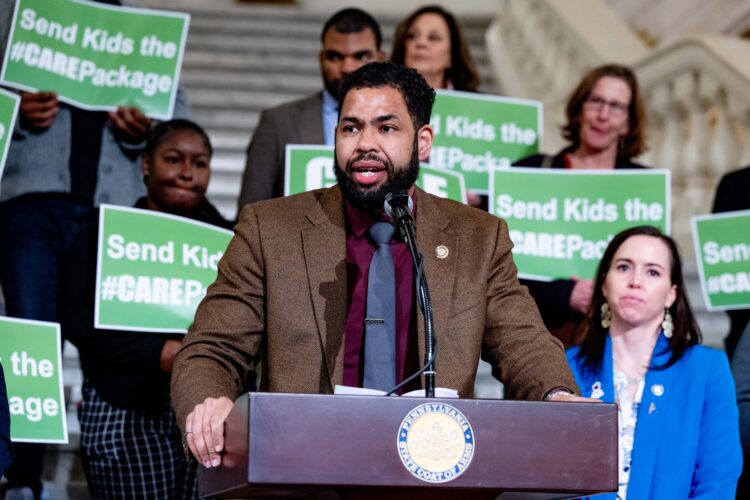
Rep. Rick Krajewski, D-Philadelphia, speaks at a news conference in March in Harrisburg. Krajewski sponsored legislation that will legalize marijuana that was passed by the state House of Representatives this week.
A 173-page bill that regulates adult-use cannabis in the commonwealth went from introduction to committee approval in less than 24 hours.
While Democrats laud the proposal as long overdue and the best amalgamation of many state models, Republicans argue the process was fast-tracked, secretive and potentially dangerous.
“The time is now for Pennsylvania,” said Rep. Rick Krajewski, D-Philadelphia. “We have listened carefully to public health experts, criminal justice reformers, small business advocates and community leaders. Our bill reflects what we’ve learned — that we can and must legalize cannabis in a way that is safe, equitable and beneficial to all Pennsylvanians.”
Critics argued that’s not true. Without comment from law enforcement advocacy groups or those representing children’s health and well-being, they worry the bill will only cause harm.
Rep. Charity Grim Kruppa, R-Fayette, said introducing the bill on a Sunday evening and forcing a vote on the House Health and Human Services Committee the following day is rushed by design.
“This is not lawmaking,” she said. “This is rushing, railroading and robbing the public of its right to know. This bill carries enormous consequences for our youth, our public health, our workforce and our communities. Something of this magnitude should not be fast-tracked with just a few short days for review and reaction.”
Specifically, the bill regulates potency levels to make the drug safer and wipes clean criminal records marked by cannabis-related convictions. It also reinvests the estimated $500 million tax revenue back into the state to assist communities disproportionately impacted by the War on Drugs.
“Prohibition was never about public safety — it was about control and punishment, targeting and devastating Black and Brown Pennsylvanians,” said Krajewski. “The cannabis industry has been monopolized by corporatized private equity and it is time to propose an alternative retail model that will benefit all Pennsylvanians. We need to repair the harms of criminalization, create family-sustaining union jobs and make this industry work for all of us.”
Gov. Josh Shapiro laid a similar vision for the industry during a February budget address for his third spending proposal. Revenue from “sin taxes” like adult-use cannabis legalization and skill games regulation, would help fund the governor’s spending targets for public education and mass transit.
Twenty-four other states have already legalized adult-use cannabis, including most of Pennsylvania’s neighbors, except West Virginia.
“I want to be real with you – as a father of four and as the former chief law enforcement officer of this commonwealth, this one was hard for me,” said Shapiro during his budget address. “But I took the time to study it and understand the impacts – to understand the choice between continuing the black market of drug dealing versus a highly-regulated industry with protections in place for our children. Letting this business operate in the shadows doesn’t make sense.”
He added that Pennsylvanians who want to buy marijuana can just drive into one of the neighboring states in which it is legal.
“By doing nothing, we’re making Pennsylvania less competitive,” Shapiro said, later adding, “We’re losing out on revenue that’s going to other states instead of helping us here.”
Because Shapiro’s proposed budget assumes regulated sales within Pennsylvania won’t begin until Jan. 1, 2026, the primary source of revenue from legalized adult-use marijuana would initially be from license fees paid by those participating in the production and sale of the products. The governor’s office anticipates those fees will yield $509.5 million.
The governor’s proposed 20% tax on the wholesale price of marijuana products is expected to produce $15.6 million during the 2025-26 fiscal year, with another $11.4 million coming in sales taxes derived from retail sales of marijuana.
As the system ramps up, the wholesale tax is expected to rise to $63 million in 2026, $130.3 million in 2027 and $185.5 million in 2028. The IFO, when adult-use marijuana legalization was proposed last year, estimated an additional $113 million increase of sales tax revenue the first full fiscal year of legalized retail sales, with the additional sales tax revenue changing little in future years.
Legalizing adult-use marijuana has been a difficult lift in the General Assembly. Though the Democrat-controlled House of Representatives has been supportive of the idea, the Republican-controlled Senate has remained opposed to the proposal.
The bill now awaits consideration on the House floor. Its fate in the upper chamber is uncertain.
A Celoron, N.Y., man has been acquitted of child sex abuse charges filed in Warren County in June.
Darren W. …
The Warren County School District has proposed a $93.86 million budget for the 2025-26 school year, reflecting a …
Brooklyn Square has another vacancy to be filled.
Rite Aid officials said Monday that the chain is entering a …
Part of the cannabis industry went big for the current administration – and fingers are crossed it will pay off.
Mom and pop businesses employing hundreds of thousands of people are worried about what the administration is going to do about cannabis. While over 80% of the public say it should be legalized and even other part of the government are supporting medical marijuana. The future is unknown. The appointment of Terrance Cole as President Donald Trump’s nominee to lead the Drug Enforcement Administration (DEA) has brought both optimism and skepticism to the ongoing debate over federal cannabis rescheduling. But is there any hope from the administration on cannabis? A significant portion of the industry backed the winning ticket, certain it would mean success for marijuana. The recent movement to help veterans with medical marijuana seems positive and data based. All hope is turned to the DEA pick now.
Cole’s recent comments during his Senate confirmation hearing have sparked discussion about the Trump administration’s stance and the future of cannabis policy at the federal level. Cole stated reviewing the stalled marijuana rescheduling process would be “one of my first priorities” if confirmed, acknowledging “it’s time to move forward” after repeated delays in the administrative process. This has offered a glimmer of hope to advocates who have long awaited progress on the issue. However, Cole repeatedly declined to commit to supporting the specific proposal to move cannabis from Schedule I to Schedule III, a recommendation initiated under the Biden administration and backed by the Department of Health and Human Services (HHS).
Terrance Cole, DEA pick
But Cole has emphasized the need to review the science and consult with experts before making any decisions.
Cole’s long career in law enforcement and his previous public statements reveal a traditionally conservative stance on cannabis. He has linked marijuana use to health risks and youth suicide, and has used hashtags such as #justsayno and #notlegal4distribution in social media posts. This history has led some observers to question whether his stated willingness to prioritize the rescheduling review will translate into meaningful action or simply maintain the status quo.
The cannabis rescheduling process has been mired in delays. A scheduled hearing to assess the Biden-era rescheduling proposal was canceled pending an interlocutory appeal, leaving the matter in the hands of the incoming Trump administration. Former DEA and HHS officials have warned that, without proactive support from President Trump himself, the process could stall indefinitely or be suspended altogether if the administration reinterprets prior legal arguments.
Thousands of mom and pop businesses, Industry stakeholders and advocates are cautious. While Cole’s remarks about moving the process forward are welcomed, his refusal to endorse the Schedule III proposal and his historical opposition to reform temper expectations. Many believe the Trump administration’s overall approach remains uncertain.
The Fresh Toast is a daily lifestyle platform with a side of cannabis. For more information, visit www.thefreshtoast.com.
Copyright 2025 The Fresh Toast. Distributed by TRIBUNE CONTENT AGENCY, LLC.
There have been a lot of headlines about cannabis and marijuana lately.
From the bipartisan support in government, to states looking to legalize at least for medical, to Mexico having a pro canna protest, the buzz leans towards a change in the law.
Currently, there are 39 states that have legal medical laws and 23 states that have legal recreational laws.
Today, this was announced- Pennsylvania Lawmakers Approve Bill To Legalize Marijuana Just One Day After It Was Introduced: “Right now, Pennsylvanians who use cannabis are either crossing state lines to purchase from other legal markets or buying from the illicit market.”
I cannot imagine any other circumstance where the Federal government is so out of touch with the will of the people.
Plus, in the land of tariffs, cannabis avoids all of that as it is readily grown in the US. This is why we like the Cannibis / Marijuana ETF (NYSEARCA: MSOS).
Imagine the revenue not just from the product itself, but then add packaging, marketing, distribution, sales and tourism. It could add a minimum of 125 billion a year in money to the government.
The headline above is what investors are looking for.
Blackrock showing interest aligns with not only the headlines, but also the alcohol and tobacco budding interest.
Then add the big pharma…
I recorded a 2-part radio broadcast on KSFRFM Santa Fe interviewing a New Mexico regulator and a local cannabis store owner. Part 1 airs May 7th.
You know I love good stories, but I also love to look at charts to help with market timing.
The Cannabis ETF (MSOS) is the first US-listed actively managed ETF to provide exposure solely to American cannabis and hemp companies, including multi-state operators (MSOs).
The ETF currently allocates 81% of its holdings in the US dollar.
That means that the ETF can put those dollars to use and increase the holdings to other cannabis related companies when it is appropriate to do so.
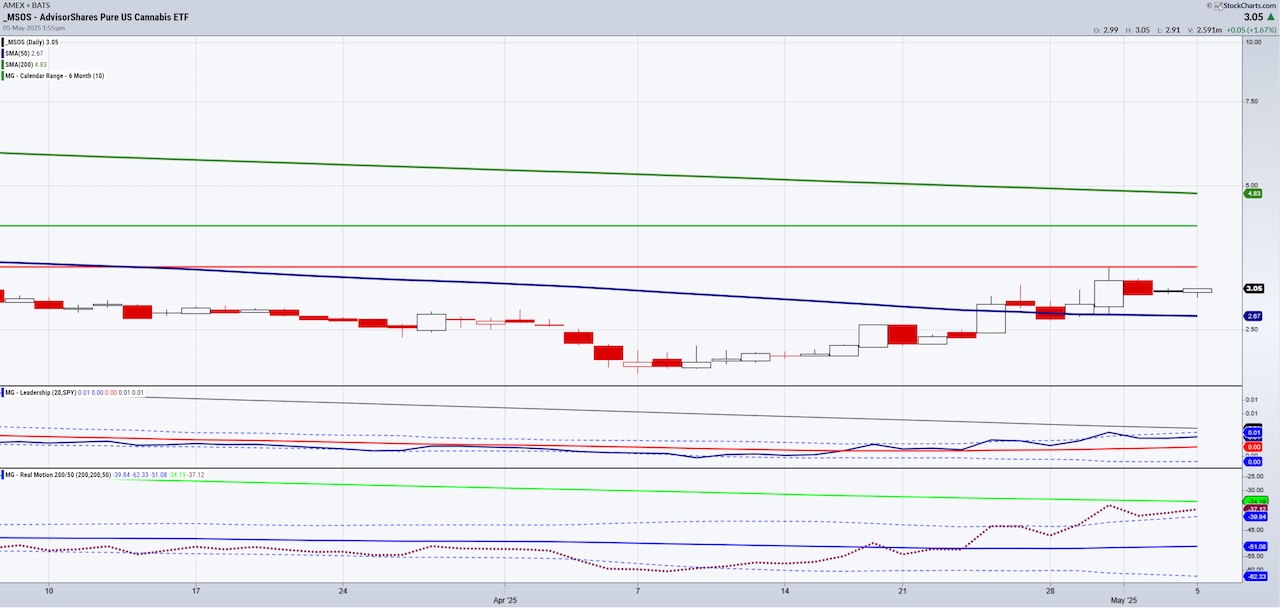
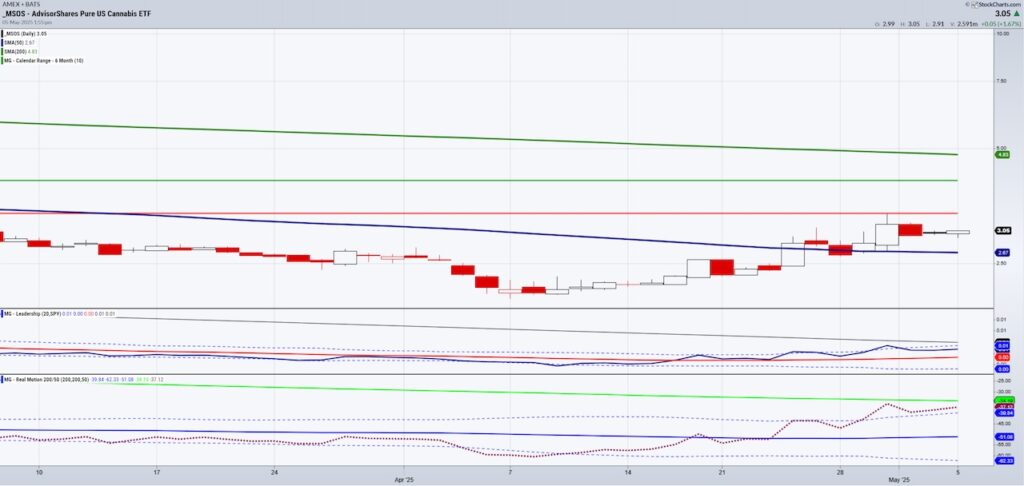
On the Daily chart,
MSOS entered a recovery phase, cleaning the 50-DMA.
The red horizontal line with the January 6-month calendar range low at 3.38.
MSOS outperforms the SPY.
And momentum tells us that there is a bullish divergence with the dots very close to the 200-DMA while the price is far from it (4.80).
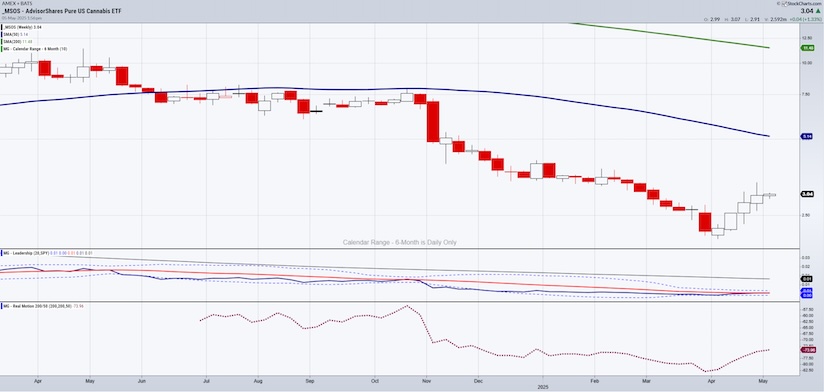
The weekly chart is even more interesting. The last time the price traded above the 50-WMA was in May 2024.
Should MSOS clear 5.00 we know something is up.
Bottom line is that investing in MSOS continues to be a lottery ticket.
However, 2.00 is where the price bleed stopped.
Through 3.40, there is resistance, but like any trade, having stops, targets and trailing stops is advisable.
The author may have a position in mentioned securities at the time of publication. Any opinions expressed herein are solely those of the author and do not represent the views or opinions of any other person or entity.
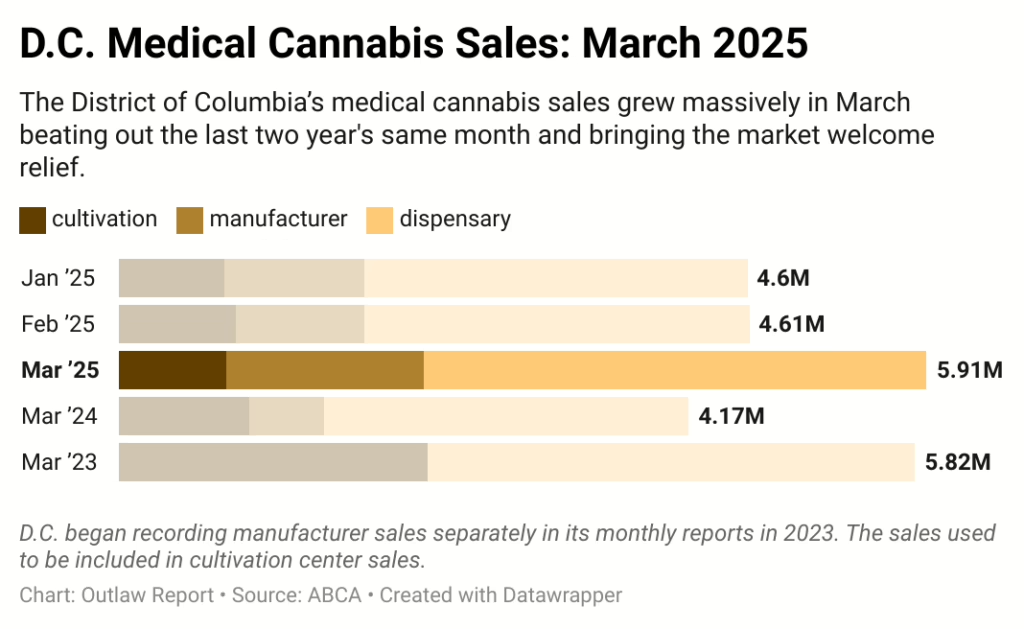
Washington D.C.’s medical cannabis market experienced a huge leap in sales growth in March 2025. The Alcoholic Beverage and Cannabis Administration monthly medical cannabis sales report for March 2025 was a sign of light for the D.C. cannabis market.
Monthly medical dispensary sales in D.C. rose over $3.1 million for the first time since June 2023 which was the last month before Maryland’s market launched its adult-use program. The increase in profits is welcome news for a market beleaguered by slow enforcement against illegal shops and intense competition in Maryland’s adult use market.
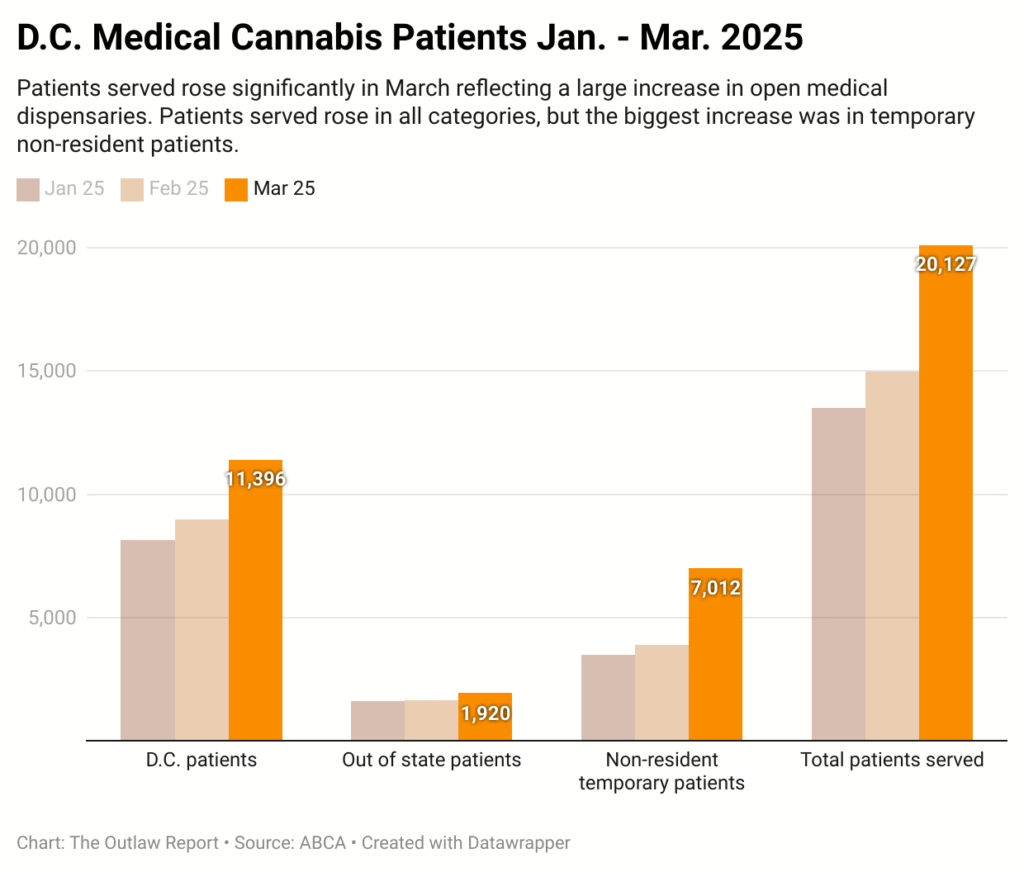
This coincides with a decent market expansion on the retail side. 24 medical dispensaries were open in March 2025, just seven more than in February. However, these stores served an exploding patient population.
Patients served grew significantly by over 5,000 people in March. About double the number of patients served last March which means the market doubled and grew more in one month than in the entire previous year.
The March numbers also do not factor in the deadline to close unlicensed shops on Mar. 31 which caused a rush of new dispensaries to open in April. With these transitioned medical dispensaries, there has been an emphasis on bringing new patients into the medical market. And now, instead of a few dozen stores recruiting old I-71 patrons to D.C.’s now medical market, there are almost 40 operational shops across D.C. bringing in new patients. D.C. recently announced the closure of the 50th unlicensed store (though some of these have reopened).
Manufacturers also sold a record breaking $1.4 million in product in March. The most they have sold in a month since sales were tracked separately starting in October 2023.
March in short
Temporary non-resident patients grew by 3,137.
There will be 2,094 possible patient expirations in April, May and June
There were 13 additional stores open and operating in April. There are 23 stores listed on the ABCA website that do not seem open according to their websites or lack thereof.
Temporary self-certification patient sales grew by over $350,000 in March.
Cultivation sales fell from February to March by just over $75,000.
Q2 2025 was still over $1.5 million lower in sales from the same quarter in 2024.
There were 36 scheduled inspections and 10 unlicensed facilities closed.
License Opportunity: DC Medical Cannabis Manufacturer and Retailer License Potentially Available for Sale, Contact Owner to Learn More. Click here
Employment Opportunity: DC Licensed Internet Retailer Dispensary Now Hiring. Contact info@getlocald.com to Learn More.
The day’s local, regional and national news, detailed events and late-breaking stories are presented by the ABC 6 News Team, along with the latest sports, weather updates including the extended forecast.
(ABC 6 News) — A date has been set for the cannabis license application lottery in Minnesota.
Drawings will be held on June 5 for social equity and general applicants for three license types: cannabis cultivator, cannabis manufacturer, and cannabis mezzobusiness.
The lottery for general retailer applicants will happen later this summer.
“The office has prioritized the review of applications for the license types necessary to successfully stage the market,” said OCM Interim Director Eric Taubel via a press release. “Today’s announcement reflects the office’s goal to license the supply chain from the starting points in order to foster an equitable cannabis market that prioritizes public health and safety, consumer confidence, and market integrity.”
“In the coming weeks, more and more applicants will be notified that they are advancing to the application lotteries. They will soon join the hundreds of qualified social equity applicants who are already deep in the process of completing application requirements,” said Jess Jackson, OCM’s director of social equity, via a press release. “It’s exciting to see the entrepreneurial spirit of our applicants as they get closer to having a license in hand and prepare to open their doors for business.”
Cannabis is a $1.1 billion industry in Washington, and there are programs across the state designed to get people into the business or to help those who are already in it.
Gonzaga University has partnered with a company called Green Flower to offer certificate programs in Cannabis Health care and Medicine and Cannabis Compliance and Risk Management. Launched in 2023, the program invites visitors to the website to “kickstart their cannabis career.”
“While we do see participation from traditional college-age students, the majority of enrollees are returning adult learners– individuals who have already established careers and are now seeking to transition into the cannabis industry,” said Rachelle Strawther, founding director of Gonzaga’s Center for Lifelong Learning.
Seattle Central College, Tacoma Community College, and the Washington State Department of Health also offer cannabis certificate programs in areas from cultivation to medical consulting.
Recreational marijuana was legalized in Washington in 2012, one of the first states to do so, alongside Colorado.
“There’s a lot of opportunity ahead and a lot to learn,” said Max Simon, CEO of Green Flower. “We have partnerships with over 60 colleges and universities across the country to power their cannabis programs.”
Shilo Kumpf owns cannabis stores in Pasco and Spokane under her company, Lucky Leaf Co. She recently took Gonzaga’s Cannabis Health care and Medicine course because she said she had family members and customers battling cancer. Kumpf wanted to understand more about how cannabis products might help.
Cannabis can sometimes help ease chemotherapy-induced nausea, according to a study from the Journal of Clinical Oncology. And there are a multitude of medicinal uses for it, according to the online cannabis course, said Kumpf.
“A lot of it is learning what topicals work for arthritis or even dry skin, learning about dosages,” she said.
Kumpf opened her first store in 2015, and said a lot has changed in the last 10 years.
“There weren’t a lot of edibles, and there weren’t a lot of tinctures,” said Kumpf, who added that early gummies and cookies had a strong, gross flavor.
“Now we have cannabis sorbet ice creams,” she said.
Rather than buying flower, people are more into rosin and dabs, said Kumpf.
Dabs and rosin are concentrated forms of marijuana. People use various specially made tools to heat the dab or rosin and then inhale the vapors.
People’s tolerance level for cannabis has increased as new products have lined the shelves over time, Kumpf said.
“Taking a dab, that’s 80% THC compared to 30% or 40% THC in flower,” she said.
THC, or tetrahydrocannabinol, is the compound that produces a psychoactive effect when smoked or ingested.
Cannabis sales in Washington in April were about $93 million, according to Headset, a cannabis data platform.
Simon says his company has grown rapidly over the last 10 years. He said his medical-centered cannabis course attracts all kinds of health care practitioners, from traditional medical doctors and nurses to alternative health care specialists, like chiropractors and acupuncturists.
“ They take these programs mostly because their patients are asking them information, and they don’t really have good credible knowledge, and oftentimes in medical schools or traditional schools, these subjects really aren’t taught at all,” Simon said.
Tacoma Community College’s certificate program starts May 7, and programs at the Washington State Department of Health and Seattle Central College are rolling online programs that can be taken anytime. Registration for Gonzaga’s online cannabis classes are open until May 11.
University of California San Diego School of Medicine researchers have linked higher colon cancer mortality with cannabis use disorder (CUD).
According to the researchers, CUD patients had a substantially higher five-year mortality rate (55.88 %) compared to patients without cannabis use disorder (5.05 %)
Based on the electronic health records of more than 1,000 colon cancer patients treated across the University of California Health system between 2012 and 2024, the evaluation delved into how cancer outcomes differed based on patients’ documented cannabis use before diagnosis, with various study controls in place.
The evaluation found patients diagnosed with cannabis use disorder prior to cancer diagnosis were 24.4 times more likely to die within five years of diagnosis compared to those without CUD.
While unsettling findings, lead author Raphael Cuomo, Ph.D. insists the study isn’t about vilifying cannabis, which is used by many cancer patients to ameliorate the effects of other treatment and the disease.
“It’s about understanding the full range of its impacts, especially for people facing serious illnesses,” said Dr. Cuomo. “We hope these findings encourage more research — and more nuanced conversations — about how cannabis interacts with cancer biology and care.”
Among the potential reasons for this link is CUD is frequently accompanied by depression, anxiety, and cognitive impairment. This can compromise adherence to cancer treatment, therefore negatively impacting treatment efficacy and increasing mortality risk.
“Socioeconomic disadvantage, stigma, and competing health concerns may further limit access to timely, high-quality oncologic care among patients with CUD,” says the study report. “Moreover, elevated healthcare utilization for non-cancer conditions may shift focus away from cancer management, contributing to poorer outcomes.”
It’s important to note this link has been established among those with a history of cannabis issues. Other research has indicated cannabis might also have a role in colo-rectal cancer treatment. For example, this study from 2023 indicated the non-intoxicating cannabinoid CBD (cannabidiol), could inhibit invasion and metastasis in colorectal cancer cells.
In 2023, the USA Colo-Rectal Cancer Alliance said while not enough evidence existed to directly recommend medical marijuana as a treatment option, it supported the need for further research.

![Packages of cannabis that two Thai nationals attempted to bring into the country in February [INCHEON AIRPORT REGIONAL CUSTOMS]](https://koreajoongangdaily.joins.com/data/photo/2025/05/07/780ffafe-505a-4825-bf55-4eec608af8e6.jpg)